
What to Avoid with AI Implementation: The Predictable Failure Modes SMEs Keep Making
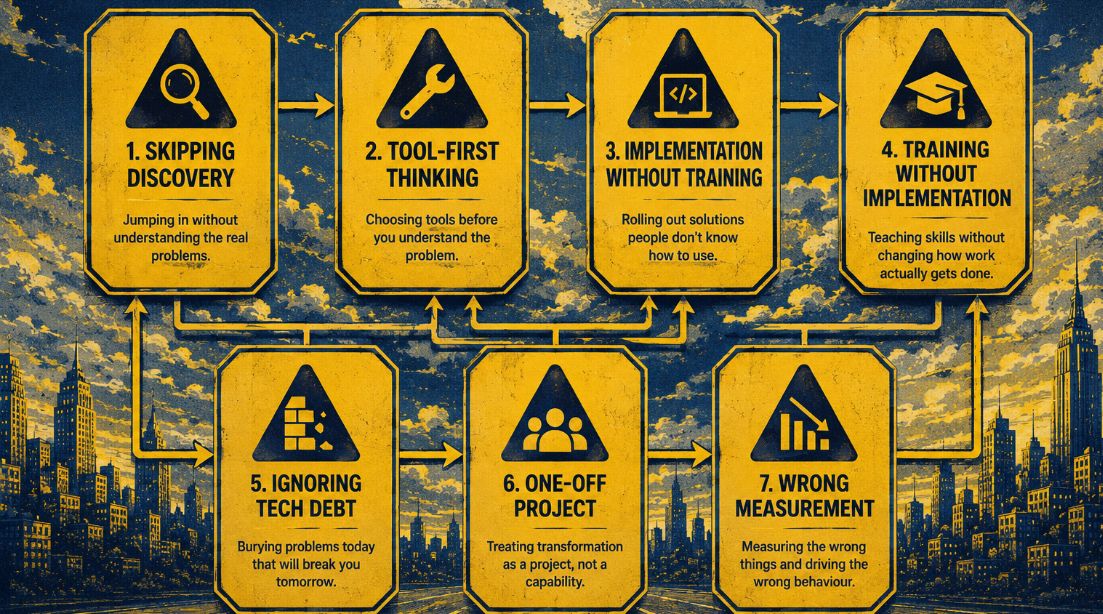
What to avoid with AI Implementation is the question SME leaders should be asking before they start, because the failure modes that sink AI Implementation projects are remarkably consistent across businesses, sectors and engagement scales. The same mistakes repeat. The same warning signs precede the same outcomes.
The same recovery work is needed after the same crises. This piece walks through the seven predictable failure modes that most SME AI Implementation projects fall into, why each one happens and what to do instead. The goal is not to scare leaders away from the work, it is to help them avoid the patterns that have caused so many implementations to disappoint.
What to Avoid with AI Implementation: The Pattern of Predictable Failure
The single most important thing to understand about what to avoid with AI Implementation is that the failure modes are predictable, not random. Implementations do not fail in unique and creative ways. They fail in the same handful of ways, for the same handful of reasons, in business after business. The pattern is consistent enough that experienced implementation partners can identify which failure mode is likely from the first conversation, which makes the avoidance work tractable rather than mysterious.
The reason the patterns repeat is structural rather than individual. SME leaders making decisions about AI Implementation face a set of common pressures (budget constraints, time pressure, board expectations, vendor pitches) that push them toward the same shortcuts and the same compressions of the work.
The good news is that knowing the patterns lets the business plan around them. The seven failure modes we cover in this piece are not exhaustive, but they account for the bulk of disappointing implementation outcomes we see in SMEs through 2026. Each has a specific avoidance pattern that costs little but saves considerable downstream pain.
What to Avoid with AI Implementation: Skipping Discovery
The first and most common failure mode is skipping discovery. Discovery is the phase that establishes what the business actually needs the AI to do, what underlying conditions need addressing before implementation can succeed and what the realistic scope of the first implementation should be. As we covered in our What is AI Implementation foundational blog, discovery sits at the start of the six-phase implementation work and produces the inputs that every subsequent phase depends on.
Skipping discovery happens because discovery feels like work that delays the ‘real’ implementation. The business wants AI capability, the budget is committed, the vendor is briefed, and discovery feels like a slow start that postpones the visible work. The compression of discovery to a short kick-off meeting feels efficient.
The consequence is design built on assumptions, build executed on incomplete requirements, integration that surfaces tech debt nobody planned for and a deployment that does not match what the business actually needs. The downstream rework cost typically runs to multiples of what proper discovery would have cost in the first place. As we covered in our Tech Debt and AI blog, AI Implementation surfaces tech debt that has been invisible up to that point, and discovery is when that becomes visible at a cost the business can manage. Skipping discovery means the tech debt surfaces during integration, where the cost of addressing it is significantly higher and the disruption is significantly worse.
The avoidance pattern is to treat discovery as the most important phase rather than the most postponable. Spend the time properly. Document the findings. Let the design phase reflect what discovery surfaced rather than what was assumed. This is exactly what we do in our AI Workshop.
What to Avoid with AI Implementation: Tool-First Thinking
The second failure mode is tool-first thinking, which is the pattern of picking the AI tool before understanding what the business actually needs. SME leaders see a Copilot demo, a ChatGPT enterprise pitch, a Claude integration, an automation platform announcement, and they form a view about which tool the business should standardise on before they have done the work to understand what the implementation should actually deliver.
Tool-first thinking happens because tools are concrete, visible and easy to understand, while implementation work is abstract, slow and easier to defer. Picking a tool feels like decisive leadership. Doing the discovery work feels like procrastination.
The consequence is implementation work that is structurally limited by the constraints of the chosen tool rather than aligned with the business need. The tool dictates the architecture rather than the architecture dictating the tool. Workflows get redesigned to fit the tool’s capabilities rather than the tool being selected to support the workflows the business actually needs. The vendor lock-in question we covered in our AI as a Utility blog becomes structural rather than strategic.
The avoidance pattern is to defer tool selection until after discovery has established what the implementation should actually deliver. The right tool for one business is the wrong tool for another. The tool decision is downstream of the implementation decision, not upstream of it.
What to Avoid with AI Implementation: Implementation Without Training
The third failure mode is implementation without training, which is the pattern of deploying AI capability without building the team capability needed to operate it. The business completes the technical work, switches the capability on and expects the team to figure out how to use it productively.
Implementation without training happens because training feels like a separate workstream that can happen later, or because the business expects the team to learn organically once the tools are available. The compression of training to a short demo session at deployment feels like efficient sequencing.
The consequence is capability that sits idle while the team continues to work in pre-implementation patterns. The technical work is complete. The commercial outcomes are absent. The investment looks like it has been wasted because the benefits are not arriving. As we covered in our AI Training for Teams blog, capability deployed without trained users produces no benefits, and the training has to be structured at the team level to produce the multiplier effect that implementation is meant to deliver.
The avoidance pattern is structured AI training that runs alongside the implementation work, not after it. Training begins during the build and integration phases and continues into the embedding phase. The team learns the new capability as it becomes available, not in a single overwhelmed session at go-live.
What to Avoid with AI Implementation: Training Without Implementation
The fourth failure mode is the inverse of the third. Training the team thoroughly without actually implementing the AI capability they have been trained on. The business invests in workshops, certifications and enthusiasm, and the team ends up with sophisticated understanding of AI concepts they have no production capability to apply.
Training without implementation happens because training feels like a lower-risk first step than implementation. Workshops are visible, time-bounded, easy to celebrate and produce immediate enthusiasm. Implementation is harder to scope, harder to fund and harder to celebrate in the same way. The compression of the AI commitment to ‘we trained everyone’ feels like meaningful progress.
The consequence is a team that knows what good AI use looks like, has no production capability to demonstrate it on and slowly disengages from AI work because the enthusiasm has nowhere to go. The training investment depreciates, the team becomes cynical about AI initiatives and the implementation work that should have followed the training becomes harder to start because the appetite has cooled.
The avoidance pattern is to commit to implementation alongside training from the outset, with a clear timeline that brings production capability into the team’s hands within a defined period after training begins. Training is the runway but implementation is the flight.
What to Avoid with AI Implementation: Ignoring Tech Debt
The fifth failure mode is ignoring tech debt, which is the pattern of attempting to deploy AI on top of an unaddressed accumulation of code, architecture, infrastructure, data and process debt. As we covered extensively in our Tech Debt and AI bridge blog, AI Implementation surfaces tech debt that has been invisible up to that point, and businesses that have not addressed the relevant debt before implementation begins end up addressing it under crisis conditions during the implementation work.
Ignoring tech debt happens because debt is invisible by default and businesses do not know what they do not know. The team has absorbed the cost of the debt for years. Leadership has not seen the debt because it does not appear on the balance sheet. The implementation is briefed against the idealised tech stack rather than the actual one.
The consequence is that integration surfaces data inconsistencies that were never reconciled, process gaps that were never documented, system incompatibilities that were never resolved and security configurations that were never audited. Each surfaced debt becomes an unplanned project. The implementation timeline doubles, the budget overruns and the leadership team starts to wonder whether AI was really the right investment.
The avoidance pattern is the deliberate tech debt assessment that should happen during the discovery phase, surfacing the relevant debt before the implementation work begins. The full structured approach is covered in our How to Reduce Tech Debt blog, but the principle is that the tech debt that touches the AI implementation needs to be visible, prioritised and addressed before the implementation runs into it during integration.
What to Avoid with AI Implementation: Treating It as a One-Off Project
The sixth failure mode is treating AI Implementation as a one-off project rather than the beginning of an ongoing capability. The business plans for a single implementation, completes it, declares success and treats AI as ‘done’.
This failure mode happens because the implementation project has a beginning, a middle and an end, and the natural cognitive frame is to treat anything with that shape as a project rather than a practice. Project management discipline pushes toward completion and closure. The business is not structured to treat implementation as the start of an ongoing rhythm of capability building.
The consequence is that the AI capability deployed in the first implementation becomes the entirety of the business’s AI position. As newer capability emerges, as the broader landscape shifts, as competitors deploy their own implementations, the business stands still on the implementation it completed. The compounding benefit that should have followed never arrives because there are no subsequent implementations to compound on.
The avoidance pattern is to plan the first implementation as the foundation for an ongoing programme, with a roadmap for subsequent implementations already sketched even if not committed. The first implementation establishes the patterns. The second implementation refines them. The third implementation runs at significantly lower cost and significantly higher benefit because the foundations are in place.
What to Avoid with AI Implementation: Measuring the Wrong Things
The seventh failure mode is measuring the wrong things. The business measures activity metrics (number of AI projects started, number of AI users, hours of AI training delivered) rather than outcome metrics (commercial change produced, capability and confidence built, business processes transformed).
Activity measurement happens because activity is easier to count than outcomes. Projects started can be tallied. Users can be enumerated. Hours can be tracked. The dashboard looks healthy. The reporting cadence is satisfying. The leadership team feels comfortable that AI is happening.
The consequence is that the business reports success on metrics that bear no relationship to whether AI Implementation has actually delivered commercial value. As we covered in our AI Training ROI blog, the correct measure of AI work is capability and confidence, not activity, and the same principle applies to implementation.
The avoidance pattern is to define the outcome measures during the discovery phase, before any implementation work begins. The outcome measures are commercial, specific and tied to the business changes the implementation is meant to produce. The activity measures can be tracked alongside, but they cannot be the primary metric.
What to Avoid with AI Implementation: What SME Leaders Should Take From It
What to avoid with AI Implementation is the question that determines whether your business captures the benefits the work is supposed to deliver or joins the long list of SMEs that committed AI budget and saw disappointing results. The seven failure modes we have covered are predictable, common and avoidable, which means the businesses that take them seriously are dramatically more likely to succeed than the businesses that assume their implementation will somehow be the exception.
The practical takeaway is structural. The seven failure modes are not isolated mistakes, they are connected patterns. Skipping discovery makes tool-first thinking more likely. Tool-first thinking makes implementation without training more likely. Implementation without training makes one-off project thinking more likely. The patterns reinforce each other, which is why businesses that fall into one failure mode frequently fall into several. The fix is the same in each case: structured work, sequenced properly, measured against outcomes rather than activity, sustained as an ongoing capability rather than a one-off project.
For SME leaders committing to AI Implementation in 2026, the question is not whether the work is worth doing. The benefits, as we covered in our Benefits of AI Implementation blog, are real and significant. The question is whether the implementation will be done in a way that captures those benefits or in a way that loses them to the predictable failure modes. The answer to that question is determined before the implementation begins, in the discovery work and the strategic commitment that precedes it.
Complete our free AI Readiness Assessment to understand where your business sits on the AI Confidence Journey, which of the seven failure modes your current AI plans are most exposed to and how to structure your implementation work to capture the benefits durably rather than fleetingly.
%20(1).png)
%20(1).png)
%20(1).png)