
Benefits of AI Implementation: What You Actually Get and How to Keep It
The benefits of AI Implementation are the reason SMEs commit budget to AI work in the first place and they are also the thing companies most consistently fail to capture.
Real benefits exist, they are commercially significant and they compound over time, but they only show up reliably when the implementation is structured properly and when the business takes deliberate action to avoid the predictable failure modes that prevent benefits from being realised.
This piece walks through the actual benefits AI Implementation delivers when done well, the dimensions across which they show up and what SMEs need to do to avoid the problems that stop those benefits arriving.
Benefits of AI Implementation: The Commercial Case
The benefits of AI Implementation are commercial outcomes, not technological achievements. The right way to measure whether implementation has delivered benefits is whether the business is now doing something it could not do before, doing something faster or better than before, or doing something with less risk or cost than before. AI Implementation that has not produced commercial change has not produced benefits, regardless of how impressive the technology looks.
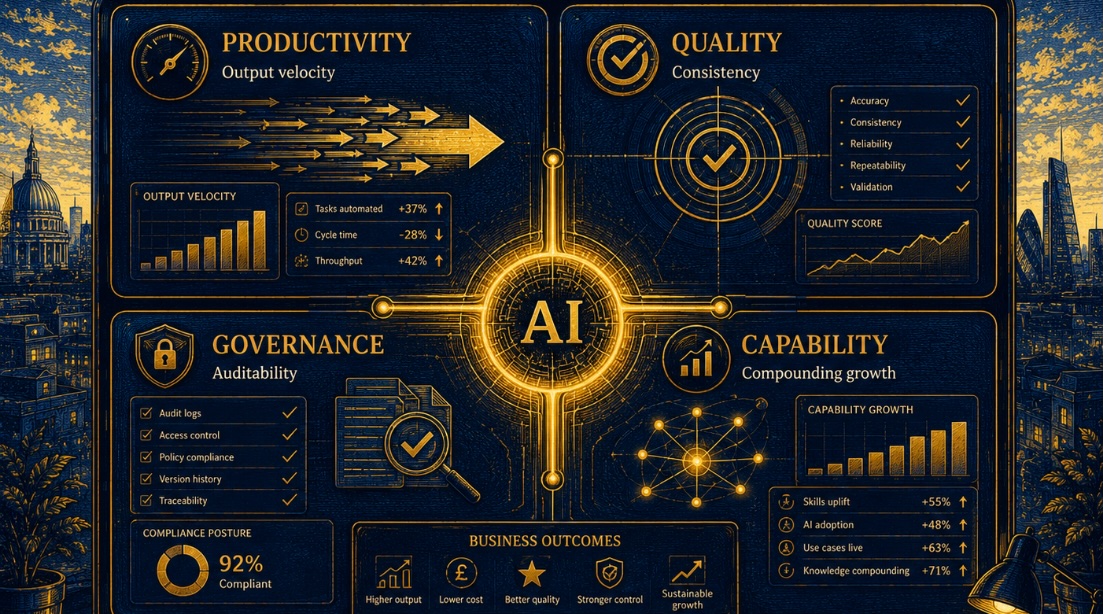
The commercial case for AI Implementation rests on four interconnected categories of benefit. Operational productivity. Quality and consistency. Governance and compliance. Capability that compounds over time. Each category delivers measurable value, and each one is undermined by specific failure modes that we cover throughout this piece. The businesses that handle implementation well capture benefits across all four categories. The businesses that handle it poorly capture none.
The commercial logic also has a structural shape. Implementation produces a one-off uplift when the new capability goes live, and then a compounding uplift as the business builds further work on top of the implemented foundation. The first implementation delivers the smallest benefits because the foundation is being built. The third or fourth implementation delivers the largest benefits because the patterns are established, the teams are trained and the governance is in place. The businesses that recognise this structural shape commit to AI Implementation as an ongoing practice rather than treating each implementation as a one-off project.
Benefits of AI Implementation: Operational Productivity
The first and most measurable category of benefit is operational productivity. Teams that operate inside well-implemented AI capability deliver more output per hour, complete projects faster, handle larger volumes of work without proportional increases in headcount and spend more of their time on the high-value parts of their job rather than the toil they used to absorb.
The productivity gains show up across specific dimensions. Document production accelerates, with first drafts produced in a fraction of the time previously required and the team focusing on editorial judgement rather than blank-page work. Data analysis accelerates, with patterns surfaced from large datasets in minutes rather than days and the team focusing on interpretation rather than aggregation. Customer service accelerates, with routine queries handled by AI-augmented workflows and the team focusing on the complex cases that need human judgement. Internal communication accelerates, with the structured generation, summarisation and translation of business communications removing significant time overhead from team operations.
The benefits of AI Implementation on the productivity side are real but they are not the productivity gains the breathless coverage suggests. The actual gains for SMEs running well-implemented AI typically sit between fifteen and thirty percent across the augmented workflows, which is significant but not transformational at the individual task level. The transformation comes from compounding those gains across multiple workflows and across the broader team, not from any single workflow producing tenfold output overnight. As we covered in our AI Training for Teams blog, team-level capability produces multipliers that individual capability cannot match, and the productivity benefits of implementation depend on the training that runs alongside it.
Benefits of AI Implementation: Quality and Consistency
The second category of benefit is quality and consistency, which is frequently overlooked because it is harder to measure than productivity but is often the more commercially valuable benefit. Well-implemented AI produces consistent quality across team members, time periods and workload volumes in a way that human-only operation rarely achieves.
The consistency benefit shows up in three specific ways. The first is standard adherence. The AI-augmented workflow applies the same standards to every output, which means clients receive consistent treatment regardless of which team member is handling their account on any given day. The second is error reduction. Routine errors that human teams make under pressure are largely eliminated, because the AI-augmented workflow includes checks and validations that are applied uniformly rather than depending on the attention level of individual team members. The third is brand consistency. The voice, tone and structural conventions of the business are applied uniformly across all AI-augmented outputs, which strengthens brand presence in ways that team-by-team variability rarely achieves.
The quality benefits also have a strategic compounding effect. Businesses that consistently produce higher-quality, more standardised work build reputations for reliability that translate into commercial advantage. Clients who know what they will receive return more readily. Internal stakeholders who trust the team’s outputs cooperate more effectively. The benefits of AI Implementation on quality are often slower to surface than the productivity gains but produce more durable commercial value over time.
Benefits of AI Implementation: Governance and Compliance
The third category of benefit is governance and compliance, which has become significantly more commercially important through 2026 as the regulatory environment for AI in the UK and EU tightens. Well-implemented AI is auditable, governed and compliant in ways that uncontrolled AI use is not, and the difference matters more every quarter.
The governance benefits of AI Implementation include visible AI use across the business (rather than the shadow AI activity that most UK SMEs still struggle with), documented data flows that can be traced and audited, structured access controls that limit AI activity to appropriate roles and outputs, and policy adherence that is built into the implementation rather than relying on team discipline alone. As we covered in our EU AI Act blog, the substantive provisions of the EU AI Act come into force on 2 August 2026 with penalties up to 7% of global annual turnover, and businesses with structured, auditable AI Implementation are dramatically better positioned to demonstrate compliance than businesses with uncontrolled shadow AI use.
The compliance benefits also include data protection improvements that are often surprising to SME leaders who have not considered the connection. Well-implemented AI runs inside the data protection envelope of the business, with personal data handled through controlled pipelines and access logged through structured mechanisms. Shadow AI use, by contrast, frequently involves personal data being entered into consumer AI tools with no controls, no logging and no compliance position. The benefits of AI Implementation on the data protection side can be the difference between a defensible regulatory position and an indefensible one.
Benefits of AI Implementation: Capability That Compounds
The fourth category of benefit, and the one that distinguishes well-implemented AI from any other AI activity, is capability that compounds over time. Each implementation builds on the foundations the previous ones established. The teams trained for the first implementation are ready for the second. The tech debt addressed for the first implementation no longer needs addressing for the second. The governance established for the first implementation extends to cover the second. The patterns repeat, the work accelerates and the cost of each subsequent implementation falls while the benefits of each subsequent implementation rise.
The compounding effect is the reason AI Implementation should be treated as an ongoing capability rather than a one-off project. Businesses that complete one implementation and stop have captured a portion of the available benefit. Businesses that build implementation into their operational rhythm capture the full compounding benefit, which over two or three years is dramatically larger than the sum of any individual implementation. This compounding pattern, which we cover in our AI Confidence Journey framework, is what separates the businesses that use AI from the businesses that build AI capability.
Benefits of AI Implementation: How to Avoid Losing Them
The benefits of AI Implementation are real, but they are also fragile, and SMEs lose them more frequently than they capture them. Four common failure modes prevent benefits from being realised even when the implementation itself is technically complete.
The first is implementation without training. The AI capability exists, but the team has not been trained to use it effectively, which means the capability sits idle while the team continues to work in the pre-implementation patterns. As we covered in our AI Training for Teams blog, capability deployed without trained users produces no benefits. The fix is structured AI training that runs alongside the implementation, not as a token afterthought.
The second is training without sustainment. The team is trained, the capability is deployed, the early benefits are visible, and then the AI Champions who should sustain the capability are not identified, supported or given authority to do their work. Capability decays. Within months, the team reverts to pre-implementation patterns and the benefits evaporate. The fix is the AI Champion model we cover in the training piece, with champions formally given the structural role of sustaining capability after the implementation concludes.
The third is skipping optimisation. The implementation goes live, the early benefits are captured and the business assumes the work is done. AI capability that is not actively optimised does not stay current with the broader AI landscape, which shifts continually. Within a year, the implementation is producing outputs that are noticeably worse than what newer capability could produce, and the benefit gap widens. The fix is the structured optimisation work we cover in AI Optimisation and Support, which keeps the implementation current.
The fourth is measuring the wrong benefits. The business measures activity (number of AI projects started, number of AI users) rather than outcomes (commercial change produced, capability and confidence built), declares success on the activity metrics and never discovers that the outcome metrics tell a different story. As we covered in our AI Training ROI blog, the correct measure of AI work is capability and confidence, not activity, and businesses that measure activity miss the actual benefits even when they are present.
Benefits of AI Implementation: What SME Leaders Should Take From It
The benefits of AI Implementation are commercial outcomes that compound over time when the work is structured properly and protected against the predictable failure modes that prevent benefits from being captured. Four categories deliver measurable value: operational productivity, quality and consistency, governance and compliance, and capability that compounds. Each category is undermined by specific failure modes that SMEs can avoid with deliberate attention.
The practical takeaway for SME leaders is to commit to the full work, not the fragments. Implementation without training produces no benefits. Training without sustainment produces benefits that decay. Sustainment without optimisation produces benefits that fall behind the market. Optimisation without proper measurement produces benefits that look good but cannot be defended commercially. The benefits arrive when all four pieces work together inside a structured AI Confidence Journey, and they fail to arrive when any single piece is missing.
Complete our free AI Readiness Assessment to understand where your business sits on the AI Confidence Journey, which benefits of AI Implementation should be your priority and how to structure the work to capture them durably rather than fleetingly.
%20(1).jpg)
%20(1).png)