
Claude vs ChatGPT: Best AI for SMEs in 2026
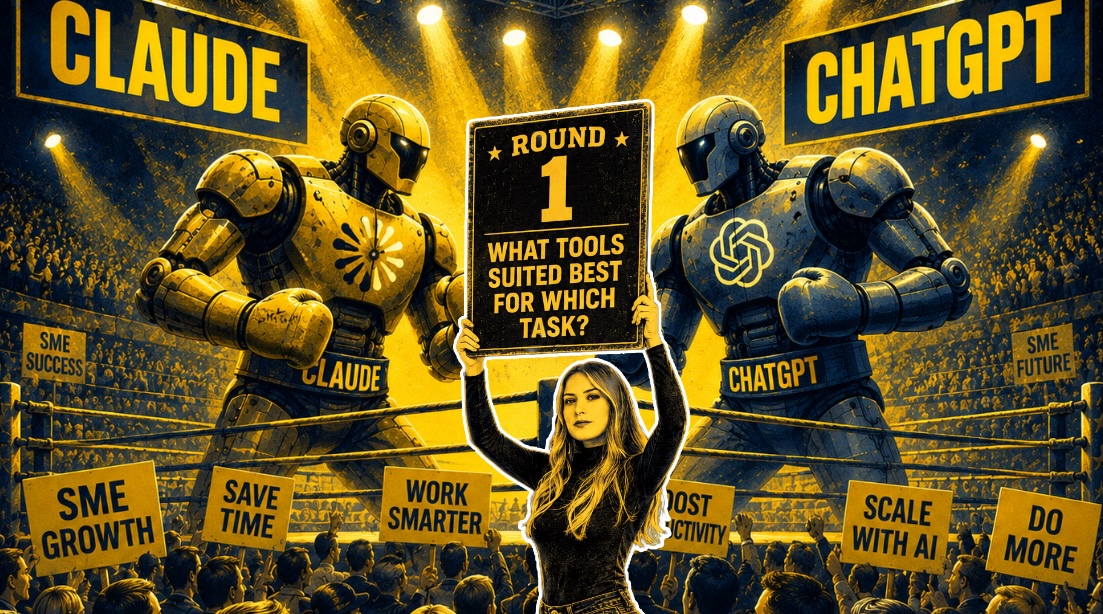
Claude vs ChatGPT for business is now the most consequential AI tool decision most SMEs will make this year and the answer most leaders settle on is wrong.
The conventional advice (pick one, stick with it) makes sense for personal users but fails almost every business with even moderately diverse work. Both tools have caught up to each other on raw capability, both run state-of-the-art models, both have web search, deep research and agentic features and both now offer context windows of up to 1 million tokens. The real differences sit in features, workflow strengths and pricing structures, and they matter enormously when you are choosing the tool your team will rely on every day.
This blog is the honest 2026 verdict, with no affiliate bias and no vendor loyalty, drawing on current pricing, current capability and current product reality rather than the marketing claims of either side.
Claude vs ChatGPT for Business: The Quick Verdict
For all the busy executives out there, here's the summary.
Choose Claude if your business runs heavily on writing, document analysis, research, coding or analytical work where you want a genuine collaborator rather than a fast assistant. Claude consistently produces more natural prose, sounds less like AI and reads as if a thoughtful person wrote it.
Choose ChatGPT if your business depends on image generation, voice work, broad integrations with existing tools, custom chatbots or browser-based agent automation. ChatGPT remains the more flexible all-in-one toolkit, especially when multimodal work matters.
Choose both if your work spans both categories. At $20 per month each, paying for Claude Pro and ChatGPT Plus together costs $40 per user per month, which is still cheaper than many alternatives, and many SMEs we work with end up here with clear internal rules about which tool handles which task.
The rest of this blog explains the reasoning behind those verdicts and shows how the choice maps onto where your business sits on the AI Confidence Journey.
Claude vs ChatGPT for Business: Where Claude Wins
Claude’s strengths cluster around four areas that matter for many SMEs and the case for each is now well documented in independent reviews.
Writing quality and tone
Claude consistently produces more natural prose than ChatGPT, sounding less like AI and reading as if a thoughtful person had written it. Reviewers note that ChatGPT often defaults to over-formatted, aggressively-bulleted output where paragraphs would be clearer, while Claude writes in full sentences and takes a position. For businesses producing client-facing communications, proposals, marketing content or anything where voice and judgement matter, Claude typically requires less editing to reach a publishable standard, which compounds across the hundreds of pieces of written work your team produces every month.
Coding and developer tooling
Anthropic’s lead in coding has gone from a slight edge to genuine dominance, with Claude Code now widely regarded as the leading agentic coding tool among professional developers. By December 2025, Anthropic held roughly 54% of the enterprise coding market according to Menlo Ventures research, and Claude Code, included in the standard Claude Pro plan, lets developers describe outcomes rather than write lines of code. OpenAI’s Codex is a credible competitor, but for UK SMEs doing software development, technical automation or anything requiring agentic coding, Claude has built a meaningful advantage that the broader market has confirmed.
Analytical and research work where collaboration matters
Reviewers consistently describe Claude as a better partner rather than a faster assistant, asking clarifying questions when prompts are broad, offering predefined answer options to speed up the back-and-forth, and staying on context across long, iterative pieces of work. For SMEs doing research, strategic analysis, financial modelling or any work where you need an AI that pushes back on your thinking rather than just executing instructions, Claude tends to produce better outcomes.
Compliance-heavy and high-judgement work
Anthropic’s design philosophy has consistently prioritised safety, predictable refusal behaviour and reliable output, which makes Claude the safer default for legal, financial and regulated industry work. As we explored in our AI compliance coverage, this matters increasingly for UK businesses operating under GDPR and sector-specific regulations.
Claude vs ChatGPT for Business: Where ChatGPT Wins
ChatGPT’s strengths cluster around equally legitimate use cases for many SMEs and these are the areas where the OpenAI ecosystem genuinely outclasses Anthropic’s.
Image generation. ChatGPT’s image generation, powered by GPT Image 1.5, remains one of the most powerful AI image generators on the market and is included with the standard $20 ChatGPT Plus subscription. Claude has no native image generation. For SMEs producing social media content, marketing visuals or branded imagery, this is a significant operational advantage that ChatGPT delivers out of the box.
Video generation status
This is the area where the picture has shifted most in 2026. ChatGPT previously offered video generation via Sora 2, but OpenAI announced the shutdown of Sora on 24-25 March 2026, with the standalone app closing on 26 April and the API following in September. The video capability inside ChatGPT has been heavily reduced as a result, and is no longer a meaningful reason to choose the platform. SMEs needing AI video should look at dedicated tools like Google Veo, Runway or Kling rather than relying on ChatGPT.
Voice and multimodal interaction
ChatGPT’s Advanced Voice Mode is genuinely impressive, allowing real-time voice conversations with access to the phone’s camera and screen sharing. For accessibility, training, customer service experimentation or anyone who wants AI as a hands-free assistant, this is a clear ChatGPT win. Claude has voice capabilities but they are less polished and less prominent in the product experience.
Integration ecosystem and custom GPTs
OpenAI’s deep integration into Microsoft 365 via Copilot, established connections to Zapier, Slack, HubSpot and hundreds of other business tools, and the third-party GPT marketplace all give ChatGPT a broader on-ramp into existing business workflows. Anthropic has been building integrations rapidly through MCP and other channels but the ecosystem is not yet as mature.
Computer use benchmarks
On the OSWorld benchmark (a test of real-world computer use across applications), GPT-5.4 currently scores around 75% compared to Claude Sonnet 4.6 at 72.5%. The gap is small and likely to shift with each model release but at the moment ChatGPT has a slight edge on autonomous web and application-based agentic work.
Atlas, Tasks and other extras
OpenAI’s AI-first browser Atlas (currently macOS only), ChatGPT Tasks for scheduled AI prompts, Custom GPTs, and the Canvas document interface all add up to a substantially broader feature surface than Claude offers. None of these are essential, but together they make ChatGPT the more flexible Swiss Army knife for businesses that value optionality.
Claude vs ChatGPT for Business: The Honest Truth About Pricing
The pricing comparison is less straightforward than the headline numbers suggest and it is worth understanding the full picture before making a decision.
At the consumer tier, both Claude Pro and ChatGPT Plus cost $20 per month, which makes the choice cost-neutral for individual users. ChatGPT also offers a cheaper $8 ChatGPT Go tier (with ads) and a premium $200 ChatGPT Pro tier with significantly higher usage limits. Claude counters with Claude Max at $100 per month for 5x usage or $200 per month for 20x usage, designed for heavy users who hit limits on the standard plan.
For team plans, Claude Team is $25 per user per month while ChatGPT Business is $30 per user per month. Both include shared workspaces and collaboration features, with ChatGPT adding workspace management and shared custom GPTs.
API pricing differs sharply if you are building AI-powered products rather than just using the tools internally. GPT-5.4 costs $2.50 per million input tokens and $15 per million output tokens. Claude Opus 4.6 costs $15 per million input tokens and $25 per million output tokens. So Claude is roughly 6x more expensive on input and 1.67x more expensive on output. Claude Sonnet 4.6 narrows the gap considerably at $3 input and $15 output, which makes Sonnet the more sensible default for most product builds where Opus is overkill.
The practical takeaway for SMEs is that consumer tier costs are identical, team tier costs favour Claude slightly, and API costs favour ChatGPT meaningfully if you are building customer-facing products. None of these differences should drive your decision on their own.
Claude vs ChatGPT for Business: Why Many SMEs Use Both
The most operationally effective SMEs we work with rarely pick just one, and the maths is straightforward. At $20 per month each, paying for Claude Pro and ChatGPT Plus together costs $40 per user per month, which is still less than a single Microsoft 365 Copilot seat. For that price you get genuine best-in-class capability for both writing and multimodal work, rather than the compromise of a single platform that does some things brilliantly and others adequately.
The catch is that running both without a workflow strategy delivers worse results than running one well. Teams that swap between tools randomly produce inconsistent output, lose context with every switch and end up debating which tool is better rather than getting work done. Teams that define which tool handles which task category extract significantly more value from the combined investment.
A common SME setup looks like this. Claude handles writing, document review, contract analysis, research, coding and any client-facing content where tone consistency matters. ChatGPT handles image generation, voice work, web-based agent tasks and integrations with existing business tools. Teams clear about this division of labour consistently outperform teams running either tool alone, because each tool gets used in the area where it actually delivers the most value.
This kind of structured workflow decision is exactly what an AI Workshop is designed to deliver, using our LUMA and Rose/Thorn/Bud methodology to map your operations function by function and identify which tool fits which workflow. The output then gets sequenced through your AI Roadmap and rolled out properly through AI Training, so your team builds capability on the tools they are actually going to use.
Claude vs ChatGPT for Business and Your AI Confidence Journey
The right tool decision depends partly on where your business sits on the AI Confidence Journey, the five-stage path every business travels from initial AI uncertainty to genuine operational confidence.
Confused businesses should not be picking tools yet, because they have no clear view of where AI delivers commercial value in their operations. The first step is our free AI Readiness Assessment, which clarifies where you stand before any tool selection happens. Choosing between Claude and ChatGPT before understanding your workflows is the AI equivalent of buying machinery before knowing what you make.
Curious businesses can use the AI Workshop phase to test both tools against real work scenarios, which produces the practical evidence base for a structured decision rather than a guess.
Committed businesses use the AI Roadmap phase to formalise which tool handles which category of work, with measurement built in from the start.
Capable businesses have deployed the chosen tools through AI Implementation and are training their teams on the workflows the tools support, not on the tools in isolation.
Confident businesses revisit the decision as both products evolve, which they do constantly. Anthropic and OpenAI both ship major updates every few months, and the right tool for your business in early 2026 may not be the right tool by the end of the year. Ongoing AI Optimisation and Support is what keeps the decision current as the broader AI landscape continues to shift.
Claude vs ChatGPT for Business: The Verdict for UK SMEs in 2026
Claude vs ChatGPT for business is not a single answer, it is a workflow decision dressed up as a product comparison. Claude wins on writing, document analysis, coding, analytical work and compliance-heavy outputs. ChatGPT wins on image generation, voice, integrations, custom chatbots and the broader feature ecosystem. For many SMEs, the genuine verdict is to use both at a combined $40 per user per month, with clear internal rules about which tool handles which work, sequenced through a structured AI strategy rather than ad hoc adoption.
The mistake most businesses make is picking based on marketing, reputation or whichever tool a colleague recommended, rather than on a clear-eyed match between tool strengths and operational needs. The businesses extracting the most value from AI in 2026 are the ones who have made this match explicit, sequenced their adoption through a structured journey and stayed flexible as the tools continue to evolve. The technology is not the bottleneck, it never was. The strategy around the technology is.
Complete our free AI Readiness Assessment to understand which AI tools fit your specific operations and how to build a tool strategy that delivers real commercial value rather than just paying for subscriptions and hoping the right one wins.
.png)
.png)
%20(1).png)