
AI Training ROI: Why SMEs Are Measuring the Wrong Thing
AI training ROI is the question every SME leadership team eventually asks, usually after they have spent money on training that produced enthusiasm, a workbook and very little they can actually point to six months later.
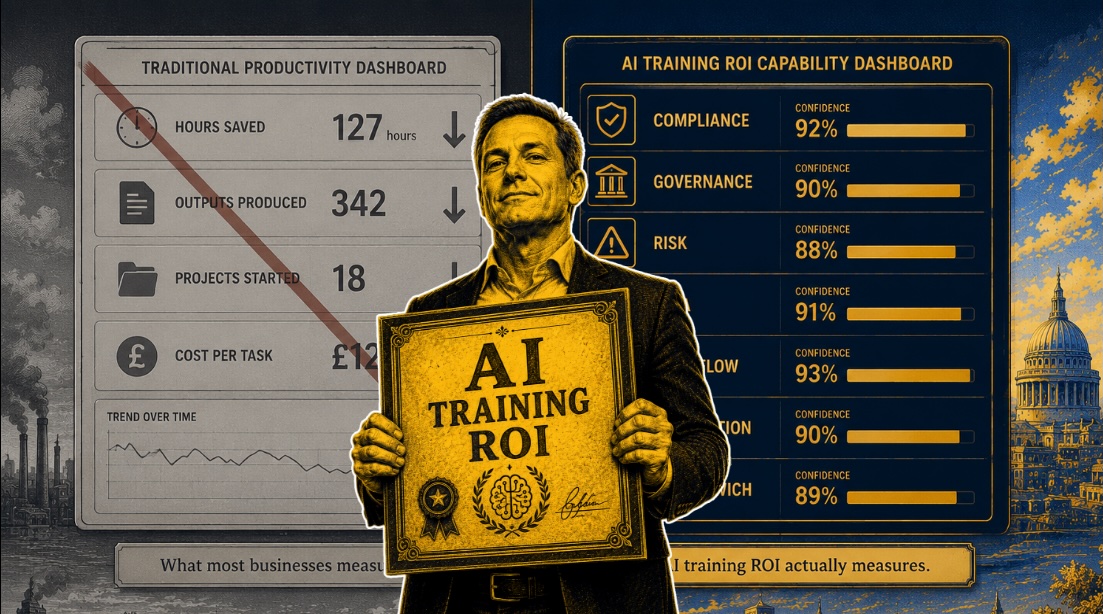
The frustration is understandable but the diagnosis most people reach is wrong. The problem is rarely that the training itself was bad. The problem is that businesses are measuring AI training ROI against the wrong metrics, which means the training that did work cannot be defended and the training that did not work cannot be improved. This is the case for rethinking what AI training ROI actually means and why the standard productivity-based measures are misleading almost everyone.
Why Most AI Training ROI Measurement Is Broken
The standard approach to AI training ROI measurement looks something like this. Before training, the business measures how long a particular task takes, how many of that task get done per week, what the error rate is and what the cost per output is. After training, the same metrics get measured again, the difference gets calculated and the result is presented as the ROI of the training spend.
The logic seems sound but the execution falls apart almost immediately. Reducing toil in one workflow tends to shift the toil somewhere else rather than eliminate it. The team member who saves four hours a week on AI-assisted drafting often spends those four hours on a workflow they have not yet mastered, where their lack of capability produces a different kind of waste. The productivity gains in measured workflows look impressive on paper. The actual commercial impact across the whole business is smaller, harder to attribute and frequently invisible to the measurement framework.
The deeper problem is conceptual. Productivity-based AI training ROI treats AI capability as a tool skill, the same way you might measure ROI on a new piece of software. Tools have predictable input-output relationships you can measure cleanly. AI does not. AI is a general-purpose capability that compounds across workflows in ways no measurement framework designed for tool training can capture. The result is that businesses chase metrics that look measurable but tell them almost nothing about whether the training is actually working.
The Right Way to Measure AI Training ROI
Consider what happens when a new employee joins a business that depends on Microsoft Office for the running of its day-to-day operations but the employee has never used Microsoft Office before. The business would obviously put that new employee on a basic training programme to bring them up to a sensible competency level. The measurement of success for that training is exactly what we need to consider when thinking about the measurement of success for AI training.
The point of training the new employee on Microsoft Office is to give them the capability and confidence to use the critical tools the business depends on. The measurement of whether the training worked would not be how many more emails they send as a result. It would not be how many more Word documents they create. It would not be how many more Excel tabs they build, how many fancy graphs they produce or how much output volume they generate.
You would measure whether they have become capable and confident using the tools. Capable enough to apply them properly to their work, confident enough to use them without supervision and, potentially, help move the dial for the business. Both of those words map directly onto stages four and five of the AI Confidence Journey, the destination every SME business is trying to reach with its AI capability building. The measurement framework that already governs how you would assess Microsoft Office training success is the same framework that should govern how you assess AI training success.
AI training ROI works exactly the same way. The right question is not how many AI projects your team has started, how many hours of toil they have eliminated or how many outputs they have produced. The right question is whether they have become capable and confident enough to use AI properly, which is a fundamentally different measurement framework.
What Confident AI Use Actually Looks Like
That scenario gives us the principle. The practical question for AI training ROI is what capability and confidence actually look like when applied to AI because the answer is more substantial than it first appears.
A team that is genuinely capable and confident using AI has built awareness across seven foundational dimensions, each of which represents real commercial capability the business can defend, govern and rely on. These seven are not exhaustive. Other dimensions matter and other dimensions will emerge as AI continues to evolve. The seven below are the foundational set every training programme should be building toward as a starting point.
Compliance awareness
Confident AI users understand what they can and cannot put into an AI tool, what the data implications are, where the regulatory boundaries sit and how to keep the business on the right side of the rules. The training delivers this knowledge in a way generic AI use does not.
Governance awareness
Confident AI users understand the difference between approved tools and shadow tools, the role of internal policies and the importance of operating inside the business’s AI framework rather than around it. The training builds the muscle memory of structured AI use.
Risk awareness
Confident AI users understand the failure modes of AI itself, including hallucination, confident wrongness, prompt leakage and the limits of model knowledge. They know when to trust AI output, when to verify it and when not to use AI at all. The training transforms naive enthusiasm into informed judgement.
Data awareness
Confident AI users understand that AI output quality is downstream of input quality, which means they understand the need for clean data, accurate data and properly structured data. The training builds the discipline of treating data seriously rather than throwing whatever is available at the model and hoping for the best.
Workflow awareness
Confident AI users understand that AI capability without process discipline produces inconsistent results. They understand the need for accurate workflows, repeatable processes and the kind of structural rigour that lets AI augment work rather than introduce chaos into it. The training builds the operational instinct alongside the tool capability.
Instruction awareness
Confident AI users understand how to set up AI tasks effectively, the structural patterns that produce reliable outputs and the difference between an instruction that works and one that almost works. This is the productive skill alongside the protective awareness. As we covered in our AI context engineering blog, the patterns that produce reliable AI output have already shifted significantly since 2024, and effective training builds the underlying capability rather than the syntax of any single platform.
AI sandwich awareness
Confident AI users understand the AI sandwich: the principle that human judgement should sit on both sides of AI work, with humans setting up the task properly at the front end and verifying the output properly at the back end. AI in the middle, humans at the edges. The training embeds this discipline as the default operating mode.
When a team has built capability and confidence across these seven dimensions, AI training ROI is no longer a question. The training has produced a measurable shift in business capability that compounds across every workflow the team applies AI to. The shift is not in the productivity of any one task. The shift is in the readiness of the business to deploy AI safelyand commercially in a governed way across whatever workflows matter most.
Mapping AI Training ROI to the AI Confidence Journey
The confidence-based framing of AI training ROI is not abstract. It maps directly onto the destination of the AI Confidence Journey, the five-stage path every SME travels from initial AI uncertainty to genuine operational confidence with AI.
The destination stage of the journey is Confident, which is defined as the point at which a business asks ‘what do we refine next?’ rather than ‘how do we get started?’. Confident is not a vibe. It is a measurable operational position in which the team is using AI productively, the business has visibility into how AI is being used and the governance, compliance, risk, data, workflow and sandwich disciplines are all embedded as standard practice.
This is the destination AI training is designed to reach. AI training ROI is genuinely the measurement of how close to the Confident stage your business has actually moved as a result of the training spend. The right metrics are diagnostic.
→ Can your team articulate the compliance boundaries on their AI use?
→ Can your team explain which tools are approved and why?
→ Can your team identify the failure modes of the AI they are using?
→ Can your team recognise when their input data is not fit for purpose?
→ Can your team describe the workflows AI is part of, including the verification steps?
→ Can your team set up an AI task effectively and recognise when an instruction is not working?
→ Can your team describe the AI sandwich and apply it instinctively?
The answers also tell you where the training has worked and where the next round of capability building should focus, which is what makes the confidence-based AI training ROI framework actionable in a way the productivity-based framework never was.
Why This Reframing Matters Commercially for UK SMEs
The confidence-based approach to AI training ROI is not a workaround for the difficulty of measuring productivity gains. It is a genuinely better framework for understanding what the training is actually delivering, and the commercial implications for SMEs are significant.
A business that measures AI training ROI by productivity metrics ends up optimising for the wrong things. Teams chase output volume rather than output quality. Leadership invests in training that produces measurable enthusiasm in narrow workflows while leaving the team unprepared to deploy AI safely across the business. The result is the IDC research finding we keep coming back to: 43% of AI training spend in 2026 is being wasted, which is what happens when the measurement framework is wrong and the outcomes are measured against metrics the training was never going to produce in the way the framework expects.
A business that measures AI training ROI by capability and confidence ends up building genuine capability. The training is judged on whether the team has become ready to use AI properly, which is the actual commercial outcome the business needs. The productivity gains that follow are emergent rather than designed, which means they compound across every workflow the team applies AI to rather than just the ones the original measurement framework looked at.
The bigger commercial point is that AI training ROI measured as capability and confidence is what justifies sustained training investment rather than one-off training spend. The Microsoft Office scenario holds here too. No business buys Microsoft Office training as a one-time event with a measurable productivity ROI attached. They buy it as an ongoing capability investment that pays off across years of work. AI training for business sits in the same category, but only if the measurement framework allows for it.
(H2) AI Training ROI: What This Means for Your Business
AI training ROI is one of the most consequential conceptual decisions a UK SME leadership team makes, because the framework you adopt determines what you optimise for, what you measure against and what you eventually conclude about whether the spend was worth it. The wrong framework produces the 43% wasted statistic. The right framework produces capability that compounds across years of AI evolution.
Capability and confidence are the right markers. The destination of the AI Confidence Journey is the right outcome. The seven foundational dimensions of capable AI use (compliance, governance, risk, data, workflow, instruction and the AI sandwich) are the right diagnostic metrics to start with, even though other dimensions matter and others will emerge as AI continues to evolve. The Microsoft Office training scenario is the right way to explain the principle to a board that has been trained to expect productivity numbers.
SME leaders who adopt this framework end up with two things their peers do not have. A defensible measure of whether AI training is actually working. A clear roadmap for what to invest in next as the business moves through the AI Confidence Journey toward the Confident destination.
Complete our free AI Readiness Assessment to understand where your team’s current AI capability sits across these foundational dimensions and what an effective training pathway would look like to close the gap.
.png)
.jpg)