
Tech Debt and AI: Don't Deploy AI on a Shaky Foundation
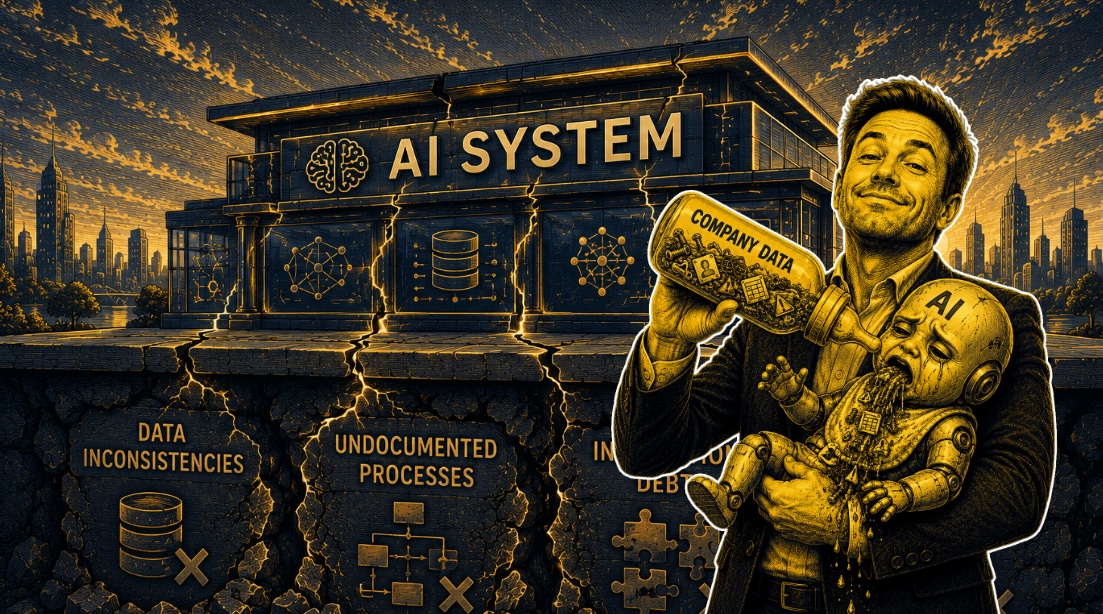
Tech debt and AI is the connection most SME leaders do not make until they have already committed budget, briefed a vendor and started a deployment that runs into problems they did not see coming.
AI implementation surfaces tech debt that has been invisible up to that point, because AI systems are unforgiving of the data inconsistencies, undocumented workflows and unreliable integrations that human teams have learned to work around for years.
The businesses that handle AI well in 2026 are the ones that addressed the relevant tech debt first, not the ones that tried to deploy AI on top of whatever happened to be there. This piece walks through the structural relationship between tech debt and AI implementation, the four specific debt categories that block AI success and what SMEs should do about it before committing serious AI budget.
How Tech Debt and AI Implementation Collide
The collision between tech debt and AI happens at a specific structural point, which is when the AI system tries to consume the existing technology stack as input. Human teams have spent years adapting to the quirks of the systems they work with. When the customer data is inconsistent across CRM and finance, the team checks twice. When the integration between two platforms breaks, the team manually reconciles. When the documented workflow does not match the actual workflow, the team follows the actual one anyway. The accumulated tech debt is invisible because the team has absorbed the cost of working around it.
AI systems do not work around debt. They consume input at machine speed, produce output based on the input they receive and propagate errors at scale. When the customer data is inconsistent, the AI applies that inconsistency to every customer record it touches. When the integration breaks, the AI does not know to manually reconcile, it just produces wrong answers consistently. When the documented workflow does not match the actual workflow, the AI follows the documented one regardless and produces output that does not fit how the business actually operates.
The collision between tech debt and AI is therefore not a technical inconvenience, it is a structural mismatch between how AI systems work and how UK SMEs have organically accumulated their technology stacks. The mismatch surfaces every debt the business has carried, frequently for the first time, and forces decisions that should have been made years earlier. As we covered in our What is Tech Debt foundational blog, every business carries tech debt. The question is whether the business has addressed enough of the relevant debt before the AI implementation begins, or whether the implementation will be the event that forces the conversation.
Why Tech Debt and AI Quality Are Connected
AI quality is downstream of input quality. This is the most important sentence in any conversation about tech debt and AI, because it explains why investments in AI that should have delivered transformational outcomes end up producing disappointing ones. The AI system is rarely the problem. The inputs the AI system is being asked to consume are usually the problem.
Three categories of input quality matter most. The first is data quality, which we cover in more detail below. The second is process clarity, which determines whether the AI can understand what the business is actually trying to do. The third is system reliability, which determines whether the AI can interact with the wider technology stack without surfacing the architectural debt the business has carried for years.
The strategic implication is that AI investment without tech debt investment is not really AI investment, it is hope. The businesses that deliver real returns from AI in 2026 are the ones that recognised the connection between tech debt and AI quality early and addressed the input quality problems before the AI work began. The businesses that did not recognise the connection are spending their AI budgets on systems that produce credible-looking outputs from unreliable inputs, which is a worse position than not having deployed AI at all because it adds false confidence to existing problems.
Tech Debt and AI: The Data Problem
Data debt is the category of tech debt that surfaces most aggressively when AI implementation begins, and it is also the category most SMEs have allowed to accumulate the longest. As we covered in our Signs of Tech Debt diagnostic blog, data debt shows up as inconsistent records across systems, duplicate customer entries, missing or unreliable fields and lineage that nobody can trace back to source.
For AI implementation, four data debt problems consistently cause the most trouble. The first is inconsistent customer records across systems, where the same customer exists in CRM, finance and operations with different details in each. The AI cannot reconcile what the business has not reconciled, which means AI-driven customer work produces inconsistent results across the systems it touches.
The second is undocumented data definitions. When ‘revenue’ means one thing in the finance system and another in the sales system, when ‘active customer’ has three different definitions depending on which team you ask, the AI has no way to know which definition to apply. The output looks credible and is structurally meaningless.
The third is missing data lineage. AI systems trained or operated on data with unknown lineage produce outputs with unknown reliability. The compliance implication, as the EU AI Act tightens through 2026, is significant. Businesses that cannot demonstrate the lineage of their AI training data face increasing regulatory exposure on top of the operational risk.
The fourth is data trapped in unstructured formats. PDFs, scanned documents, free-text fields, email threads. The data exists, but it is locked in formats that AI systems cannot consume reliably without significant pre-processing work. For most SMEs, the largest single barrier to AI implementation is not the AI system itself, it is the structured data the AI system needs that does not currently exist in usable form.
Tech Debt and AI: The Process Problem
Process debt is the second category that consistently surfaces during AI implementation and is the category most consultancies miss. The connection between tech debt and AI on the process side is straightforward. AI implementations succeed by automating, augmenting or accelerating existing processes. If the existing processes are undocumented, inconsistent or chaotic, the AI work cannot proceed because there is nothing reliable for the AI to automate, augment or accelerate.
The pattern SMEs frequently fall into is that the AI implementation begins, the team realises that the target process has never been documented, the documentation work then has to happen alongside the AI work, the documented version turns out to differ significantly from the actual version, the reconciliation work then has to happen, and three months into the implementation the business is no closer to AI deployment than it was at the start, because the underlying process work was never done.
Avoiding this requires recognising that process documentation is the cheapest possible AI investment a business can make. It does not require external vendors. It does not require new technology. It does not require significant budget. It requires the discipline to document the actual workflows, agree the standards across the team, identify the handoffs that are working and the handoffs that are not, and produce the documented version of how the business actually operates. Businesses that do this before the AI work begins are months ahead of businesses that try to do it during.
Tech Debt and AI: Where to Address Debt Before Deploying AI
Not all tech debt needs to be addressed before AI implementation can begin. The strategic question is which debt is structurally blocking the specific AI work the business wants to do, and the answer depends on the use case. Four categories of debt warrant attention before any significant AI implementation.
The first is data debt that touches the AI use case directly. If the AI use case is customer service automation, the customer data debt is critical. If the use case is sales forecasting, the sales pipeline data debt is critical. If the use case is operational reporting, the operational data debt is critical. The debt categories that touch the specific use case need addressing before deployment. The other data debts can wait.
The second is process debt in the workflows the AI will participate in. If the AI will operate in the marketing workflow, the marketing process debt needs to be addressed. The AI cannot automate processes that do not exist in documented form. The processes adjacent to the AI work do not need the same urgency.
The third is integration debt at the touchpoints the AI will use. If the AI will integrate with the CRM, the CRM integration debt is critical. The integration debt in systems the AI will not touch can wait. The principle is that integration debt becomes structural blocker when it sits on the path the AI implementation needs to take.
The fourth is compliance debt that the AI implementation would amplify. Existing compliance debt becomes significantly more dangerous when AI is added to the picture, because AI systems amplify whatever problems exist in the inputs they consume. Businesses with significant compliance debt should address it before AI implementation because the consequences of AI amplifying compliance problems are materially worse than the consequences of those problems existing without AI involvement.
Tech Debt and AI: What This Means for Your AI Strategy
Tech debt and AI is the structural connection that determines whether your AI implementation delivers what it should. The connection is not theoretical, it is operational, and it surfaces at predictable points during every AI engagement. The businesses that handle AI well in 2026 are the ones that recognised the connection early, prioritised the debt that touches the AI use case directly, addressed it before the AI work began and structured the AI strategy around the realistic tech debt position of the business rather than the idealised one.
The connection is also why our discovery work at the start of every AI Implementation engagement spends significant time on the underlying tech debt position. We are not pretending to be a development consultancy. We are recognising that AI deployment on a shaky foundation produces results that look impressive in demos and disappointing in production. The AI Confidence Journey we use as the spine of our work runs through stages where tech debt assessment and selective reduction are explicit deliverables, because we know from experience that this is the work that determines whether the AI implementation succeeds or stalls.
The practical takeaway for SME leaders is that tech debt and AI cannot be addressed in sequence by accident. The relevant debt has to be identified, prioritised and addressed deliberately, before or alongside the AI implementation, with the connection between the two work streams managed explicitly.
Businesses that try to address tech debt and AI in parallel without coordination produce poor results in both. Businesses that try to address AI first and tech debt later end up addressing tech debt under crisis conditions during the AI work, which is the worst possible scenario. The right structure is identification of the relevant debt during the AI Readiness Assessment, prioritised reduction during the planning stage and AI implementation on a foundation that has been deliberately prepared for it.
Complete our free AI Readiness Assessment to understand where your business sits on the AI Confidence Journey, which tech debt items in your current stack are likely to block your AI ambitions and what your structured pathway to addressing them should look like before AI implementation begins.
%20(1).jpg)
%20(1).png)
