AI Readiness Assessment: Where Every AI Plan Should Start
An AI readiness assessment is a structured check of your operations, data, processes and people that shows where AI can add value and what stands in the way. In our view, it is the most practical first step for any SME considering AI, because it tells you where to start before you spend on tools.
If someone in your team installed ChatGPT a few months ago and nobody can say what it has saved, an assessment is where to begin.
The Office for National Statistics report that around 35% of UK businesses with 10 or more employees now use AI, yet adopters use only around 1.6 AI technologies on average. The ONS describe that adoption as 'relatively shallow'.
What is an AI readiness assessment?
At its simplest, it is a diagnostic. It looks at how you work today and shows which areas stand to gain most from AI, what the barriers are and what a sensible first step looks like.
Assessments come in two depths. A quick online assessment gives you an early read on readiness in minutes. A deeper diagnostic, such as a facilitated workshop, tests those findings with your leadership team and turns them into priorities.
What does an AI readiness assessment cover?
A thorough assessment looks at four areas.
1. Data: where it lives, how clean it is and whether AI tools can use it.
2. Processes: the manual, repetitive tasks that suit automation.
3. People: your team's current skills and appetite for change. The ONS found that only 11% of businesses with 10 or more employees reported that more than half their workforce had received AI-related training.
4. Commercial context: your margins, growth targets and where you lose time.
Quick assessment or full diagnostic?
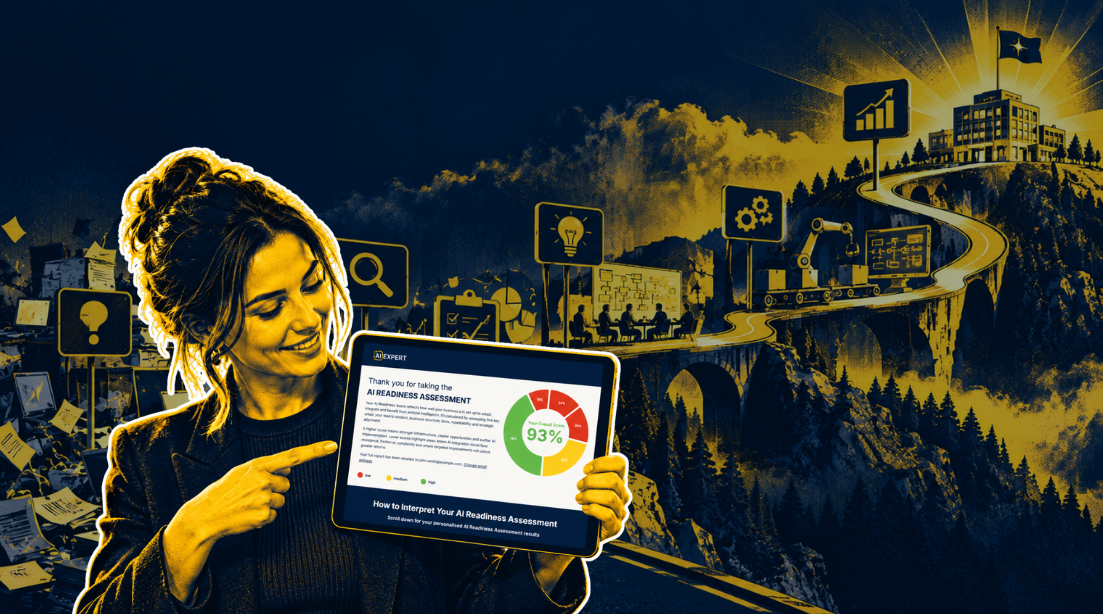
Our free AI readiness assessment takes two to three minutes. It gives you a readiness score and a personalised report in plain business language, with no technical knowledge needed.
A quick assessment points you in the right direction. It cannot map your processes in detail or test findings with your team.
That is the job of our AI workshop, which brings leadership, operations and finance together for half a day to a full day. Using LUMA and our own Rose, Thorn, Bud framework, it produces a prioritised summary of AI opportunities and next steps.
What to look for in an assessment provider
Independence matters most. In our view, an assessment from a software vendor will tend to recommend that vendor's software.
As independent advisers who do not sell software, we only recommend tools that fit your business. Sometimes the right answer is to wait. A useful diagnostic should also reflect your sector and operating context rather than your technology stack alone.
How to prepare for a deeper diagnostic
The quick online version needs no preparation. For a workshop, gather a rough picture of where your team spend time each week, the systems that hold your customer and operational data and the one or two processes that frustrate people most. That context lets the session focus on your real opportunities from the start.
Why skipping the assessment costs more
In our experience, the most common mistake is jumping straight to a tool. Someone installs ChatGPT, use becomes patchy and, months later, nobody can point to a saving. The team then conclude that AI has little to offer, when the real gap was a proper starting point.
Skipping the assessment also tends to mean tools that do not fit, consultants hired without a clear brief and internal projects that stall. Each failure makes the next AI project harder to win support for.
An AI readiness assessment in practice
A fast-growing e-commerce retailer started with our AI Readiness Assessment to find which customer data they could put to work. An AI Workshop and AI Roadmap followed, leading to segmentation and recommendation engines in their email platform.
According to our retail marketing automation case study, email conversion rates rose by more than 40% within two months and average order value increased by 17%.
Jon Rew, Managing Director of Scimitar Sports, took a similar route. 'We learned a lot from the AI Readiness Assessment,' he said. His team then moved on to an AI Workshop and a phased AI Roadmap.
You can see more examples in our AI case studies.
How the assessment fits your wider AI strategy
The assessment shows where the opportunity is. An AI roadmap sets out how to get there, with costs, risks and expected returns. AI implementation then turns the plan into working tools.
This sequence controls risk, since you build confidence at each stage before investing in the next. Our AI compliance support can also pick up any governance issues the assessment surfaces.
How soon can you see value?
In our experience, often within weeks. Spotting a manual process that takes three hours a week and automating it is a small project once you know where to look.
Frequently asked questions
Do you need technical knowledge to complete an AI readiness assessment?
No. You describe how you work day to day. The assessment then identifies where AI fits, in plain business language.
Is an assessment only useful for large businesses?
No. In our view, smaller businesses often have the most to gain, since manual processes take up a larger share of team time. An assessment helps focus limited resources on the best opportunities.
What happens after an AI readiness assessment?
You receive a report with your score and findings. The natural next step is an AI workshop to test those findings with your team. There is no obligation to go further.
How much does an AI readiness assessment cost?
Our quick online assessment is free, takes two to three minutes and carries no obligation. Our AI workshop is a separate, deeper service.
Start your assessment
Every AI plan should start with an AI readiness assessment. Take our free AI Readiness Assessment: it takes two to three minutes, carries no obligation and gives you a readiness score with a personalised report.