The Importance of an AI Readiness Assessment
The importance of an AI readiness assessment is most obvious when you look at businesses that skipped one.
A January 2026 IDC study of 1,317 senior AI decision-makers found that 43% of AI training budgets were spent on tools that didn’t deliver expected value. Some 70% of AI compute spend goes on hardware sitting idle. And over half of organisations — 50.8% — can’t measure their AI ROI at all. These aren’t businesses that chose bad technology. They’re businesses that deployed before they understood whether they were ready.
An AI readiness assessment is the diagnostic step that prevents all of this. It tells you where AI fits your business, where it doesn’t, and what needs to be in place before you invest.
What Is an AI Readiness Assessment?
An AI readiness assessment evaluates your business against the foundational requirements for successful AI adoption. It examines your current operations, your data maturity, your infrastructure, your team’s capabilities and your commercial objectives to determine where AI will deliver genuine value — and where it’s likely to waste money.
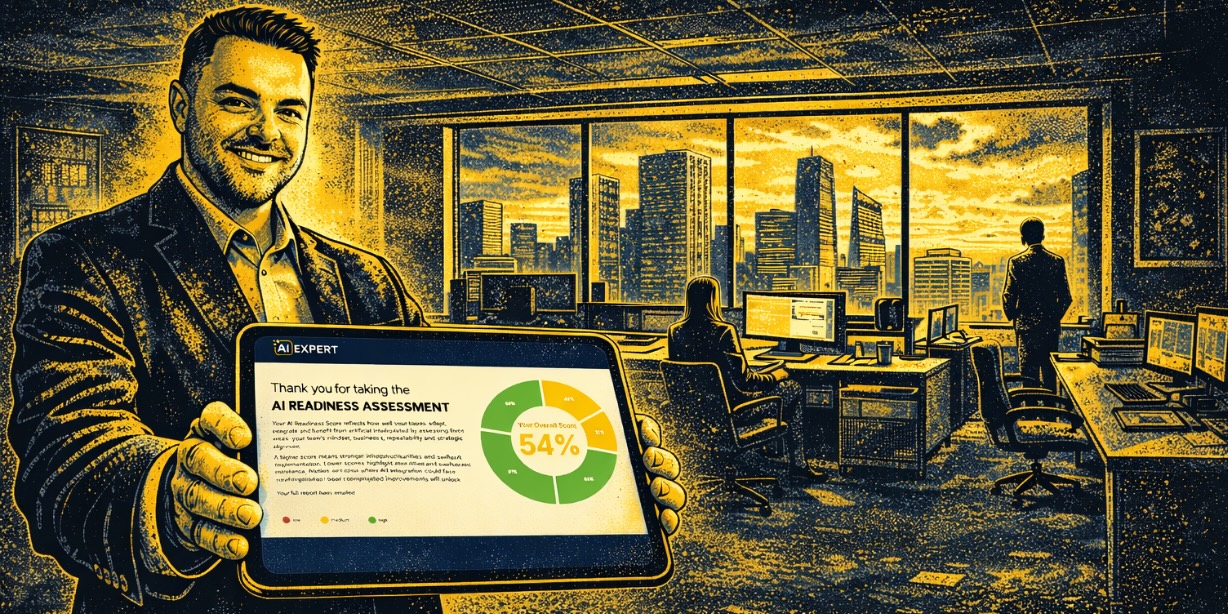
At AI Expert, our AI Readiness Assessment is free, takes only two to three minutes to complete and delivers a personalised report with an AI readiness score for your business. There’s no obligation, no sales pitch and no software to buy. It’s designed to give business leaders a clear, honest picture of where they stand before committing any budget.
The assessment is the entry point to a structured methodology: it feeds directly into an AI Workshop, which turns the findings into prioritised opportunities, followed by an AI Roadmap that lays out the implementation plan. But even as a standalone exercise, the assessment delivers immediate value by highlighting risks, gaps and opportunities that most businesses don’t know they have.
The Importance of an AI Readiness Assessment: What It Prevents
The IDC research makes the case clearly. The majority of AI failures aren’t caused by bad tools, they’re caused by poor foundations — data that isn’t ready, infrastructure that creates bottlenecks, teams that aren’t aligned and success metrics that were never defined.
An AI readiness assessment catches these problems before they cost you money.
Among the IDC study’s respondents, 47.7% cited data quality, consistency and governance as a top challenge affecting business outcomes. Data storage costs and management were flagged by 45.6%. The complexity of data cleaning and preparation by 44.1%. These are foundational issues. If your data isn’t in order, no AI tool — regardless of how advanced — will deliver reliable results. The assessment identifies exactly where your data stands and what needs fixing before deployment.
The study also found that 92% of organisations using multiple AI frameworks report negative efficiency. Fragmentation — where different teams adopt different tools without coordination — is one of the most expensive mistakes businesses make with AI. An AI readiness assessment surfaces this risk early, before fragmented adoption becomes entrenched and costly to unpick.
The Importance of an AI Readiness Assessment for Protecting Your Budget
The financial argument is stark. The IDC data shows that 32.6% of organisations identify controlling AI costs as their top concern over the next two years but you can’t control costs you don’t understand and you can’t understand them without first assessing where you are.
An AI readiness assessment establishes your baseline. It shows you what infrastructure you already have, what gaps exist and where spend is likely to escalate if you deploy without preparation. It identifies the difference between what you think you need and what you actually need — and that difference is often where the biggest waste occurs.
Consider the IDC finding that 25.7% of organisations reported idle GPU time as a significant source of budget waste during training, with a further 24.2% flagging overprovisioned clusters. These are infrastructure problems that stem directly from deploying without understanding requirements. A readiness assessment maps those requirements first, so your investment is sized correctly from the start.
For SMEs, where AI budgets are tighter and margins for error are smaller, this diagnostic step isn’t a nice-to-have. It’s the most commercially responsible thing you can do before spending anything on AI.
An AI Readiness Assessment Aligns Your Leadership Team
One of the most underappreciated aspects of an AI readiness assessment is the clarity it brings to leadership conversations. Most SME leadership teams know AI matters but disagree on where to start, how much to spend and what the priorities should be. Without a shared baseline, these conversations go in circles.
The assessment provides that baseline. It gives your leadership team a common set of facts — your readiness score, your specific gaps, your clearest opportunities — so that subsequent decisions are grounded in data rather than opinion.
This directly feeds into the AI Workshop, where AI Expert uses the LUMA framework and our Rose, Thorn, Bud methodology to turn the assessment findings into prioritised, actionable opportunities. The workshop is where alignment becomes strategy but without the assessment, there’s nothing concrete to align around.
As Alistair Hayward-Wright, Managing Director of Hayward-Wright Accounts, described: “The AI Readiness Assessment highlighted where we needed to put in some groundwork, which we weren’t aware of, and that provided a really strong foundation for our discussions in the AI Workshop. Since then we’ve been consistently blown away by the opportunities and potential for AI in our business.”
That pattern — assessment reveals gaps, workshop turns gaps into priorities, roadmap turns priorities into action — is how AI adoption works when it’s done properly.
What Happens After an AI Readiness Assessment
The assessment is the starting point, not the finish line. Once you have your readiness score and personalised report, the natural next step depends on where you stand.
For businesses with clear opportunities and solid foundations, the next step is an AI Workshop to define specific use cases, success metrics, and implementation priorities. The workshop output feeds into an AI Roadmap — a phased plan showing what to deploy, in what order, at what cost, and with what expected return.
For businesses where the assessment reveals foundational gaps — data quality issues, infrastructure limitations, or AI Compliance concerns — those gaps get addressed first. This avoids the expensive mistake of deploying AI on top of broken foundations, which is exactly how 43% of training budgets end up wasted.
For businesses that aren’t ready yet, the assessment tells you that honestly and that’s valuable too. Knowing you’re not ready — and knowing specifically what needs to change — is infinitely better than spending six months and five figures discovering the same thing through failed deployments.
AI Implementation follows once the groundwork is done, integrating AI tools into your operations with minimal disruption. And AI Training ensures your team can manage and evolve those tools independently over time.
The Bottom Line
The importance of an AI readiness assessment is simple: it’s the difference between deploying AI with confidence and deploying AI with crossed fingers. Every business that’s wasted budget on AI tools that didn’t deliver, infrastructure that sat idle, or initiatives that couldn’t demonstrate ROI shares the same root cause — they didn’t assess their readiness before they started.
The assessment takes two minutes. The cost of skipping it can run into tens of thousands for any SME serious about using AI to save time, reduce costs, and stay competitive, it’s the smartest first step you can take.
Complete our free AI Readiness Assessment — it takes two minutes and tells you exactly where your business stands.