What to Look for in an AI Workshop Before You Book
An AI workshop is one of the most commercially valuable investments an SME can make right now, but only if you book the right one. Most workshops on the market offer a surface-level overview of AI tools, a few hours of slides and a vague sense that something should happen next. That is not good enough when your competitors are already moving.
This guide cuts through the noise. It covers what a high-quality workshop actually delivers, the questions you should ask before committing and how to tell whether the outcome will translate into real business results.
Why an AI Workshop Matters for SMEs Right Now
According to McKinsey's 2025 State of AI report, over 70% of organisations are now using AI in at least one business function. For SMEs, however, the gap between awareness and action remains wide. Many business owners understand that AI is relevant to their operations but have no structured way to identify where to start.
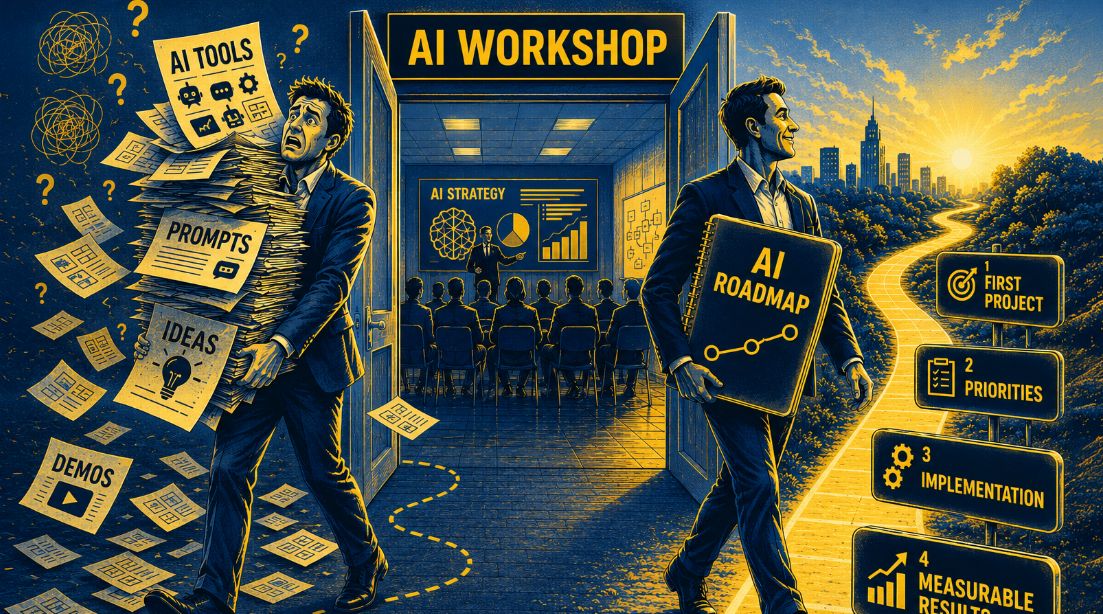
A well-structured AI workshop closes that gap. It moves you from vague interest to a specific, prioritised plan. The best workshops do not just explain what AI can do in theory. They focus on your business, your processes and your actual constraints. As a result, you leave with a roadmap rather than a reading list.
If you are already exploring the broader landscape, the AI Expert blog on AI and small business sets useful context for why the timing matters.
What a Good AI Workshop Should Cover
A Genuine Assessment of Your Current Operations
Before anyone talks about solutions, a credible workshop should start with diagnosis. That means examining where your team's time goes, which processes are repetitive and rules-based and where manual effort is creating bottleneck or error. Without this, any AI recommendations are guesswork.
At AI Expert, the workshop process uses the LUMA framework alongside a Rose, Thorn, Bud methodology to surface these inefficiencies systematically. Rose identifies what is working well, Thorn exposes what is genuinely painful and Bud captures what could realistically be improved. It is a structured approach, not a free-form brainstorm.
Clear Prioritisation of Opportunities
Not every AI opportunity is equal. A good workshop distinguishes between quick wins you can implement immediately, medium-term projects that require some integration work and longer-horizon investments that need more planning. This prioritisation is what separates a useful session from an overwhelming one.
You should leave knowing exactly which two or three things to act on first. If a workshop does not give you that clarity, it has not done its job.
A Realistic View of Costs and Timelines
One of the most common complaints about AI consultancy is that it stays abstract. Businesses want to understand what implementation will actually cost and how long it will take before they see results. A workshop worth booking will address this directly. It should give you indicative costs, realistic timelines and a view of expected return on investment.
This is the foundation of a useful AI roadmap: not a wish list, but a phased plan with numbers attached.
What to Look for in an AI Workshop: Five Non-Negotiable Criteria
Does the AI Workshop Address Your Specific Industry?
Generic AI workshops are everywhere. The question to ask any provider is whether their methodology adapts to your sector. A professional services firm has different automation priorities to a manufacturer or an ecommerce business. If the workshop content does not flex to your context, the outputs will not be usable.
Does It Lead to a Concrete Next Step?
The workshop itself is not the destination. It is the starting point for AI implementation. Before you book, ask the provider what deliverable you will walk away with. A structured action plan or a documented roadmap is the minimum. If the answer is 'insights and recommendations', push for more specifics.
Who Is Actually Running It?
This question matters more than most SMEs realise. Check whether the people facilitating the session have genuine commercial backgrounds or whether they are purely technical. AI tools are only valuable when the person advising you understands business operations, not just algorithms. Look for evidence of real projects delivered, not just credentials listed.
Is There Support After the Session?
Implementation is where most AI projects stall. A workshop that ends on the day with no follow-through is a missed opportunity. Ask whether post-workshop AI optimisation support is available, and whether the provider offers hands-on help when it comes to integrating tools into your existing systems.
Does It Cover Compliance?
With the EU AI Act now in force and UK AI governance frameworks evolving, any workshop that ignores the regulatory dimension is leaving you exposed. This is particularly relevant for businesses handling customer data or operating in regulated sectors. A credible provider will raise AI compliance as part of the conversation, not treat it as a footnote.
The Questions to Ask Before You Commit
Before booking any AI workshop, run through these practical checks. Ask the provider how they measure success after a session. Ask to see examples of the outputs previous clients received. Ask whether the workshop is delivered on-site or remotely, since face-to-face sessions tend to generate richer diagnosis. Ask what happens if you need to pause or adjust the roadmap after the session.
The answers will tell you quickly whether you are dealing with a provider who understands business delivery or one who is selling a product.
If you want to build an honest picture of where your business currently stands before attending any workshop, AI Expert's free AI readiness assessment takes two minutes and gives you a clear starting point.
How AI Expert Approaches the Workshop Process
AI Expert's AI consulting services are built specifically for UK SMEs. The workshop is not a product demonstration. It is a structured session that uses proven diagnostic tools to identify your highest-value AI opportunities, rank them by impact and feasibility and produce a phased implementation plan you can act on immediately.
Most projects show visible impact within the first month. That is a direct result of the methodology: identify clearly, plan specifically and support actively through AI implementation rather than leaving businesses to work it out alone.
Frequently Asked Questions
What is an AI workshop and what does it involve?
An AI workshop is a structured session in which a consultant analyses your business operations, identifies where AI can add measurable value and produces a prioritised action plan. A good workshop covers diagnostics, opportunity ranking, cost and timeline estimates and clear next steps.
How long does an AI workshop take?
Most effective AI workshops run between half a day and a full day, depending on the size and complexity of the business. Shorter sessions can identify quick wins but may lack the depth needed to produce a reliable implementation roadmap.
Do I need technical knowledge to get value from an AI workshop?
No. The best AI workshops are designed for business owners and operations leaders, not technical teams. You do not need to understand how AI works. You need to understand your own business and a good facilitator will do the rest.
How much does an AI workshop cost?
Costs vary significantly by provider and scope. What matters more than the upfront cost is the quality of the output. A workshop that produces a credible roadmap with a clear ROI case will pay for itself quickly. A cheap session that leaves you no clearer than before will cost you more in the long run. – Booking the right AI workshop is not about choosing the most sophisticated-sounding option. It is about finding a provider who understands your business, delivers a clear output and supports you through what comes next. If you want to explore what an AI workshop could identify in your business, get in touch with the AI Expert team and find out where the real opportunities are.
%20(1).png)
%20(1).jpg)
%20(1).png)