AI Courses UK: What SMEs Should Check Before Booking

Most AI courses UK providers sell teach AI concepts, while most SMEs need their people to work differently on Monday morning. Before you book, be clear on what your team should be able to do after the training and check that the course will get them there.
The gap matters. The Office for National Statistics found that only 11% of businesses with 10 or more employees reported that more than half of their workforce had received AI-related training, even though 55% of employees report using AI for work or education.

Why many AI courses UK providers sell fall short
Universities, online platforms and independent providers all now offer AI training. Many courses cover the concepts: how large language models work, basic prompting and tools such as ChatGPT or Copilot.
That knowledge has value. Generic training, though, rarely maps onto the workflows, risks and opportunities inside a particular business. A marketing manager who finishes a 12-hour online course may return enthusiastic yet unsure how to apply it to the processes their team run every day.
The gap between AI knowledge and AI application
In our experience, a familiar pattern follows: businesses send people on a course, enjoy a burst of enthusiasm and then watch adoption stall. The training had no link to real operational context.
That is why our AI training runs role-specific workshops around each client's own tools and processes. It takes more thought to design. In our view, it also pays back faster.
What should AI training for SMEs cover?
In our view, the most useful training focuses on application, fits the learner's role and produces something practical, such as a redesigned workflow, a tested prompt library or a documented process change. In our experience, sessions that use your own documents and systems stick far better than those built on generic examples.
Role-specific learning beats generic certification
A finance director and an operations manager use AI in very different ways. A session that treats them identically tends to serve neither well.
That is why 'which AI course should we book?' is often the wrong starting point. A better question is what your team should be able to do differently afterwards.
Responsible use and the EU AI Act
Any credible programme should cover responsible and compliant use. If the EU AI Act applies to you, Article 4 has required organisations since 2 February 2025 to 'take suitable measures' so their staff have 'a sufficient level of AI literacy', as Mayer Brown explains. EU lawmakers have since provisionally agreed changes to parts of the Act, so check the latest position when you plan.
Training that skips governance leaves businesses exposed to risks they may not know they carry. Our AI compliance support covers policies, oversight and staff training.

Do you need a course or a consultant?
Course providers tend to measure enrolments and completions, while you should judge consultants on outcomes. For many SMEs, especially those early in their AI journey, the more useful first investment is a diagnostic that shows where AI will have the biggest impact.
We would say that, of course, since diagnostics are part of what we offer. The test is simple: a good diagnostic should make any later training cheaper and better targeted.
Our AI workshop works this way. It brings leadership, operations and finance together to find where AI will add the most commercial value. The prioritised summary it produces then shapes what training you need and for whom.
Jon Rew, Managing Director of Scimitar Sports, followed that route. 'We learned a lot from the AI Readiness Assessment,' he said, before his team moved on to an AI Workshop and a phased AI Roadmap.
Start with an AI readiness assessment
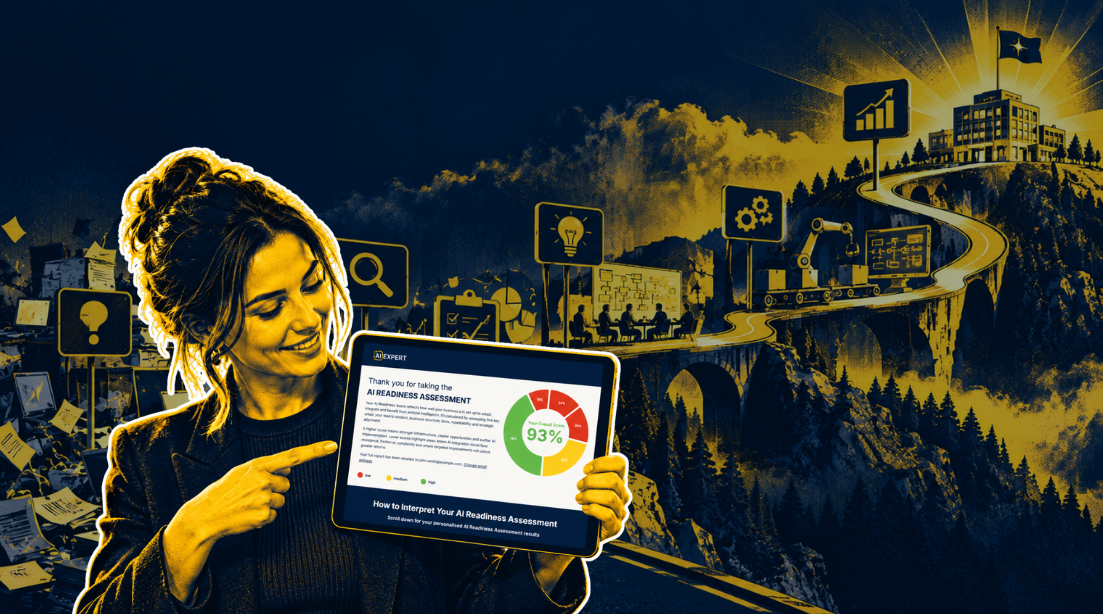
Before committing budget to training, find out where you stand. Our free AI readiness assessment takes two to three minutes and gives you a readiness score and a personalised report.
How to compare training providers
Four questions to ask about AI courses UK providers offer
If formal training is the right call, put these questions to every provider.
1. How do you tailor content to our sector and roles?
2. What practical output will the training produce?
3. Do you cover governance and compliance alongside tool use?
4. Have your trainers delivered AI projects in commercial settings?
Providers who cannot answer clearly are probably selling a course rather than building capability. Ask to see a practical output from a previous client, such as a redesigned workflow or prompt library. For wider context, our summary of EY research on teams using generative AI is worth reading alongside any training decision.
As independent advisers who do not sell software, we use LUMA and our own Rose, Thorn, Bud framework to match training to real business needs.
Frequently asked questions
What is the best AI course for UK businesses?
The best course is the one built around your team's roles and tasks. Decide what people should be able to do differently, then choose or commission training that delivers exactly that.
Are AI courses worth it for small businesses?
They can be, provided the training connects to real tasks and implementation support follows it. In our experience, training in isolation produces enthusiasm without lasting change.
Do staff need technical skills to benefit from AI training?
No. Good training for non-technical teams focuses on using AI tools safely and effectively within each role. What matters is that it reflects the tasks your team actually perform.
How does AI training fit into a wider AI strategy?
Training works best as part of a plan. An AI roadmap sets out where AI fits, what it costs and the expected return. Training then builds the skills to deliver that plan.
Find the right starting point
Before you book any of the AI courses UK providers offer, find out where AI can make the biggest difference to your business. Take our free AI Readiness Assessment: it takes two to three minutes, carries no obligation and gives you a readiness score with a personalised report.