
World Models vs LLMs: Will One Replace the Other?

In the world models vs LLMs debate, the answer for SMEs is clear: world models will not replace ChatGPT, Claude or Copilot. They will work alongside them and take on physical tasks that language tools cannot handle.
If you have just rolled out Copilot or trained your team on ChatGPT, the headlines may leave you wondering whether you backed the wrong technology. You did not.
New to the topic? Start with our guide to AI world models and the next wave of AI.
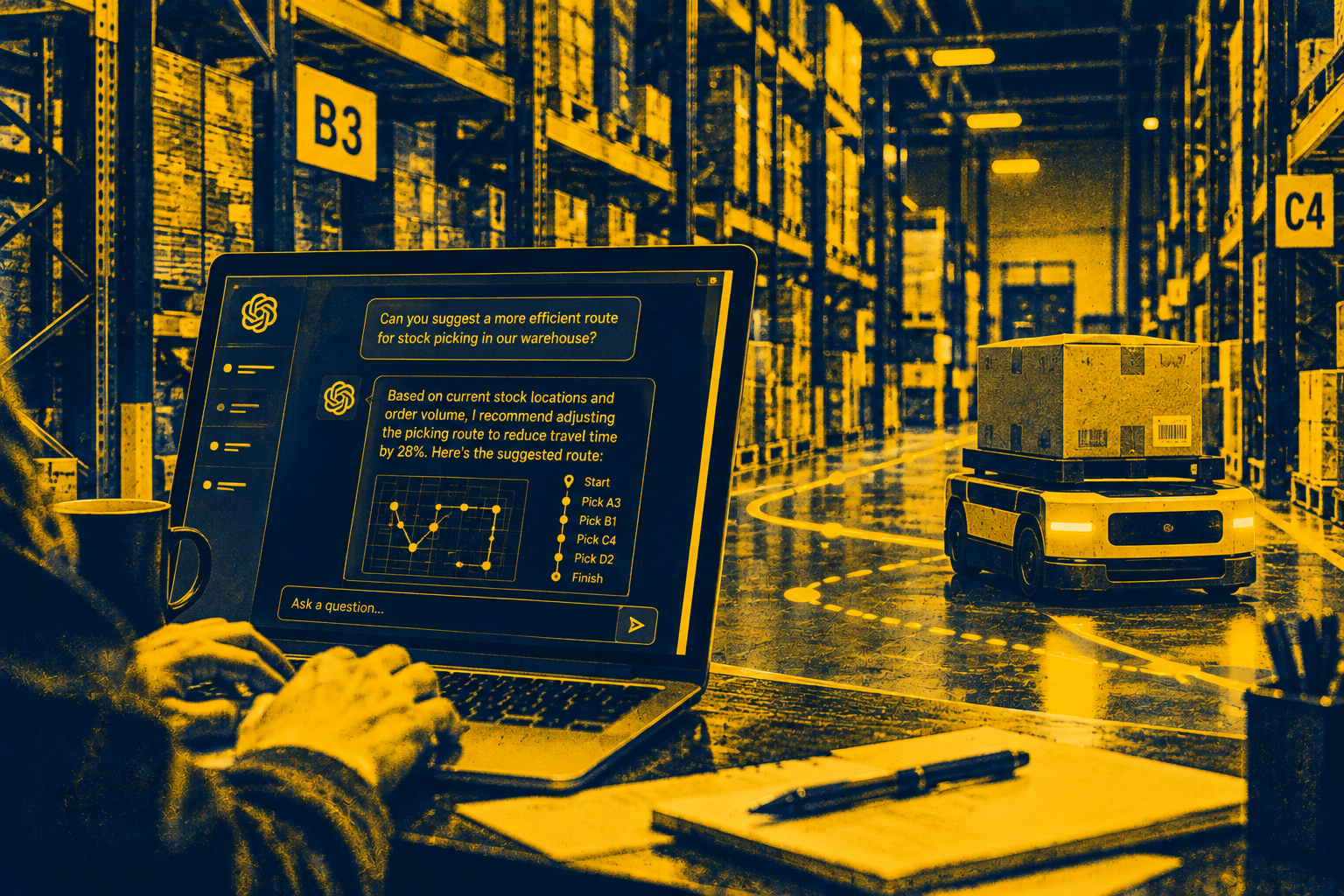
LLMs Already Handle Your Desk-Based Work
Large language models predict the next word in a sequence. Having learned from vast amounts of text, they write, summarise, code, analyse documents and answer questions in plain English.
That explains their lead in UK adoption. According to the Office for National Statistics, large language models were the most widely used AI technology among businesses with ten or more employees in June 2026, at 18%.
If you are still choosing a tool, our comparisons of Claude vs ChatGPT for business and Microsoft Copilot vs ChatGPT for business set out the practical differences.
Where LLMs fall short
LLMs learn about the world second hand, through what people have written. They can describe how a forklift works without any sense of what happens when one takes a corner too fast. They have no direct grasp of gravity, distance or momentum.
Yann LeCun, who left Meta to found AMI Labs, put it bluntly at Brown University in April 2026. LLMs, he said, 'fool us into thinking they are smart because they manipulate language' while remaining 'completely helpless when it comes to the physical world'.
World Models Predict What Happens Next
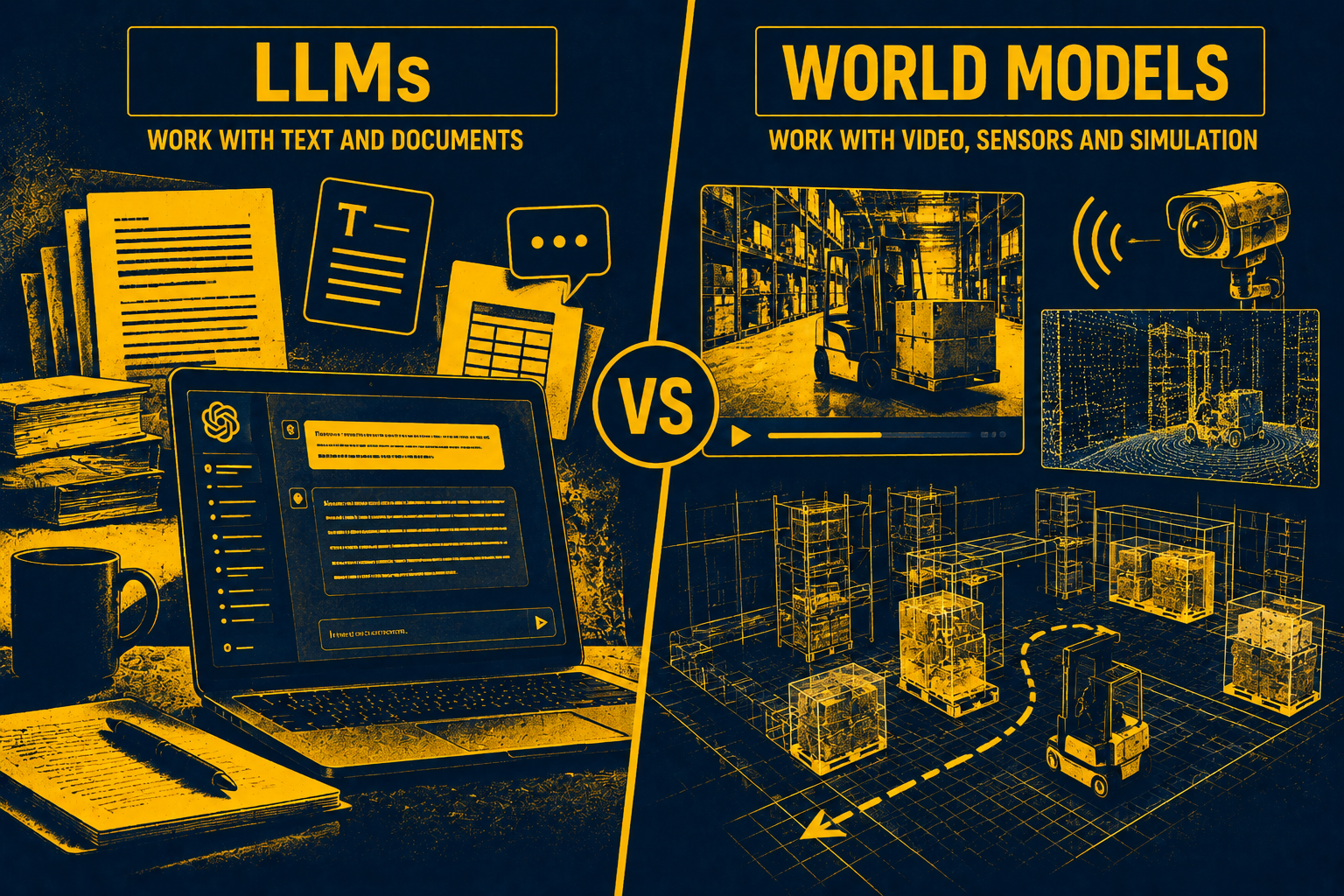
A world model predicts the next state of an environment, rather than the next word in a sentence. LeCun describes a system that takes the current state of the world and an action you plan to take, then predicts the result.
World models learn from video, images and sensor data instead of text. That lets them simulate a warehouse, a road or a production line and test scenarios before anything physically moves.
Text prediction vs physical prediction
Ask an LLM what happens when a pallet falls from a high shelf and you get a sensible written answer. Ask a world model and it simulates the fall, predicting where the pallet lands, what it hits and how the scene changes frame by frame. One explains, while the other predicts consequences.
World Models vs LLMs: Each Wins Different Work
LLMs excel at anything that lives on a screen: emails, proposals, reports, code and customer queries. They are cheap, easy to use and already sit inside the software most SMEs pay for. However, they hallucinate and they cannot reliably predict physical outcomes.
World models excel at simulation, planning and physical reasoning, which makes them a natural fit for robotics, logistics and manufacturing. The catch is maturity. In our assessment, most still need specialist hardware and technical teams.
The ONS figures show why this matters. AI use reaches 58% among information and communication businesses yet only 13% in construction, in our view, that gap reflects the limits of today's tools, which world models could start to close.
Why World Models Will Work Alongside LLMs
The strongest counter argument comes from LeCun himself. Brown's report of his lecture says he sees the LLM approach as 'essentially a dead end'. His target, though, is the claim that LLMs alone will reach human-level intelligence, as we explored in our piece on Yann LeCun's bet on AMI Labs.
For everyday business tasks, LLMs already deliver. Language also remains the easiest way for people to tell machines what they want.
A warehouse manager will not write code to instruct a robot. They will say 'move the returns to bay four' and a language model will turn that into a plan. A world model then works out how to carry it out safely.
World models vs LLMs: how hybrid systems split the work
The leading labs already combine both. Google DeepMind's Genie 3 generates an interactive world from a text prompt. Language sets the scene and the world model simulates it.
Gemini Robotics 1.5 uses one model as a 'high-level brain' that plans a task and can call tools such as Google Search. That model passes natural language instructions to a second model, which turns them into motor commands.
NVIDIA's Cosmos 3 combines vision reasoning, world generation and action prediction in a single system. Founder Jensen Huang credits 'breakthroughs in multimodal reasoning language, vision and world models' for what he calls 'the big bang of physical AI', part of NVIDIA's push across the entire AI stack.
The pattern is consistent. Language handles the conversation and the reasoning, while world models handle the physics.
SMEs Should Master LLMs First
In our view, world models will reach smaller businesses through suppliers rather than direct purchase. You are more likely to meet one inside a warehouse robot, a fleet platform or a design tool than to buy one outright.
If you are at the start of the AI confidence journey and still working out where AI fits, the priority is getting real value from the language tools you already pay for. If you run physical operations such as logistics, construction or retail, add one step: ask your suppliers how they plan to use world models.
We have seen the value of physical data firsthand. When we helped a Midlands manufacturer build predictive maintenance for their production lines, sensor data and historic maintenance records cut unplanned downtime by 35% in the first six months. Businesses that capture this kind of data now will hold the advantage when world models reach their suppliers.
As we do not sell software, our advice starts from your operations and your budget. Our job is to separate what you can use this year from what belongs on the watch list.
FAQs
Will world models replace LLMs?
Current evidence says no. LLMs handle language and reasoning while world models handle physical prediction and simulation. Leading systems from Google DeepMind and NVIDIA already combine both.
What is the difference between a world model and an LLM?
An LLM predicts the next word in a sequence, based on text. A world model predicts the next state of an environment, based on video, images and sensor data.
Are world models better than LLMs?
Neither is better overall. World models suit robotics, simulation and physical planning, while LLMs suit writing, analysis and customer communication.
Can SMEs use world models today?
A handful of tools, such as World Labs' Marble and NVIDIA's open Cosmos models, exist now. However, most practical uses still need specialist teams. For most SMEs, we expect world models to arrive through suppliers over the next few years.
The Verdict on World Models vs LLMs
The world models vs LLMs question has a practical answer. Build capability with the language tools you use today and watch world models closely if your work happens in the physical world. To see where you stand, take our free two-minute AI Readiness Assessment and get a personalised report with your AI readiness score.
%20(1).jpg)
%20(1).png)