What an AI Ethics Course Won't Tell You
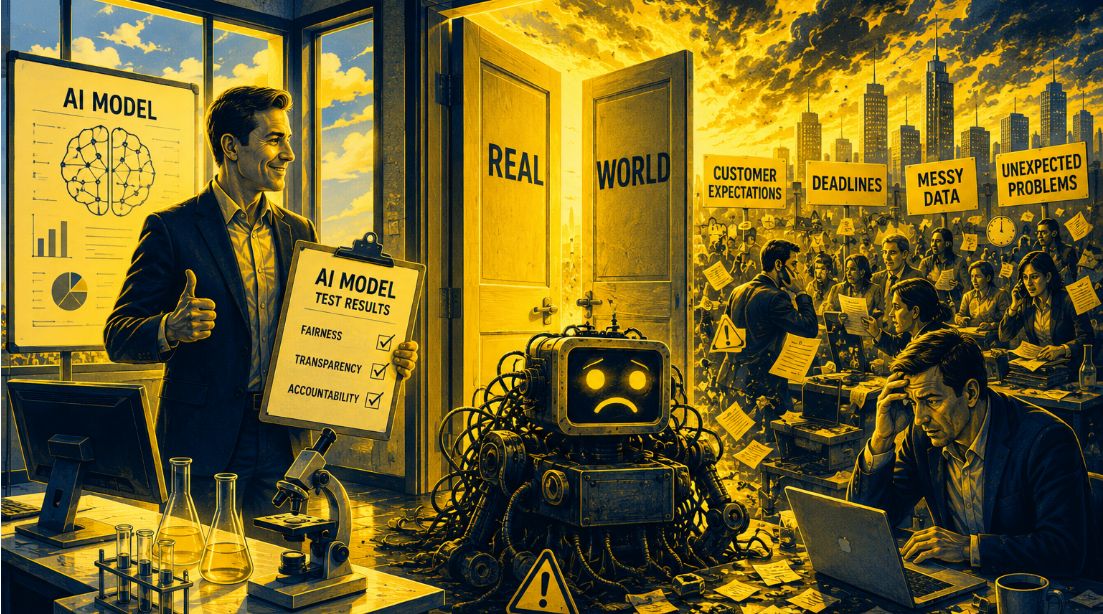
An AI ethics course can teach you the principles. It can walk you through fairness, transparency and accountability. What it rarely does is tell you how those principles behave when they collide with a real business decision at 9am on a Tuesday.
That gap matters. For UK SMEs navigating AI adoption in 2025 and 2026, the distance between classroom theory and operational reality is where most responsible AI efforts fall apart. Understanding that distance is the first step to closing it.
What an AI Ethics Course Actually Covers
Most AI ethics courses follow a familiar structure. They introduce foundational frameworks, cite the EU AI Act, reference bias in training data and explain why explainability matters. That content has genuine value. The EU AI Act, which came into force in August 2024, creates real compliance obligations for businesses deploying certain AI systems and understanding the regulatory landscape is not optional.
However, a course that ends at theory leaves you with a map but no vehicle. Responsible AI is not a qualification you earn once. It is a set of decisions you make continuously, often under commercial pressure, with incomplete information.
The Difference Between Knowing and Doing
The research is consistent on this point. A 2025 McKinsey survey found that while awareness of AI governance has increased significantly among business leaders, fewer than a third of organisations have embedded ethical AI practices into their operational workflows. Knowing the principles and building systems that honour them are two very different things.
For SMEs in particular, the challenge is not motivation. Most business owners want to act responsibly. The challenge is capacity. You rarely have a dedicated AI ethics team. The person responsible for AI deployment is often also responsible for three other business functions. As a result, principles that look clean on a slide become complicated in the actual workflow.
What Responsible AI in Practice Actually Requires
Responsible AI in practice starts before you choose a tool. It starts with an honest assessment of where AI is being deployed, what decisions it is influencing and who is affected if something goes wrong.
A Risk-Based Approach, Not a Rule-Based One
Rules tell you what you cannot do. A risk-based approach tells you what you need to think about. The difference is significant. Rules create a false sense of security because they imply that compliance equals safety. A risk-based mindset asks harder questions: what could go wrong here, how likely is it and what is the cost if it does?
This is precisely the kind of structured thinking that AI Expert's AI consulting services are built around. The Rose, Thorn, Bud framework used in every engagement is designed to surface problems before they become incidents, not after.
Governance That Fits the Size of Your Business
Enterprise-level AI governance frameworks are rarely appropriate for an SME. They are built for organisations with legal teams, compliance officers and dedicated data scientists. Applying them directly to a fifteen-person business creates friction without proportionate protection.
What SMEs need is governance that is proportionate, practical and embedded into existing workflows. That means clear ownership of AI decisions, documented processes for reviewing AI outputs and a feedback loop that allows you to identify and correct problems quickly. An AI roadmap built around your specific operational context is far more useful than a generic ethics policy copied from a larger organisation.
The Compliance Question SMEs Keep Getting Wrong
One of the most common People Also Ask questions around AI ethics is whether businesses need to comply with the EU AI Act if they are based in the UK. Post-Brexit, UK businesses are not directly subject to the EU AI Act unless they are selling into EU markets or using AI systems developed by EU-based providers. However, the UK's own AI regulation landscape is evolving rapidly and the direction of travel is clear.
The UK government's pro-innovation approach to AI regulation does not mean no regulation. It means sector-specific guidance, voluntary frameworks and a growing expectation that businesses deploying AI can demonstrate responsible practice. Our dedicated AI compliance service exists precisely because this regulatory picture is shifting faster than most SMEs can track.
What Does AI Bias Actually Look Like for an SME?
This is another question searchers ask frequently, and it deserves a direct answer. AI bias in an SME context rarely looks like the headline examples from large tech companies. It tends to be subtler. It appears when an AI-powered recruitment tool systematically ranks candidates from certain postcodes lower. It shows up when a customer service chatbot handles enquiries differently depending on how they are phrased. It emerges when a pricing algorithm, trained on historical data, embeds historical inequities into future decisions.
None of these require malicious intent. They require attention, the kind of attention that an AI workshop focused on your specific use cases can help you develop. Identifying these risks before deployment, not after, is the practical work that an AI ethics course alone does not prepare you for.
Why AI Ethics and Commercial Success Are Not in Conflict
There is a persistent myth that responsible AI slows business down. It does not. In fact, the opposite tends to be true. Businesses that deploy AI with clear governance frameworks experience fewer costly errors, maintain stronger customer trust and build internal confidence in the tools they use. According to Gartner's 2025 AI governance research, organisations with documented AI oversight processes are significantly more likely to report positive ROI from their AI investments.
Responsible AI is not a constraint on commercial performance. It is a foundation for it. Our work with UK SMEs consistently shows that the businesses seeing the strongest returns from AI are those that took the time to understand their risks before they scaled their deployment. You can explore how this plays out across different industries in our AI work case studies.
If you are not sure where your business stands right now, the most useful first step is an honest self-assessment. Our free AI readiness assessment takes two minutes and gives you a clear starting point.
Frequently Asked Questions
Do UK SMEs need to comply with the EU AI Act?
UK businesses are not directly subject to the EU AI Act unless they sell into EU markets or use AI systems developed by EU providers. However, UK-specific AI regulation is developing quickly and responsible practice is increasingly expected. Our AI compliance service helps SMEs stay ahead of this curve.
What is the difference between AI ethics and AI compliance?
AI ethics refers to the values and principles guiding how AI is used. AI compliance is about meeting specific legal or regulatory requirements. The two overlap but are not the same. You can be compliant without acting ethically and, in theory, ethical without yet meeting every regulatory requirement. Both matter and both require active management.
Is an AI ethics course enough to prepare my business for responsible AI deployment?
It is a useful starting point, but it is not sufficient on its own. Responsible AI in practice requires risk assessment, governance frameworks, staff training and ongoing review. A course builds awareness. The operational work is what delivers protection.
How do I identify AI bias in my business?
Start by auditing the data your AI systems are trained on and the decisions they influence. Look for patterns in outputs that correlate with protected characteristics or historical inequities. Structured workshops focused on your specific use cases are the most effective way to surface these risks early. – An AI ethics course gives you the vocabulary. What your business needs is the ability to act on it, under real conditions, with real stakes. That is the gap between knowing and doing and it is where the meaningful work happens. If you want practical support deploying AI responsibly in your SME, speak to the AI Expert team and let's start with what you actually need.
%20(1).jpg)
%20(1).png)
