
AI Training for Business: The Strategic Case for Structured Capability Building
AI training for business is one of the most discussed and least understood investments on the SME landscape in 2026.
Most leadership teams know they need it but most are uncertain how to budget for it, when to commit to it, what to expect from it and how to know whether they got their money’s worth.
The result is a pattern of hesitation followed by panic followed by poorly designed training that produces little measurable return. This is the strategic overview of AI training for business, what it actually is, why it matters now and how SME leaders should be thinking about it.
What AI Training for Business Actually Means
AI training for business is fundamentally different from individual AI training, online courses or personal upskilling. The clue is in the framing. Training built around an individual learner produces an individual who can use AI for their own tasks. Training built around a business produces a workforce that can apply AI to specific commercial outcomes the company is trying to achieve.
The distinction matters because the structure, the content, the sequencing and the measurement of effective AI training for business all flow from one question. What is this training supposed to deliver for the business itself, not just the people inside it? A consultancy training every fee-earner to draft using AI has a different objective from a manufacturer training operations managers to apply AI to scheduling, which has a different objective again from a recruitment firm training consultants to use AI for candidate research. The capability being built is different., the workflows it plugs into are different and the KPIs that measure success are different.
This is why AI training for business cannot reasonably be bought off the shelf. The training that produces measurable returns is built around the specific commercial outcomes the business is trying to achieve, the specific workflows where AI capability will move the needle and the specific people whose new capability will deliver those outcomes. We covered this in detail in our AI training programmes blog, which lays out the principles that distinguish effective training from the 43% of training budgets IDC research found are being wasted in 2026.
Why AI Training for Business Matters Now
The case for AI training for business has shifted significantly in 2026, and not in the way most coverage suggests. The argument is not that AI is a powerful new tool your team needs to learn. The argument is more uncomfortable. Your team is already using AI, regardless of whether you have trained them or not.
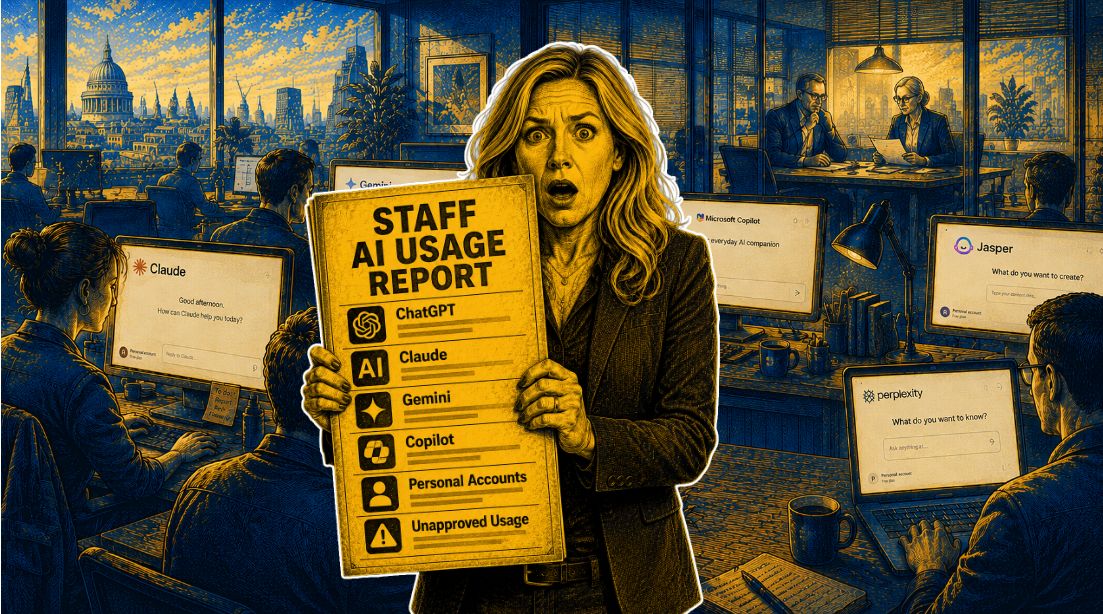
Shadow AI usage in UK businesses is now near-universal. Employees are using ChatGPT, Claude, Gemini and Copilot for everything from drafting emails to summarising meetings to writing reports. They are doing this on personal accounts, on free tiers, with no governance, no quality controls and no awareness of the commercial risks involved. The choice facing SME leadership is not whether AI capability enters the business. It is whether that capability is structured, governed and aligned with commercial outcomes, or whether it remains an uncontrolled patchwork of individual workarounds that creates as much risk as it does productivity.
AI training for business is how leadership teams convert that uncontrolled patchwork into a structured commercial capability. Without it, the productivity gains are uneven, the risk exposure is significant and the compliance position is weaker than most boards realise. With it, the business has visibility, governance and a measurable trajectory of capability building that compounds over time.
The Three Things AI Training for Business Should Actually Do
The 43% of training spend that fails in UK businesses fails for predictable reasons. The training that produces returns does three things consistently, and the training that produces nothing skips at least one of them.
It builds capability the business specifically needs. Generic AI training builds generic AI capability. The team learns about prompting, gets shown some example use cases and goes back to their desks. None of it is anchored in the workflows the business actually operates, which means none of it translates into measurable commercial outcomes. Effective AI training for business identifies the specific workflows where AI will deliver returns, then builds the capability to deploy AI on those workflows specifically.
It builds capability across the right people. Senior leaders, operational managers and frontline team members need fundamentally different AI capabilities. The leader needs to understand strategic implications and make resource decisions. The manager needs to understand which workflows to redesign and how to govern AI use within the team. The frontline operator needs to understand how to apply AI to specific daily tasks. Training that treats all three groups identically produces a watered-down average that suits none of them properly.
It builds capability that survives the next product cycle. The AI tool landscape moves faster than any other technology shift in living memory. Training built around the specifics of one platform is obsolete before it finishes delivery. AI training for business needs to teach the underlying patterns of effective AI use, not the syntax of a tool that will look different in twelve months. The capability that compounds is the capability that transfers across whatever tools your team uses next.
AI Training for Business Within the AI Confidence Journey
The single biggest mistake in AI training for business is timing. Training delivered at the wrong stage of your business’s AI adoption journey produces wasted spend regardless of how well-designed the training itself is. We sequence training inside the broader AI Confidence Journey, the five-stage path every SME travels from initial AI uncertainty to genuine operational confidence with AI.
At the Confused stage, AI training for business is premature because there is no clarity yet on which capabilities matter. The right first step is our free AI Readiness Assessment, which establishes the operational picture training will eventually build on.
At the Curious stage, our AI Workshop identifies where AI capability will deliver commercial impact, which is what shapes the training that should follow.
At the Committed stage, an AI Roadmap defines exactly which capabilities are needed and when, with training plotted into the sequence accordingly.
At the Capable stage, AI training for business produces its strongest commercial returns, because the team builds capability on the actual tools being deployed through AI Implementation rather than on hypothetical scenarios.
At the Confident stage, training shifts from foundational capability building to ongoing development, supporting AI Optimisation and Support as the business’s AI maturity continues to compound.
The sequencing is what protects the investment. SME leaders who treat AI training for business as a tick-box exercise to be slotted in early end up paying for capability that decays before it is applied. Leaders who sequence it properly end up with measurable capability that delivers returns in months rather than years.
AI Training for Business: What This Means for SMEs
AI training for business is not a one-off purchase. It is a strategic investment in commercial capability that sits inside a broader AI adoption journey and produces returns proportional to how well it is sequenced, designed and measured. The businesses that get the most out of it treat it as a strategic input alongside vendor selection, workflow redesign and governance. The businesses that get the least out of it treat it as a course to buy and a box to tick.
The 43% wasted figure from IDC is not a mystery. It is the predictable outcome of treating AI training for business as a product rather than a process. The businesses on the productive side of that statistic are doing the discovery work first, building capability around the workflows that matter, differentiating by role and sequencing the training inside their broader AI adoption rather than in isolation.
Complete our free AI Readiness Assessment to understand where your business currently sits on the AI Confidence Journey and what an effective AI training for business programme would look like for your specific operations.

.png)