Importance of an AI Workshop & Why Most AI Projects Fail
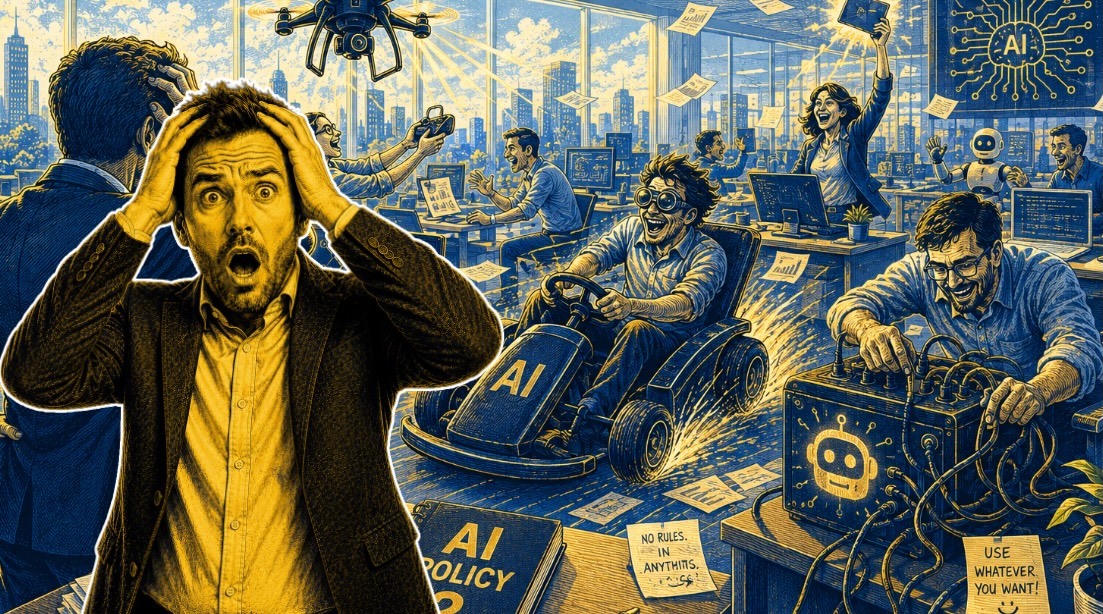
The importance of an AI workshop is best understood by looking at what happens without one.
A January 2026 IDC study of 1,317 senior AI decision-makers found that 43% of AI training budgets were spent on tools that didn’t deliver expected value, 92% of organisations using multiple AI frameworks report negative efficiency and over half can’t measure their AI ROI at all. The common thread behind these failures isn’t bad technology and it’s the absence of structured planning before deployment.
An AI Workshop is the step that prevents all of this. It’s where strategy replaces guesswork, leadership gets aligned and AI investment starts delivering commercial returns instead of expensive disappointment.
The Importance of an AI Workshop: What Happens Without One
Most businesses that struggle with AI didn’t choose the wrong tools. They skipped the planning stage entirely. They moved straight from “we should be using AI” to purchasing platforms, subscribing to tools or asking a developer to build something — without ever establishing what problem they were solving, what success looks like or how they’d measure the return.
The IDC research quantifies exactly where this goes wrong. Among organisations experiencing AI inefficiency, 41.6% reported redundant functionality across tools. Some 40.4% faced increased engineering complexity. And 40% saw their compute and resource costs rise — not because AI is inherently expensive, but because fragmented, unplanned deployments make it unnecessarily so.
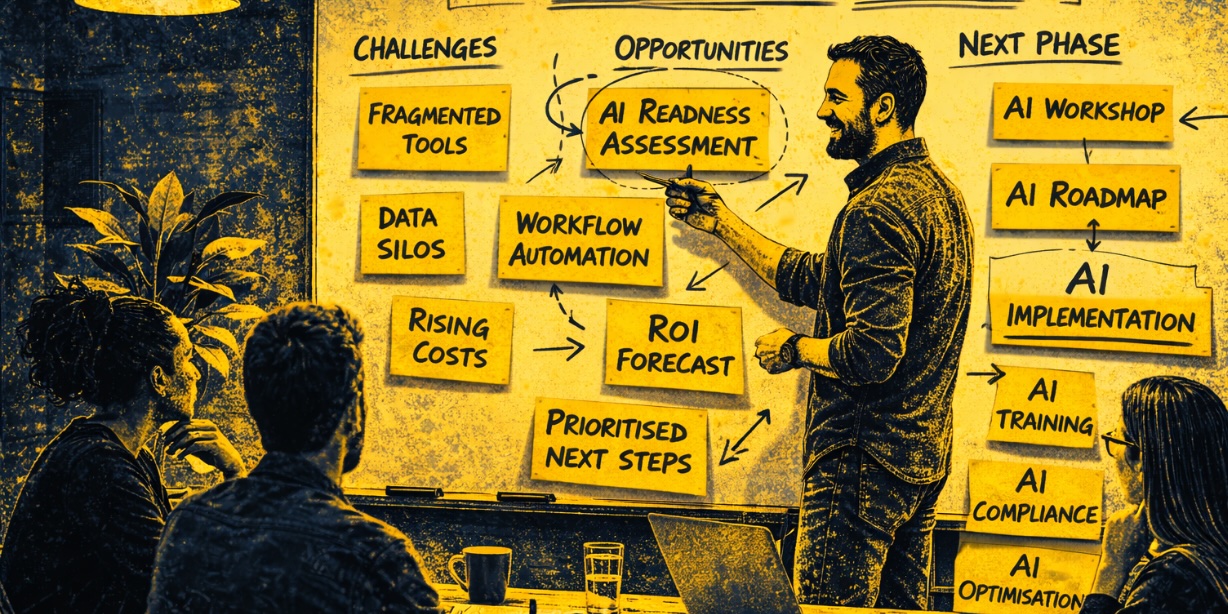
An AI Workshop prevents this by establishing clarity before any technology decisions are made. It brings your leadership team together to examine your operations, identify where AI will genuinely add value and agree on priorities — so you deploy once, correctly, rather than iterating expensively through trial and error.
Why an AI Workshop Matters More Than the Technology You Choose
There’s a persistent misconception that AI success depends on picking the right model or platform. In reality, the technology is the easy part. The hard part — and the part most businesses skip — is the strategic groundwork that determines whether that technology delivers anything useful.
The IDC study found that 50.8% of organisations can’t measure their AI ROI. Not because the tools don’t work, but because nobody defined what success looked like before deployment. When you can’t measure returns, you can’t justify continued investment. When you can’t justify investment, the programme gets cut. The business falls behind competitors who planned properly.
This is the core importance of an AI workshop. It defines success in business terms — hours saved, costs reduced, revenue protected, customer experience improved — before a single tool is selected. These metrics become the foundation your AI Roadmap is built against, ensuring that every subsequent decision can be measured and defended at board level.
The Importance of an AI Workshop for Leadership Alignment
AI adoption fails when leadership isn’t aligned. If your operations director sees AI as a cost-cutting exercise, your commercial director sees it as a growth lever, and your MD isn’t sure where to start, you’ll end up with competing initiatives that fragment your budget and deliver nothing.
At AI Expert, our AI Workshop uses the LUMA framework alongside our Rose, Thorn, Bud methodology. Rose identifies what’s already working well. Thorn highlights the problems costing you time and money. Bud uncovers the opportunities you haven’t acted on. This structured approach gets your entire leadership team working from the same data, towards the same priorities, in a single session.
As Sophie Delroy, Managing Director of Build Group, put it: “The LUMA framework was a really engaging way to break down our current set-up and objectives. From there, the AI Roadmap has given us clear actions to achieve the Bud we identified in the workshop.”
That alignment alone prevents the single biggest cause of wasted AI spend — different people pulling in different directions with no shared definition of success.
An AI Workshop Protects Your Budget
The financial case for an AI workshop is straightforward. The cost of a structured planning session is a fraction of the cost of getting AI wrong.
The IDC data paints a clear picture of what “getting it wrong” looks like. Some 70% of AI compute spend is wasted on hardware sitting idle. Training budgets are being burned on tools that underdeliver. Engineering teams are spending their time managing compatibility issues between frameworks instead of building solutions that create business value.
An AI workshop identifies these risks before they become line items on your P&L. It flags where your data isn’t ready for AI, where your infrastructure will create bottlenecks, and where you’re likely to overspend if you rush into deployment. It also identifies where AI isn’t the right answer — which is just as valuable, because it stops you wasting money on solutions to problems that don’t exist.
The IDC study found that 32.6% of organisations cite controlling the rising costs of AI as their top concern over the next two years. A workshop addresses that concern at the earliest possible stage — before the costs start rising.
For businesses earlier in their AI journey, the process typically starts with our free AI Readiness Assessment, which evaluates your current operations and data readiness. The assessment provides the baseline that feeds directly into the workshop, so the session is grounded in your specific situation rather than generic advice.
What Happens After an AI Workshop
The workshop isn’t a standalone event. It’s the strategic foundation that everything else is built on.
The immediate output is a prioritised set of AI opportunities, agreed by your leadership team, with clear commercial rationale for each. From there, the natural next step is an AI Roadmap — a phased implementation plan showing what to deploy, in what order, at what cost, and with what expected return.
AI Implementation then delivers the execution, integrating AI tools into your existing operations with minimal disruption. And AI Training ensures your team can operate, manage, and evolve those tools independently over time.
This is the methodology that consistently delivers results. Jon Rew, Managing Director of Scimitar Sports, described the process: “We learned a lot from the AI Readiness Assessment, which we addressed in the AI Workshop. We’re now implementing the AI Roadmap and AI Expert are supporting us every step of the way.”
The workshop is where the AI journey stops being abstract and starts becoming actionable. Without it, businesses are guessing. With it, they’re planning.
The Bottom Line
The importance of an AI workshop comes down to one thing: it’s the difference between AI that delivers measurable commercial value and AI that burns budget while everyone hopes for the best.
The IDC data is clear. Most organisations are wasting significant portions of their AI investment because they skipped the strategy stage. The businesses seeing 14.4% productivity gains, faster operations, and improved customer satisfaction are the ones that planned before they deployed.
An AI workshop is where that planning happens. It’s not optional. It’s the foundation.
Complete our free AI Readiness Assessment — it takes two minutes and provides the starting point for your AI Workshop.