AI Policy: What Every SME Needs in Place Now
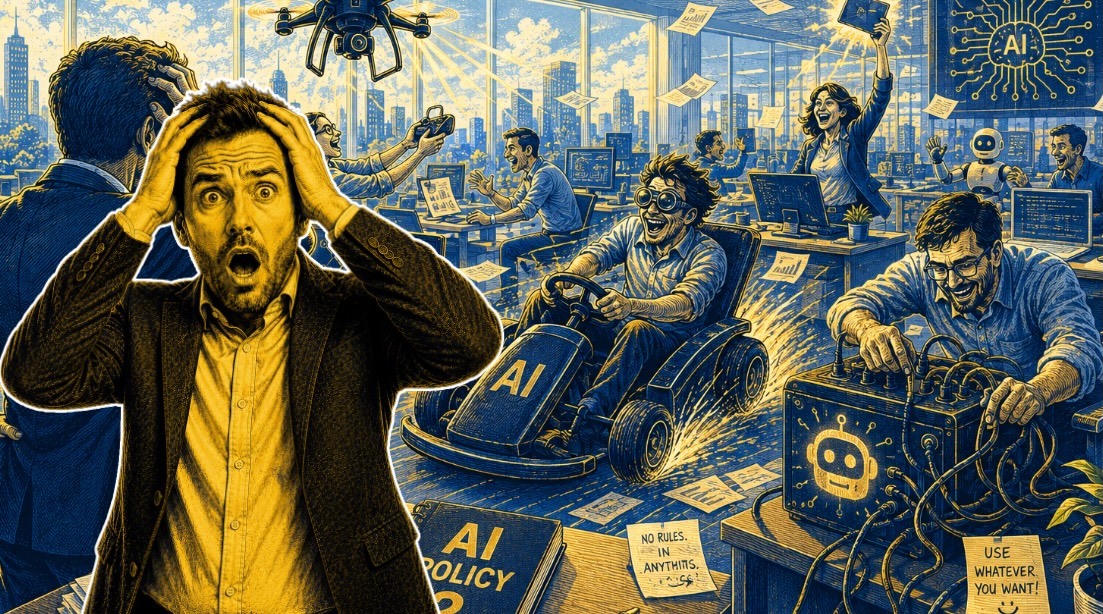
AI policy is no longer something only large enterprises need to worry about. If your team is using AI tools – and the chances, are they already are, whether you know it or not – your business carries real exposure without one. This is not a compliance exercise for its own sake. It is a practical safeguard for your data, your customers and your reputation.
What Is an AI Policy and Why Do SMEs Need One?
An AI policy is a written framework that sets out how your business uses artificial intelligence, who is accountable for it and what rules govern that use. Think of it as your operational rulebook for AI, covering everything from which tools staff can use to how customer data is handled within those tools.
Many SMEs assume this level of governance is reserved for large organisations with compliance teams and legal departments. In practice, the opposite is often true. Smaller businesses carry more concentrated risk because a single misstep – a data leak, an inaccurate AI-generated output used in a client-facing document or an employee feeding sensitive contracts into a public AI tool – can cause disproportionate damage.
The UK government's AI opportunities action plan signals that AI adoption across all sectors is accelerating. That acceleration makes governance more urgent, not less.
What an AI Policy Should Cover
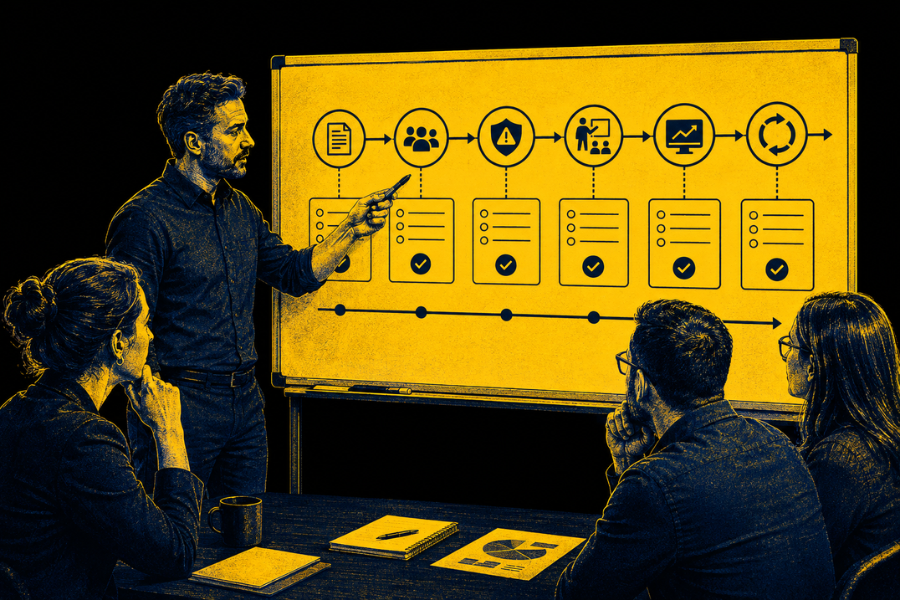
A credible AI policy needs to address several distinct areas. It should define which AI tools are approved for use across the business and specify any tools that are prohibited. It should set clear expectations around data handling, particularly regarding what information can and cannot be shared with external AI platforms. It must also assign accountability, so that someone in the business owns AI-related decisions and is the point of contact if something goes wrong.
Beyond that, it should include a response plan. If a data incident occurs or an AI tool produces harmful or inaccurate output that reaches a client, your team needs to know exactly what to do. A policy without a contingency plan is incomplete.
The Shadow AI Problem You Probably Haven't Solved
Shadow AI is one of the most significant risks facing SMEs right now, and most business owners underestimate it. Shadow AI refers to the use of AI tools by employees without any formal approval, oversight or awareness from the business. Your team is almost certainly doing this already. A recent BBC report highlighted that employees routinely use consumer AI tools at work to save time, often inputting company data, client information and commercially sensitive material without a second thought.
This is not a criticism of those employees. They are trying to do their jobs more efficiently, which is exactly what you want. The problem is that without a clear AI policy in place, there is no structure around what is acceptable and what creates risk.
Shadow AI thrives in the absence of guidance. The solution is not to ban AI use across the board, that approach simply drives the behaviour further underground. The solution is to create a transparent, practical framework that tells people what they can use, how to use it safely and where to draw the line.
How Shadow AI Connects to Data and Privacy Risk
When an employee pastes a client contract into a public AI chatbot to summarise it, that data does not necessarily stay private. Many consumer-grade AI tools use inputs to improve their models unless users actively opt out. Under UK GDPR, your business may be processing personal data through a third-party platform without a lawful basis, a data processing agreement or any record of that transfer.
The information commissioner's office has made clear that AI-related data breaches fall within the same obligations as any other data incident. Ignorance of how a tool works is not a defence. This is one of the most compelling commercial reasons to treat AI compliance as a priority, not an afterthought.
.png)
You Need a Plan for When It Goes Wrong
No AI system is infallible. Tools hallucinate. Outputs get misused. Vendors change their terms of service overnight. Any business deploying AI without a contingency plan is operating on the assumption that nothing will ever go wrong. That is a significant commercial risk.
Your AI policy should include, at minimum, a clear incident response process. Who gets notified if an AI tool produces harmful output? Who owns the decision to suspend use of a particular platform? How do you communicate with affected clients if their data has been exposed? These questions are far easier to answer in a calm policy document than in the middle of a real incident.
This is not about fear. It is about resilience. Businesses that handle incidents well – because they planned ahead – protect their reputation far more effectively than those scrambling to respond without a framework.
Turning Policy into Practical AI Adoption
A well-constructed AI policy does not slow AI adoption. It accelerates it, because people feel confident in what they are allowed to do. Teams that understand the boundaries are more likely to explore AI tools productively within them. That is where the real productivity gains sit.
The starting point for many SMEs is understanding where they stand. An AI readiness assessment identifies the gaps in current AI use and governance before they become problems. From there, an AI workshop can surface the specific operational risks in your business and help you build a policy framework grounded in how your team actually works, rather than a generic template lifted from the internet.
Jon Rew, Managing Director of Scimitar Sports, described the value of starting with a structured assessment: 'We learned a lot from the AI Readiness Assessment, which is surprising as it didn't take long to complete. The report highlighted things that were likely costing us money.' That is the kind of insight that informs a genuinely useful AI policy, not a theoretical one.
An AI roadmap then connects your governance framework to a practical plan for implementation, ensuring that as your AI use grows, your controls grow with it. For teams that need to understand the tools they are using, AI training builds the knowledge that makes policy stick in practice.
Frequently Asked Questions
Does my small business really need an AI policy?
Yes. If any member of your team uses AI tools – including free consumer tools like ChatGPT – your business already has AI activity that carries risk. A policy does not need to be complex, but it does need to exist.
What is shadow AI and why is it a risk?
Shadow AI refers to AI tools used by employees without the knowledge or approval of the business. The risk is that sensitive data, including client information and financial records, can be processed by external platforms without proper controls or data agreements in place.
Does an AI policy need to cover GDPR?
Yes. Any AI tool that processes personal data triggers UK GDPR obligations. Your policy needs to specify which tools are approved for handling personal data, what data can be shared and what agreements are in place with those tool providers.
How often should an AI policy be reviewed?
The AI landscape moves quickly. A practical rule is to review your policy at least every six months, or immediately following any significant change in the tools your team uses or the regulatory environment. – If your business does not yet have an AI policy in place, now is the right time to act. The risks around data, privacy and shadow AI are real and they are growing as AI adoption accelerates. Explore our AI consulting services to find out how we help SMEs build practical, commercially grounded AI governance. Start with our free AI readiness assessment to understand exactly where your business stands today.
.png)
.png)
%20(1).png)