How to Use AI in Your Business Without Wasting Budget

The best way to learn how to use AI in your business is to start with one repetitive task that costs your team real time, then build from there. In our experience, businesses that start with the tool rather than the problem end up with subscriptions nobody opens.
Most SME owners know they should be doing something with AI. Far fewer know where to start.
The gap shows in the data. The Office for National Statistics found that over half of employees (55%) report using AI for work or education, yet only 11% of businesses with 10 or more employees said more than half their workforce had received AI-related training.
What AI can do for your business
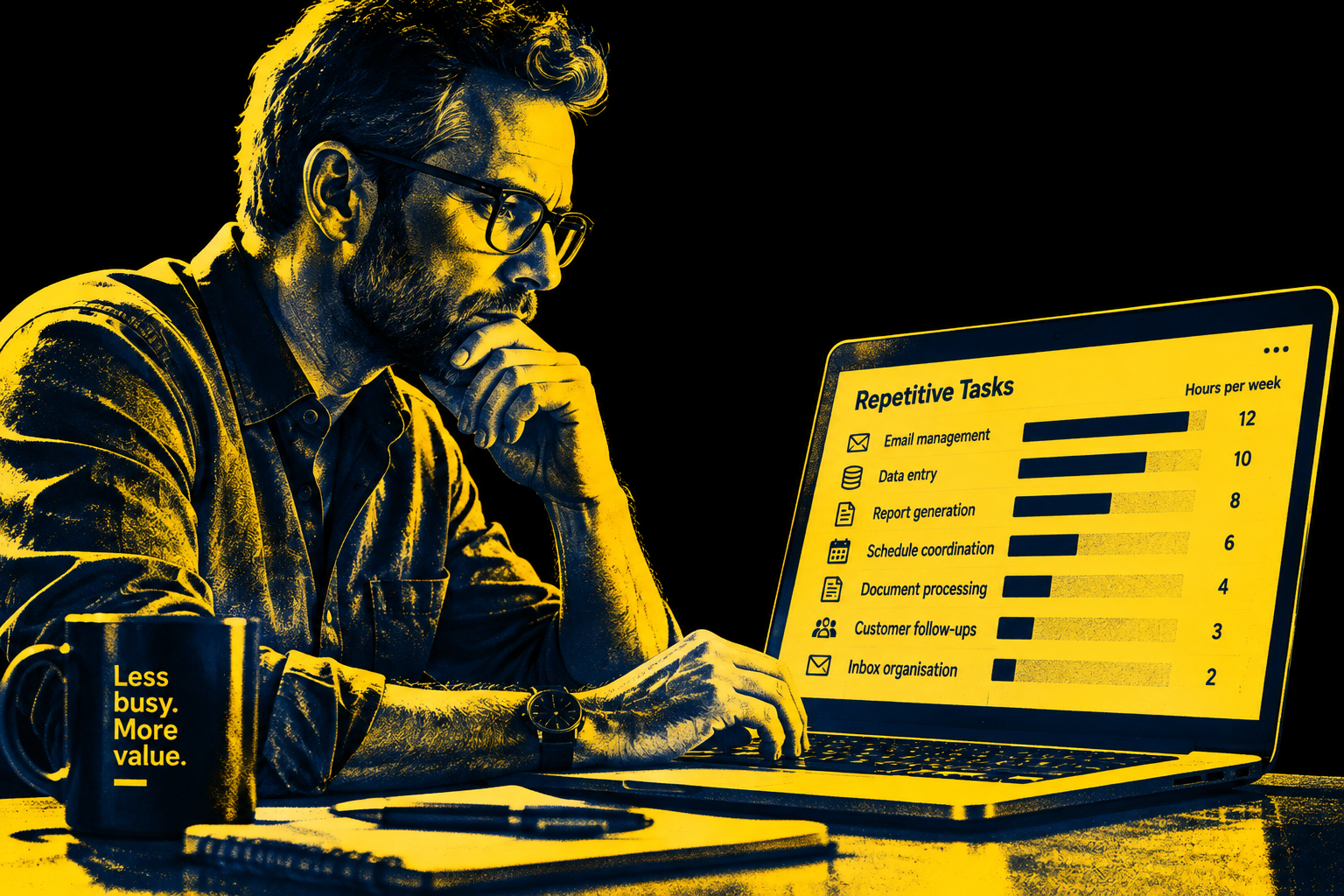
In practical terms, AI speeds up repetitive work: drafting communications, sorting data, summarising documents, answering routine customer questions and spotting patterns in operational data that would take a person hours to find.
For SMEs, the biggest gains usually come from tasks that eat time without adding value. Think about the hours your team spend formatting reports, copying data between systems, chasing information or writing the same kind of email every week. In our experience, these are the areas where AI frees people to focus on work that moves the business forward.
Treat AI as a business question before a technology one.
How to use AI on one task first
In our experience, the businesses that get most from AI begin with one or two specific, repetitive tasks. The time saving shows quickly, confidence grows and the next opportunity becomes clearer. Quote follow-ups, meeting notes and weekly reporting are common starting points in the businesses we work with.
An AI readiness assessment is a useful first step. It takes two to three minutes and gives you a readiness score and a personalised report before you spend anything on tools.
How to use AI without wasting your budget
Using AI well is largely a question of sequence. In our experience, the companies that waste money on AI buy tools before they understand the problem. A platform nobody uses or that automates a process nobody needed automating costs more than it returns.
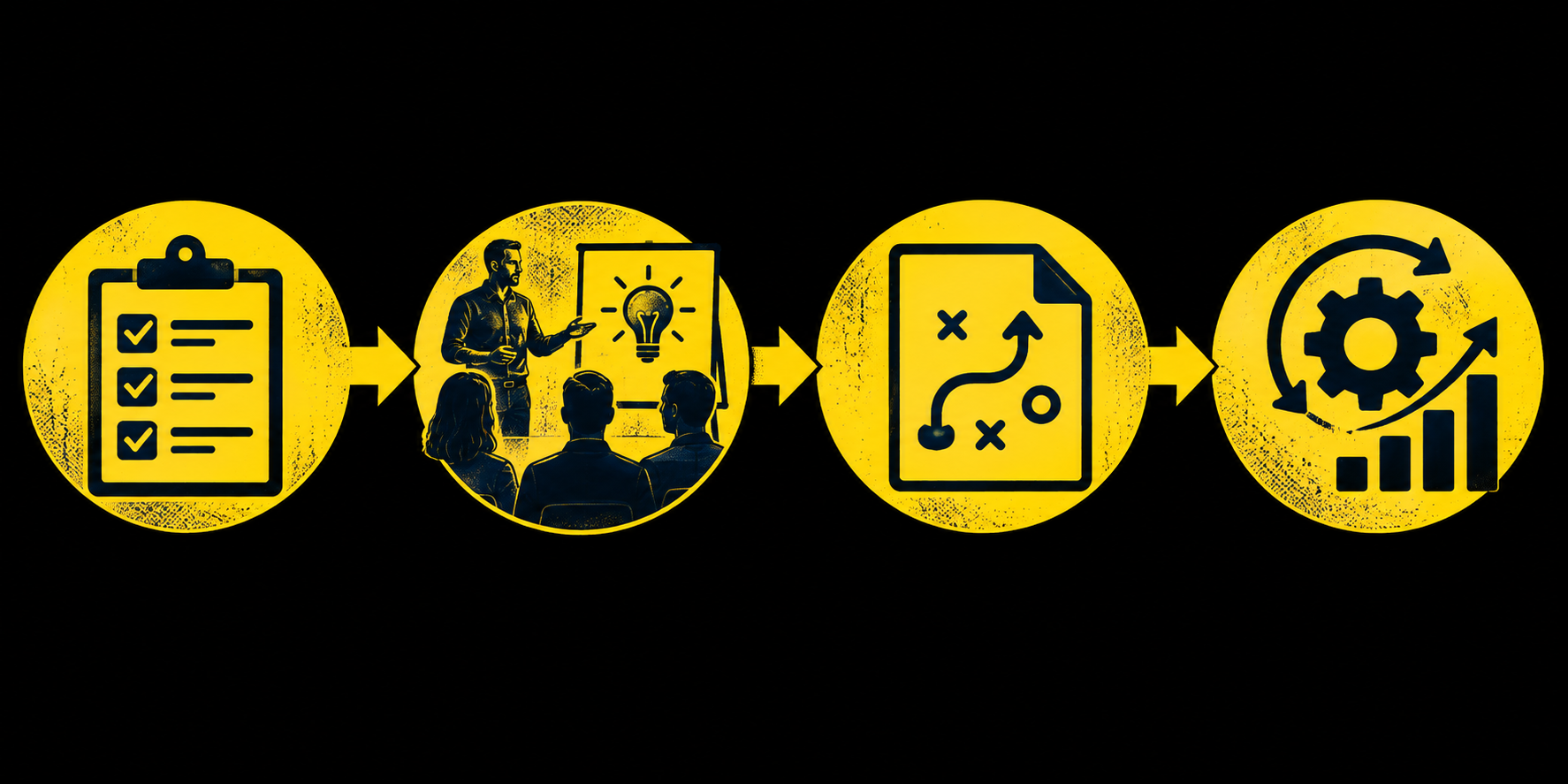
A structured approach keeps costs in proportion to value: diagnose first, plan second and implement in phases. An AI workshop brings leadership, operations and finance together for half a day to a full day to find the right starting point.
Why not just give everyone ChatGPT?
Free tools help people experiment. Without agreed tasks, rules and training, though, use stays scattered and nobody can show what it saves. In our view, that explains the ONS gap between how many employees use AI and how few businesses have trained their workforce.
Common mistakes SMEs make with AI adoption
Buying a tool because a competitor mentioned it is one of the quickest ways to waste budget. So is asking a junior team member to 'sort out AI' without a framework or a commercial objective. Both leave you with an unused subscription and a sceptical team.
The other trap is expecting AI to fix a broken process. Applied to an unclear workflow, AI simply speeds up the confusion. Process clarity must come first.
Set simple rules before you scale
Before AI touches customer or employee data, agree what staff can and cannot share with these tools. With 55% of employees already reporting AI use for work or education, in our view that conversation is overdue. A clear AI policy for SMEs covers the basics.
As use grows, our AI compliance support helps you keep pace with new regulations and risks.
Building an AI strategy that fits your business
For most SMEs, an AI strategy comes down to knowing which tasks cost the most time, which of those AI can handle reliably and how to phase the rollout so disruption stays low.
An AI roadmap does exactly this. It shows where to start, what each stage costs, the risks involved and the expected return, which gives leadership a clear commercial decision.
Jon Rew, Managing Director of Scimitar Sports, followed that sequence. 'We learned a lot from the AI Readiness Assessment,' he said. His team then tackled the issues it raised in an AI Workshop and moved on to a phased AI Roadmap.
As independent advisers who do not sell software, we use LUMA and our own Rose, Thorn, Bud framework to find where AI will pay back first.
Does your team need training to use AI?
Yes, although the technical barrier is low for most tools. The bigger challenge is knowing when to trust AI, how to review its output critically and how to build it into existing workflows without creating new problems.
Our AI training runs role-specific sessions around your own tools and processes. In our experience, teams that understand the limits of AI get far more from it than teams that treat every output as finished work.
What to expect from AI in your first six months
Set realistic expectations. AI will not fix every operational challenge in a single quarter. In our experience, well-chosen tasks can show time savings within weeks.
Our AI implementation support turns the plan into working tools and workflows. After that, our AI optimisation and support service keeps those tools tuned as your needs change.
For examples of what this looks like in practice, read our piece on how SMEs are scaling with AI automation without adding headcount.
Frequently asked questions
Do you need technical knowledge to start using AI?
No. Most practical AI tools suit non-technical users. The more important skill is knowing which business problem you want to solve.
How long does it take to see results from AI?
It depends on the task. In our experience, a well-chosen, repetitive task can show time savings within weeks, while wider changes take longer.
Is AI only relevant for large businesses?
No. In our view, some of the biggest gains come from automating small, repetitive tasks, whatever the size of the business. The clarity of the problem matters more than the scale of the operation.
How can you tell if you are ready for AI?
Our free AI readiness assessment takes two to three minutes and shows where AI could make a commercial difference to your operations.
Find your starting point
Knowing how to use AI starts with knowing where you lose time and money. Take our free AI Readiness Assessment: it takes two to three minutes, carries no obligation and gives you a readiness score with a personalised report.