Digital Transformation Strategies: Fix the Process First

Digital transformation strategies are plans for changing the way you work with technology so you get results you can measure. They decide whether new software earns its keep or becomes another subscription nobody opens.
If your team already pay for several AI tools and nobody can say what those tools save, this article is for you. Our view is simple: fix the process first, then choose the technology.
The Office for National Statistics report that self-reported AI use among UK businesses with 10 or more employees has climbed from around 12% to around 35% since late 2023. The same July 2026 release describes that adoption as 'relatively shallow', with the average adopting business using only around 1.6 AI technologies.
Use also varies widely by sector, from 58% in information and communication to 13% in construction, according to the same ONS release. Plenty of firms have started. Far fewer have a plan.
What are digital transformation strategies?
A strategy sets out which processes change, which tools support them, what the change costs and how you will judge the return. Buying software is a purchase, while redesigning how work flows and then choosing technology to support that design is a strategy.
How digital transformation strategies differ from IT projects
An IT project has a start date, an end date and a technical deliverable. Digital transformation strategies run longer and answer to commercial goals: fewer manual hours, faster decisions, lower error rates and room to grow without hiring at the same pace.
Why so many transformations fall short
Research from McKinsey found that only 16 percent of respondents said their organisations' digital transformations had improved performance and equipped them to sustain the change over the long term. That survey dates from 2018, yet the pattern it describes still appears in the SMEs we meet.
In our experience the technology is rarely the cause. Businesses often buy tools before mapping their processes or automate a broken workflow and repeat the same mistakes faster. Staff who receive a login with no training soon stop using it.
Size works in your favour, the same McKinsey research found that respondents at organisations with fewer than 100 employees were 2.7 times more likely to report a successful transformation than those at organisations with more than 50,000. We put that down to shorter decision chains in smaller teams.
Is a digital transformation strategy overkill for a small business?
This is the objection we hear most. A plan feels like a luxury when the team are already stretched, so trying a tool feels quicker.
The plan should match the size of the business. For many SMEs it starts with one process and an AI workshop lasting half a day to a full day. In our view that is a small price next to the cost of a rollout nobody uses.
Where AI fits in a modern transformation plan
AI has changed the scope of what an SME can automate. Tasks that once needed a developer, such as reading documents, drafting replies or reconciling records, now sit within reach of low-code platforms and off-the-shelf models.
That brings a new risk. In our experience, the broad but shallow adoption the ONS describe often looks like several teams trialling separate tools with no shared plan. We treat AI as one strand of the wider strategy, with the same discipline around process, people and governance as everything else.
Building digital transformation strategies that deliver
Start with the commercial problem
Every strong plan begins with a cost, time or growth problem. Hours lost to repetitive admin, errors that reach customers and processes that buckle as headcount grows all make good starting points. Our workshops bring leadership, operations and finance into one room to find these pressure points before anyone discusses software.
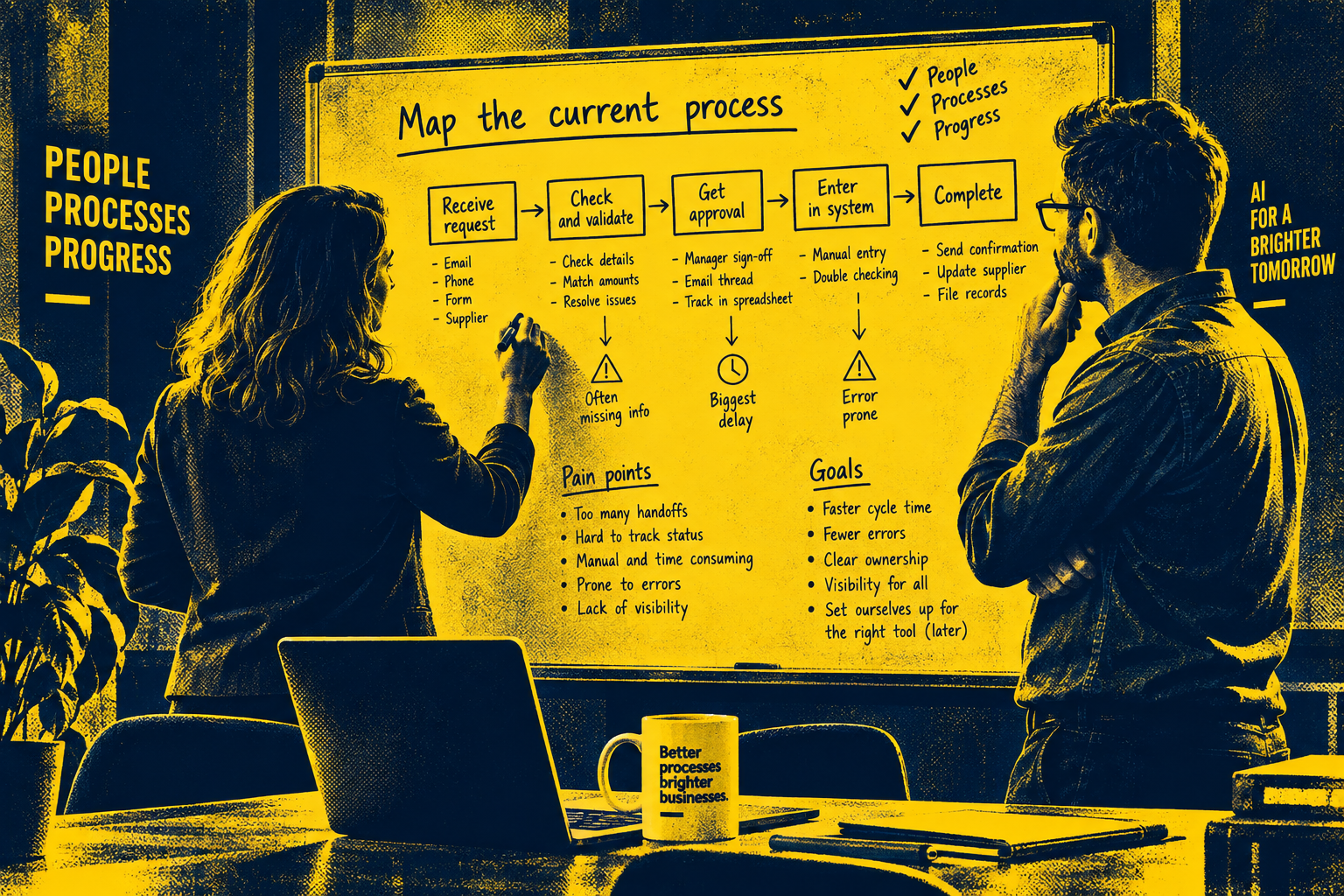
Map the process before you choose the tool
Document how the work happens today, including the workarounds nobody mentions in meetings. Once the process is clear, the right tool usually becomes obvious. In contrast, choosing the tool first tends to bend the business around the software.
Build a phased roadmap
Once you know where the problems sit, a good plan shows where to start, what each stage costs, the risks involved and the expected return. Our AI roadmap service delivers exactly this and prioritises low-risk opportunities so early wins fund the next phase.
Bring your people with you
Adoption depends on confidence. Practical, role-specific AI training turns a new system from a threat into a time saver. Refresher sessions then keep teams current as tools change.
Measure what changes
Agree the numbers before the work starts, whether that means hours saved, error rates, response times or revenue per head. Take a baseline and review it at the end of every phase. Without that baseline, nobody can prove the investment paid back.
Put governance in place from day one
Every new AI tool touches your data. A clear AI policy for SMEs and proper AI compliance support protect the business from legal and operational risk as adoption scales.
How one agency cut payroll admin to under an hour
One of our clients, a fast-growing service agency, ran payroll through a manual, spreadsheet-driven process. According to our payroll automation case study, reconciling time, attendance and employee records took more than 50 hours a month. The error rate also stayed stubbornly high.
We mapped the existing process first. Only then did we design a low-code automation on n8n with data validation, rule-based deduction logic and automated salary slip generation.
The same payroll automation case study records monthly effort falling from over 50 hours to under one hour, with errors down to near zero. The system can also scale from 50 to 5,000 employees without extra load.

We are independent advisers. Since we do not sell software, we only recommend tools that fit your business. Our AI consulting services use LUMA and our own Rose, Thorn, Bud framework to find the problems worth solving first.
Frequently asked questions
What should a digital transformation strategy include?
It should include clear business goals, a map of current processes, prioritised opportunities, costs, risks, a training plan and governance. Each element should link back to a measurable commercial outcome.
Where should a small business start with digital transformation?
Start with one process that costs real time or money and is easy to measure. A quick win builds confidence and helps fund the next stage.
Is AI part of digital transformation?
Yes. In our view, AI is now one of the most practical routes for an SME to automate manual work and improve decisions, provided it sits inside a wider plan with proper governance.
Find out where you stand before you plan
Digital transformation strategies succeed when the process comes before the technology. The first step is an honest view of where you stand today. Our free AI Readiness Assessment takes two to three minutes, carries no obligation and gives you a readiness score at the end.