
Microsoft AI Models: What the MAI Release Means for SMEs
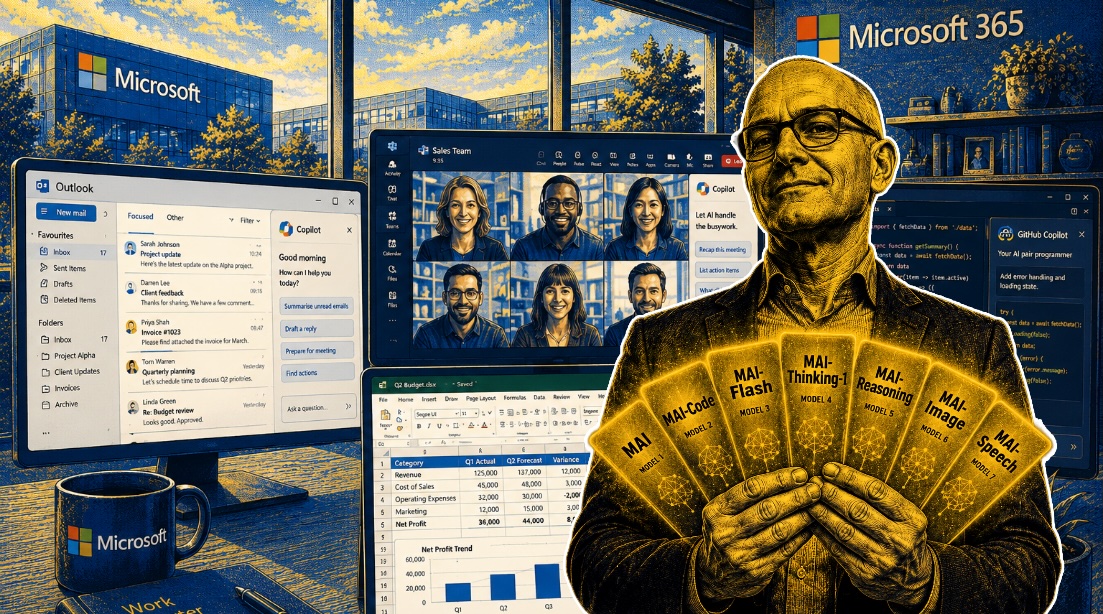
Microsoft AI models took a significant step on 2nd June 2026 when Mustafa Suleyman, CEO of Microsoft AI, announced seven new in-house models at the Build developer conference in San Francisco.
The headline is technical. but the implication for SMEs is strategic.
Microsoft has stopped being primarily a consumer of frontier AI models from OpenAI and Anthropic and has started being a producer of them. For businesses that already run Office, Teams, Outlook, VS Code and GitHub Copilot every day, the AI vendor calculation just got more complicated and considerably more interesting.
What the New Microsoft AI Models Actually Are
The flagship release is MAI-Thinking-1, a reasoning model built on a 35-billion active parameter mixture-of-experts architecture with a 256,000-token context window. According to Microsoft, the model scores 97% on AIME 2025, a widely used measure of advanced reasoning, and 53% on SWE Bench Pro, one of the toughest coding benchmarks in the industry. Independent human raters using the Surge evaluation platform prefer MAI-Thinking-1 over Claude Sonnet 4.6 in blind side-by-side testing. The SWE Bench Pro score places it marginally above Claude Opus 4.6 at 51.9% though below OpenAI’s GPT-5.4 at 59.1%.
Alongside MAI-Thinking-1, the family of new Microsoft AI models includes MAI-Image-2.5 and a Flash variant, MAI-Transcribe-1.5, MAI-Voice-2 with its own Flash variant, and MAI-Code-1-Flash for coding workloads. MAI-Code-1-Flash is already rolling out inside GitHub Copilot and Visual Studio Code. Its model card describes a 137-billion sparse mixture-of-experts design with around 5 billion active parameters per query, which delivers Haiku-class coding performance at meaningfully lower cost. MAI-Image-2.5 currently sits at number three on the Arena.AI text-to-image leaderboard, behind Google’s Nano Banana 2.
The most strategically important detail is what unites them. Every one of the new Microsoft AI models was trained from scratch with no distillation from third-party AI labs and built on commercially licensed data with clean lineage. This positioning is not accidental. Microsoft is selling these models to enterprises specifically on the basis that the training data can be defended in court, which is the exact opposite of how OpenAI and several other AI labs have been positioning themselves recently.
Why Microsoft AI Models Matter for UK SMEs
For most of the AI conversation in 2025, UK SMEs have been picking between three serious vendors: OpenAI through ChatGPT or Microsoft Copilot, Anthropic through Claude, and Google through Gemini. Microsoft was significant as a distribution partner but not as a model producer. That has now changed.
The strategic implication for SMEs is not really about the benchmark scores. The strategic implication is about distribution. Microsoft AI models are not being delivered into a vacuum. They are being delivered into Office, Teams, Outlook, GitHub, VS Code and Copilot, which means they are being delivered directly into the daily workflow of essentially every SME that runs a Microsoft estate. The friction between ‘AI capability exists in the market’ and ‘AI capability runs in your business’ just dropped substantially for the businesses Microsoft already serves.
The X commentator who wrote about this release nailed the underlying insight in one line: ‘The hard part was never training a good model. The hard part is being the room everyone already works in. Microsoft owns the room.’ This is the genuine commercial story. Foundation model quality has been converging across the major labs for the last twelve months. What differs sharply now is distribution, ecosystem integration and how easily a UK SME can put a model to work without changing how its team operates day-to-day.
The Cost Question: Is the 10x Claim Credible for Microsoft AI Models?
Suleyman’s most aggressive claim was that custom-tuned Microsoft AI models delivered a 10x cost reduction versus OpenAI’s GPT-5.5 in a McKinsey trial, while outperforming on quality. The claim invites scrutiny. It comes from a single tuned use case at one client. The cost figure assumes the McKinsey-specific tuning generalises to other workloads, which is not yet evidence. The benchmark comparison is Microsoft’s own framing, not independent.
That said, the directional argument is credible even if the specific figure overstates the case. Microsoft designs its silicon (the Maia 200 accelerator), runs its own data centres, controls the entire inference stack and has every incentive to undercut OpenAI on enterprise pricing as part of its strategy to reduce dependence. A 2x or 3x cost advantage for tuned workloads inside Microsoft’s own ecosystem looks plausible based on what is publicly verifiable. A 10x advantage as a general rule across customer scenarios does not.
For UK SMEs, the practical takeaway is this. The era when ‘frontier AI’ meant ‘the most expensive option’ is ending. Microsoft AI models are being positioned as the cost-efficient option for enterprises that want quality close to the top of the market without paying frontier prices. If even half of Microsoft’s cost claims hold up under independent testing through the second half of 2026, the AI vendor selection calculation changes fundamentally for businesses with serious AI workloads.
Microsoft AI Models and the Multi-Vendor Question
The release sharpens a question we have been threading through our recent commentary. As we covered in our AI as a Utility blog, the long-term vendor concentration risk in AI is significant. Building deeply on a single vendor means accepting structural switching costs, pricing exposure and capability dependency that compound over time. Multi-vendor strategy is increasingly the resilient default for SMEs.
Microsoft AI models complicate that calculation in interesting ways. As we explored in our Copilot vs ChatGPT for business coverage, the practical reality for most SMEs has been that Microsoft Copilot delivered AI capability through tools the business already uses, while OpenAI and Anthropic delivered AI capability through dedicated interfaces the team has to learn separately. The distribution advantage was always significant. The new Microsoft AI models extend that advantage materially.
The honest answer for SMEs is that Microsoft is now a serious model producer in its own right, not just a distribution partner for OpenAI. This raises the bar on what a credible multi-vendor strategy looks like in mid-2026. For most SMEs the practical configuration is now likely to involve Microsoft AI models for in-workflow tasks that benefit from Office and Teams integration, plus Claude or ChatGPT for dedicated AI work where the interface and capability matter more than the ecosystem fit. As we covered in our Claude vs ChatGPT for business piece, picking the right tool for the right task remains more useful than picking one vendor and trying to make it do everything.
What Microsoft AI Models Change in Your AI Strategy
The release fits cleanly into the broader AI Confidence Journey we use as the structural spine for SME AI adoption. The framework runs from Confused to Curious to Committed to Capable to Confident, with each stage carrying its own characteristic question and its own next step.
At the Confused stage, the new Microsoft AI models are not yet your concern. The right work is establishing where your business stands on the journey through a free AI Readiness Assessment, which gives you structured clarity on what AI capability your business actually needs before you commit budget or time to any specific vendor.
At the Curious stage, the new Microsoft AI models become relevant because they sharpen the comparative question. If your team is exploring what AI could do for your business, the answer is different in mid-2026 than it was in mid-2025. An AI Workshop is now the right next step for businesses that want to understand how the new vendor landscape (Microsoft, OpenAI, Anthropic, Google) maps to the specific workflows in your business.
At the Committed stage, your AI Roadmap should now reflect the operational realities of the multi-vendor world. Microsoft AI models being available inside your existing Office and Teams estate means the implementation path looks different from twelve months ago.
At the Capable and Confident stages, the optimisation work becomes interesting. Businesses operating multi-vendor AI strategies need to think carefully about which models handle which workloads, where data flows, where governance applies and how the team builds confidence using more than one set of tools. As we cover in our EU AI Act blog, the regulatory environment makes vendor selection a governance question as well as a commercial one. Microsoft’s emphasis on clean data lineage for its new models is not accidental, it is a deliberate response to the compliance environment UK SMEs operate in.
Microsoft AI Models: What UK SME Leaders Should Take From It
The new Microsoft AI models are commercial news with strategic implications for every SME thinking seriously about AI. Three takeaways matter for SME leaders making decisions in the second half of 2026.
The first is that the vendor landscape has materially shifted. Microsoft is now a credible fourth foundation model producer alongside OpenAI, Anthropic and Google. The vendor selection question is not ‘OpenAI or Anthropic’ anymore, it is genuinely four-way for the businesses with sophisticated AI needs.
The second is that distribution increasingly matters more than weights. Microsoft AI models are being delivered through the tools SMEs already use, which dramatically reduces the friction between AI capability existing in the market and AI capability running inside your business. The businesses that already run Microsoft estates have a meaningfully easier path to deploying frontier-adjacent AI capability than they did six months ago.
The third is that cost is becoming a real variable. The 10x cost reduction claim is aggressive and deserves scrutiny, but the directional argument that Microsoft can undercut OpenAI on enterprise AI pricing is credible. SMEs that have been priced out of serious AI use by frontier-tier API costs may find the calculation looks different in late 2026 than it did in early 2026.
What none of this changes is the underlying advice. The businesses that handle the new vendor landscape well will be the ones that started with strategy, not with tools. Picking Microsoft AI models, Claude, ChatGPT or Gemini before understanding what your business actually needs is putting the cart before the horse. The right starting point is still a structured diagnostic of where your business sits, what AI capability would deliver commercial value and where the highest-priority workflows are.
Complete our free AI Readiness Assessment to understand where your business currently sits on the AI Confidence Journey, what your AI vendor strategy should look like in a market where Microsoft is now a serious model producer and how to position your business for the operational maturity the AI market is now demanding.
.png)
.png)
%20(1).png)