Will You Be Affected by the EU AI Act? The UK SME Diagnostic Guide
Will you be affected by the EU AI Act is the question every UK SME leader should be answering before 2 August 2026, when the substantive provisions of the Act come into force. The honest answer surprises most UK business owners. Yes, you probably are affected. Not because your business is based in the European Union, but because the Act applies extraterritorially, catching UK businesses whose AI systems touch anyone in the EU. The scope is broader than most UK SMEs assume, the exposure is real and the deadline is closer than the calendar makes it look. This piece walks through the diagnostic questions every UK SME leader should ask, the specific business categories the Act catches most aggressively and the structured path to confirming whether your business is in scope.
Will You Be Affected by the EU AI Act? The Structural Answer
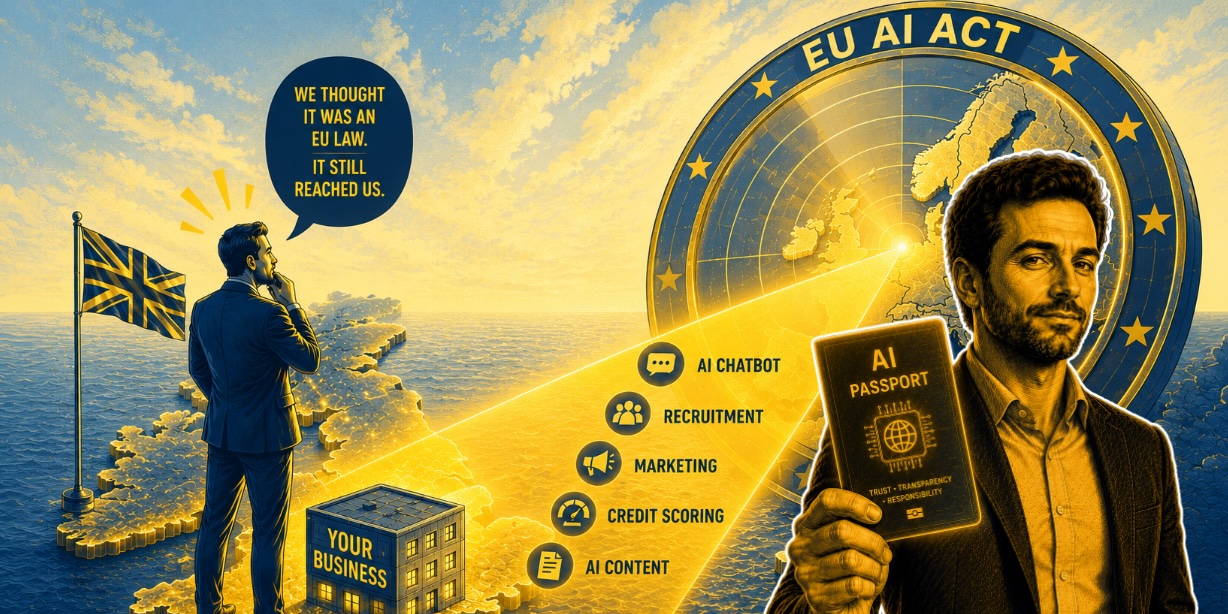
The first thing UK SME leaders need to understand about whether they will be affected by the EU AI Act is that Brexit did not put UK businesses outside the Act’s reach. This is the single most expensive misconception in the UK SME landscape right now. The Act applies to providers, deployers, importers and distributors of AI systems, and the extraterritorial provisions catch any business whose AI systems produce outputs used inside the European Union, regardless of where the business is headquartered.
The structural test is straightforward. If your AI systems are used by anyone in the European Union or produce outputs that are used inside the European Union, the Act applies to your business. The test does not depend on where your business is registered, where your team is located, where your servers are hosted or which currency you invoice in. It depends on whether the AI system produces effects that reach EU territory.
For UK SMEs, this means the practical answer to ‘will you be affected by the EU AI Act’ is almost certainly yes if any of the following are true. You have EU customers who interact with AI systems your business is using (customer service chatbots, personalisation engines, recommendation systems). You have EU-based employees whose work is affected by AI systems your business uses (performance monitoring, task allocation, HR analytics). You have EU-based suppliers whose data flows through AI systems in your operations. You export goods or services to EU markets where AI-generated content, decisions or classifications form part of the offering. You process EU personal data through AI systems for any commercial purpose.
The scope is deliberately broad. The EU legislators wrote about the Act to prevent a regulatory arbitrage where non-EU businesses could serve EU markets while operating outside the safeguards the Act creates. As we covered in our foundational What is the EU AI Act blog, this is the same GDPR pattern that has already shaped the last eight years of data protection compliance globally.
Will You Be Affected by the EU AI Act? The UK SME Business Categories Most Exposed
Beyond the general extraterritorial test, certain UK SME business categories face particularly high EU AI Act exposure because their standard operations involve AI systems the Act classifies as high risk. If your business falls into any of these categories, the diagnostic answer is not just ‘affected’, it is ‘affected in the high-obligation tier’.
Recruitment and staffing businesses. Any UK SME that uses AI for CV screening, candidate matching, interview analysis or workforce assessment falls into the high-risk tier we cover in our EU AI Act Risk Tiers Explained blog. If you serve any EU-based candidates or hiring companies, you are in scope with substantial compliance obligations.
Financial services and consumer credit businesses. AI systems used for creditworthiness assessment, insurance pricing based on individual risk profiles or eligibility determination for financial services fall into the high-risk tier. UK SMEs providing financial products or services to EU customers are directly in scope.
Marketing and content businesses. Businesses that generate content using AI (marketing agencies, content platforms, publishers) face limited risk of tier transparency obligations under the Act. Content produced for or distributed to EU audiences must be marked as AI-generated in machine-readable format. This is the tier most UK marketing SMEs underestimate.
Customer service businesses. Any business running AI-powered chatbots, virtual assistants or automated customer service that interacts with EU customers falls into the limited risk tier. The transparency obligations are lighter than high risk but still substantive, and the businesses that have deployed chatbots without disclosure are already technically non-compliant.
Healthcare, education and public sector suppliers. UK SMEs supplying AI-enabled products or services to healthcare, education or public sector clients in the EU face direct high risk tier obligations because the client-facing applications are themselves regulated at high risk levels. The Act flows through to the suppliers who provide the AI capability.
Data analytics and business intelligence businesses. UK SMEs providing AI-powered analytics services to EU clients face exposure across multiple tiers depending on what the analytics are used for. Employment-related analytics run into high risk obligations. General business analytics run into limited risk obligations. Consumer-facing analytics may run into either.
The pattern is that most UK SMEs will find themselves affected across at least one of these categories, and many will find themselves affected across several. The classification work identifies which tier applies where, which is the leverage point that determines whether the compliance burden is proportionate or overwhelming.
Will You Be Affected by the EU AI Act? The Five Diagnostic Questions
The following five diagnostic questions produce the initial UK SME EU AI Act exposure position. Each question is designed to surface the specific business realities that determine scope and obligation level.
Question one: Do any of your AI systems produce outputs that reach anyone in the European Union? This is the primary extraterritorial test. Customer service chatbots serving EU customers count. Marketing tools generating content distributed to EU audiences count. HR systems making decisions about EU-based employees count. Analytics dashboards used by EU-based colleagues count. The answer for most UK SMEs is yes to at least one category.
Question two: Do you use AI in any of the eight Annex III high-risk areas? Recruitment, employee performance monitoring, credit scoring, insurance risk assessment, essential services eligibility determination, education, critical infrastructure and law enforcement. Even a single AI system in one of these areas triggers high risk tier obligations for that specific system.
Question three: Do you deploy AI systems that interact directly with individuals? Chatbots, virtual assistants, customer service bots, AI-powered helpdesks, marketing automation with personalisation. If any of these interact with EU-based individuals, the limited risk tier transparency obligations apply.
Question four: Do you generate or manipulate content using AI in ways that could be presented as human-produced? Marketing content, sales collateral, translated materials, summaries, reports. If this content reaches EU audiences without disclosure, the limited risk tier obligations apply. Most UK marketing SMEs answer yes to this and do not currently comply.
Question five: Do you have any visibility of the shadow AI activity across your teams? Employees using ChatGPT, Claude, Copilot Free tier or Gemini on personal accounts to conduct business work create AI use that is invisible to leadership but potentially in scope under the Act. Businesses that cannot answer this question definitively cannot classify their AI use accurately.
If you answer yes to any of the first four questions, or cannot answer the fifth, you are affected by the EU AI Act. The scope of your obligations depends on which tiers apply, which requires the structured classification work our AI Act Readiness Workshop produces.
Will You Be Affected by the EU AI Act? The Consequences of Getting the Answer Wrong
The consequences of misjudging your EU AI Act exposure fall into three categories, and each of them has real commercial weight for UK SMEs approaching the 2 August 2026 deadline.
The first consequence is direct regulatory penalty exposure. The Act provides for penalties up to €35 million or 7% of global annual turnover for unacceptable risk violations, €15 million or 3% for most other obligations and €7.5 million or 1% for providing incorrect or misleading information to authorities. For UK SMEs, the percentages matter more than the absolute figures because 7% of global annual turnover is a business-ending penalty for most companies, not a line item to absorb.
The second consequence is customer and commercial exposure. Business customers who are themselves subject to the Act will increasingly require compliance evidence from their suppliers. UK SMEs that cannot produce this evidence will find themselves losing tenders, contracts and business relationships to competitors who can. This is the pattern that played out with GDPR after 2018, where non-compliant businesses lost business to compliant ones long before they faced any regulatory penalty directly.
The third consequence is investor and acquirer exposure. UK SMEs planning to raise investment, sell the business or complete any material corporate transaction over the next 24 months will face compliance due diligence that includes the EU AI Act position. Businesses that cannot demonstrate structured compliance will find valuations depressed and deals delayed or renegotiated. As we cover our forthcoming EU AI Act Business Impact blog, this is a growing feature of the M&A market through 2026.
The businesses that treat ‘will you be affected by the EU AI Act’ as a serious diagnostic question, and produce the structured answer, avoid all three consequences. The businesses that assume Brexit puts them outside the rules face all three simultaneously.
Will You Be Affected by the EU AI Act? The Structured Response
The right response to concluding you are probably affected by the EU AI Act is structured, not reactive. UK SMEs that make the compliance work into a panic project frequently produce documentation that fails on inspection, invest significantly in the wrong areas and generate the appearance of compliance without the substance of it. The pattern that produces defensible compliance positions is the same structured pathway we walk through in our AI Confidence Journey framework.
The starting point is the free AI Readiness Assessment, which surfaces the initial exposure position and identifies whether structured workshop work is required. For businesses that need the deeper work, the AI Act Readiness Workshop we run produces the documented inventory, tier classification and gap analysis in a 10 to 15 working day timebox. The workshop output either stands alone as the compliance position for businesses with limited exposure or defines the further AI Implementation work needed to close substantive gaps.
The workshop is delivered by Dave Maddock and Alasdair Munn, with Nick Baxter as commercial contact. It is priced at £2,499 for attendees of our July face-to-face event or subsequent webinar, and £2,999 standard. The workshop pathway is deliberately structured to produce defensible compliance evidence rather than performative compliance activity, which is the difference that matters when a regulator or business customer challenges the position.
Will You Be Affected by the EU AI Act? What UK SME Leaders Should Take From It
Will you be affected by the EU AI Act is a question every UK SME leader needs to answer with rigour rather than assumption. The honest answer is that most UK SMEs are affected, in ways they have not yet fully mapped, with obligations concentrated in specific high-exposure business categories. The Act catches significantly more UK businesses than the Brexit assumption suggests, and the classification of that exposure into the four risk tiers determines whether the compliance work is proportionate or overwhelming.
Three practical takeaways matter most for UK SME leaders. The first is that the extraterritorial scope of the Act catches UK businesses whose AI systems touch anyone in the EU, regardless of where the business is based. The second is that certain business categories (recruitment, financial services, marketing, customer service) face particularly high exposure because their standard operations sit in the high risk or limited risk tiers. The third is that classification cannot be completed without a comprehensive inventory of AI use, including the shadow AI activity that most leadership teams cannot currently see.
The businesses that will be in the strongest position on 2 August 2026 are the ones that have completed the classification work, documented the position and built the defensible evidence pack before the deadline arrives. The businesses that arrive at the deadline without this work face regulatory exposure, commercial exposure and investor exposure simultaneously.
Book the AI Act Readiness Workshop at £2,499 for attendees of our July face-to-face event or webinar, or contact us directly to book at £2,999 standard. Alternatively, complete our free AI Readiness Assessment to establish the starting position.
%20(1).png)
%20(1).png)
%20(1).png)