Elon Musk’s Algorithm: The 5-Step Framework
Elon Musk’s algorithm is a five-step process improvement framework he applied at SpaceX and Tesla to eliminate waste, cut bureaucracy and optimise operations. Documented publicly in Walter Isaacson’s 2023 biography, the framework has become one of the most widely referenced operating methodologies in business.
For SMEs racing to adopt AI and automation, it contains a lesson that could save them from one of the most expensive mistakes in technology adoption. The lesson is hidden in the order of the steps, and specifically in the fact that automation comes last.
The reason this matters now is that most businesses are doing the exact opposite. They are reaching for AI and automation first, bolting it onto processes they have never questioned, and wondering why the returns never materialise. Musk made the same mistake at a cost of millions before he codified the algorithm. SMEs can learn the lesson without paying the same price.
What is Elon Musk’s Algorithm? The Five Steps
The framework consists of five steps that must be executed in strict order. The sequence is not a suggestion, It is the entire point.
Step one: question every requirement. Challenge all assumptions and rules, no matter who set them. Musk insists on attaching a specific person’s name to every requirement rather than a vague department like ‘legal’ or ‘safety’, so you know exactly who to ask when the requirement needs justifying. A requirement that cannot be traced to a named person who can currently defend it is a requirement worth challenging.
Step two: delete parts or processes. Strip away anything that is not strictly necessary. Musk offers a precise calibration for this. If you do not end up having to put back at least 10% of what you cut, you have not deleted enough. The discipline inverts conventional thinking. Most businesses delete too cautiously. The algorithm demands you delete aggressively enough to occasionally overshoot.
Step three: simplify and optimise. Improve only what remains after deletion. This is where Musk delivers his most quoted warning: ‘The most common mistake of a smart engineer is to optimise a thing that should not exist’. Simplifying something that should have been deleted is wasted effort dressed up as productivity.
Step four: accelerate cycle time. Speed up the remaining process, but only after the first three steps are complete. Musk learned this the hard way. ‘In the Tesla factory, I mistakenly spent a lot of time accelerating processes that I later realised should have been deleted.’ Accelerating a process you should have removed just gets you to the wrong outcome faster.
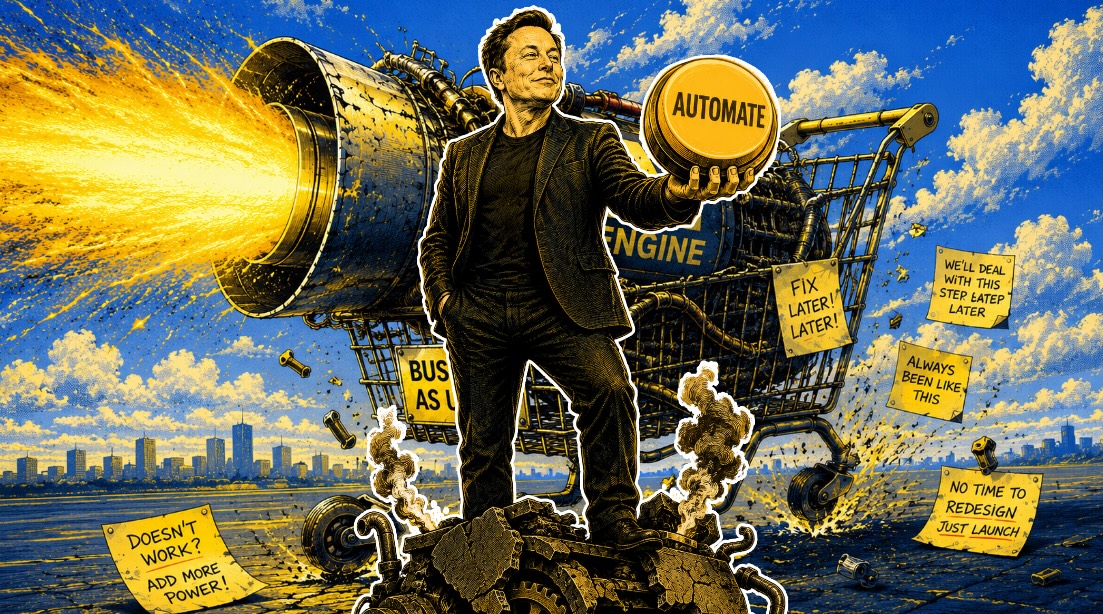
Step five: automate. Automation comes last. Only once requirements have been questioned, unnecessary parts deleted, the remainder simplified and the process accelerated should you let machines take over. Musk’s most expensive lesson lives here. The over-automation of the Tesla Model 3 production line caused significant delays, and at one point he burned around $2 million on robotic equipment before discovering that the parts those robots installed should not have existed at all.
Elon Musk’s Algorithm: Why the Order Is Everything
The power of Elon Musk’s algorithm lies entirely in the sequence. Each step justifies the existence of what survives before the next step gets to work on it. Question before you delete. Delete before you simplify. Simplify before you accelerate. Accelerate before you automate.
Run the steps out of order and you amplify waste rather than eliminating it. Automating before deleting means you build machines to perform work that should not happen. Accelerating before simplifying means you speed up unnecessary complexity. Optimising before questioning means you polish requirements that should have been challenged. This is why Musk describes becoming ‘a broken record on the algorithm’, repeating the sequence to what he called an annoying degree, because the discipline of the order is what separates genuine improvement from expensive activity.
The single most important insight for any business is the position of automation. It is last for a reason. Automation multiplies whatever it touches. Applied to an efficient process it multiplies efficiency. Applied to a flawed process it multiplies the flaws.
What Elon Musk’s Algorithm Means for UK SMEs Adopting AI
Here is where the framework becomes urgent for UK SMEs in 2026. The entire AI and automation gold rush is encouraging businesses to do exactly what Musk warns against. Buy the AI tool first. Automate the process now. Worry about whether the process made sense later.
This is the single most expensive mistake in AI adoption and we have covered it from several angles. As we explained in our AI workflow redesign blog, bolting AI onto a broken process just gives you a faster broken process. As we covered in our why AI pilots fail blog, McKinsey found that 79% of organisations are experimenting with AI yet fewer than 10% have scaled it, largely because they automated and accelerated before they questioned and deleted. Musk’s algorithm is the engineering principle underneath everything AI Expert advocates. You redesign before you automate. You question before you build.
Translated for a UK SME considering AI, the five steps become a practical sequence. Question every step in the workflow you are tempted to automate, and attach a name to every requirement so you know who can justify it. Delete the steps that exist only out of habit. Simplify what remains. Accelerate the streamlined process. Only then, with a questioned, deleted, simplified and accelerated process in front of you, should you apply AI and automation. The result is automation that multiplies efficiency rather than multiplying waste.
The businesses that skip to step five are the ones who spend money on AI tools that deliver marginal returns, then conclude that AI does not work for their business. The technology was never the problem, the sequence was.
Elon Musk’s Algorithm and Your AI Confidence Journey
The algorithm maps almost perfectly onto the journey every business takes from AI confusion to AI capability, which is why it is such a useful framework for SMEs.
Confused businesses have not yet questioned anything. They know they should be using AI but have not examined which of their processes deserve it. The first step is our free AI Readiness Assessment, which begins the questioning process by establishing where the business actually stands.
Curious businesses begin the questioning and deleting in earnest. An AI Workshop uses structured methodology to challenge requirements, map workflows function by function and identify what should be deleted, simplified or kept. This is steps one through three of the algorithm delivered as a structured engagement.
Committed businesses have questioned, deleted and simplified, and are ready to plan the acceleration and automation. An AI Roadmap sequences the work so that automation is applied to processes that have already earned their place rather than to processes that should have been removed.
Capable businesses reach step five properly. AI Implementation and AI Development apply automation to questioned, deleted, simplified and accelerated processes, while AI Training builds the capability to run the new systems. This is automation done in the right order.
Confident businesses treat the algorithm as the ongoing cycle Musk intended rather than a one-time exercise. AI Optimisation and Support keeps questioning, deleting and simplifying as the business evolves, ensuring automation continues to multiply efficiency rather than entrenching yesterday’s processes.
Elon Musk’s Algorithm: Applying It to Your Business
Elon Musk’s algorithm is not a Silicon Valley curiosity. It's a discipline any SME can apply, and it carries the single most important lesson in AI adoption. Automation comes last. Question every requirement, delete aggressively, simplify what remains, accelerate the streamlined process and only then apply AI and automation. Run the steps in that order and your technology investment multiplies efficiency. Run them backwards and you automate waste, which is exactly the mistake Musk made before he learned to follow his own framework.
For SMEs the practical takeaway is that the rush to adopt AI is best resisted until the process underneath has earned the investment. The businesses that question and delete before they automate will extract genuine returns. The businesses that automate first will join the majority who conclude, wrongly, that AI did not work for them, when the real problem was the order in which they applied it.
Complete our free AI Readiness Assessment to begin questioning the right requirements and find out which of your processes are genuinely ready for AI and automation.
%20(1).png)
%20(1).png)
%20(1).png)