
AI Workflow Redesign: The Step Most SMEs Skip
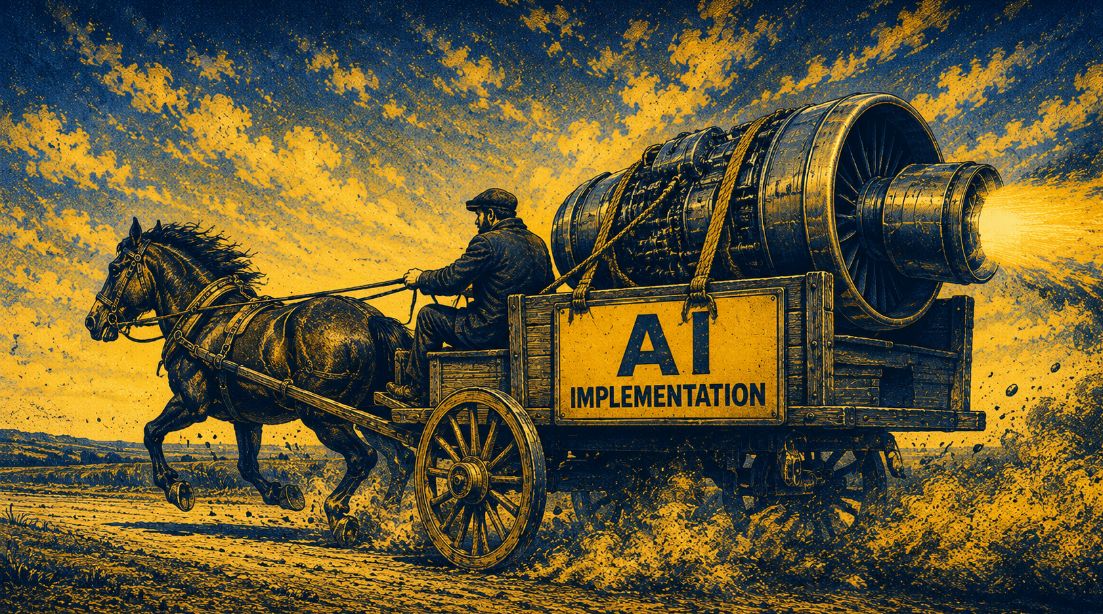
AI workflow redesign is the missing step between businesses that experiment with AI and businesses that extract genuine commercial value from it. McKinsey’s April 2026 research found that 79% of organisations are now experimenting with AI yet fewer than 10% have scaled it into production and only 1% consider themselves AI-mature.
The gap between experimentation and scaling is almost entirely explained by one thing. The businesses that scale have redesigned their workflows around AI. The businesses still in pilot mode have bolted AI onto workflows that have not fundamentally changed.
The distinction matters enormously because bolting AI onto a broken process just gives you a faster broken process. SMEs investing in AI tools without redesigning the workflows those tools sit within are systematically generating the kind of marginal returns that lead McKinsey to describe the current state of enterprise AI as ‘the gen AI paradox’: AI everywhere except on the bottom line.
AI Workflow Redesign in Plain Terms: What It Actually Means
The simplest way to understand AI workflow redesign is through the contrast with what most businesses are doing instead.
Most businesses adopt AI by taking their existing workflow, identifying a single step where AI could help, adding an AI tool to that step and leaving the rest of the process unchanged. A marketing team starts using ChatGPT to draft social posts. A finance team uses AI to summarise reports. A customer service team uses AI to suggest reply templates. The individual steps get faster. The overall process produces marginally better output. The business changes hardly at all.
AI workflow redesign is the opposite approach. You take an entire end-to-end workflow, examine what the work actually involves, what the inputs and outputs are, where the bottlenecks live and what good output looks like. Then you rebuild the workflow from scratch with AI at the centre rather than at the edges. Steps that AI can fully handle get automated. Steps that benefit from AI assistance get redesigned around that assistance. Steps where human judgement is essential get protected and structured to maximise the value of that judgement. The handoffs between AI and humans get explicitly designed rather than implicitly assumed.
The result is a workflow that operates fundamentally differently rather than slightly faster. That difference is what produces the commercial outcomes that scaled AI deployments deliver, which is exactly the difference that explains why fewer than 10% of organisations have made the jump from pilot to production.
AI Workflow Redesign: The Four-Step Process That Actually Works
McKinsey’s prescription for moving from pilot to production reduces to four steps and the methodology applies just as cleanly to SMEs as it does to large enterprises. The execution needs to be proportionate to your business but the principles are identical.
Step one: pick one full workflow rather than a fragment. The most common failure mode in AI adoption is picking individual tasks instead of complete workflows. Drafting an email is a task. Onboarding a new client is a workflow. Generating a report is a task. The full reporting cycle from data collection through to stakeholder communication is a workflow. AI workflow redesign begins with selecting a complete end-to-end process where the redesign will produce measurable commercial outcomes.
Step two: rebuild the workflow with AI at the centre. This is the step that requires structured thinking rather than tool selection. The question is not ‘where can I add an AI tool to this workflow?’ The question is ‘if I were designing this workflow from scratch knowing that current AI tools exist, what would it actually look like?’ These two questions produce dramatically different answers. The first preserves the existing process and improves it marginally. The second redesigns the process and improves it significantly.
Step three: measure rigorously against the old approach. This is the step most businesses skip entirely. Without measurement against a clear baseline you cannot make the case to scale the redesigned workflow across the rest of the business. As we covered in our why AI pilots fail blog, IDC research shows 50.8% of businesses cannot measure AI ROI, which is precisely why so many redesigned workflows stay isolated rather than spreading. Measurement needs to be designed in before the redesign starts, not bolted on after the fact.
Step four: roll out what works. The redesigned workflow only delivers business-wide commercial impact when it spreads beyond the team that built it. This requires structured rollout including AI training for the teams adopting the new workflow, governance and AI compliance frameworks that protect the business as adoption scales and ongoing optimisation to keep the workflow current as AI capability evolves.
AI Workflow Redesign Within Your AI Confidence Journey
Workflow redesign cannot happen in isolation. It sits at a specific point on the journey every business takes from AI uncertainty to AI capability and trying to do it out of sequence produces the wasted spend that the IDC and McKinsey data captures.
Confused businesses cannot productively redesign workflows because there is no clarity yet on which workflows matter or where AI delivers genuine commercial value. The right first step is our free AI Readiness Assessment which establishes the operational picture that workflow redesign will eventually build on.
Curious is where workflow redesign begins. Our AI Workshop uses structured LUMA and Rose/Thorn/Bud methodology to map your business function by function, identify the workflows where AI can deliver the most commercial impact and prioritise based on feasibility and value. This is the diagnostic step that determines which workflows are worth redesigning and which can stay as they are.
Committed is where the redesign plan gets locked in. The AI Roadmap turns workshop outputs into a sequenced costed implementation plan with the redesigned workflows specified, the KPIs defined and the rollout sequence agreed. Workflow redesign without a roadmap produces enthusiastic experiments that never scale.
Capable is where redesign meets reality. AI Implementation delivers the actual builds and integrations the roadmap identified while AI Training ensures teams can operate the redesigned workflows effectively. This is the stage where pilot mode ends and production begins.
Confident businesses continue to refine redesigned workflows as AI capability evolves. AI Optimisation and Support at this stage ensures the workflows that drove initial returns continue delivering as new tools, techniques and use cases emerge.
The reason the sequencing matters is that workflow redesign delivered too early produces theoretical plans that have no operational grounding. Workflow redesign delivered too late produces expensive rework on systems that should have been redesigned before they were built. Sequenced properly the redesign delivers the commercial outcomes that separate scaled AI from stuck pilots.
AI Workflow Redesign: Why Most UK SMEs Skip It
Three reasons explain why workflow redesign is the step most businesses avoid even though it is the step that produces the actual commercial returns.
It is harder than adding tools. Subscribing to a new AI platform takes an afternoon. Redesigning a workflow takes weeks of structured analysis, decision-making and stakeholder alignment. Most businesses default to the easier option even when they know the harder option produces better returns. This is the same dynamic that explains why most fitness programmes fail. Knowing what works and doing what works are not the same thing.
It requires admitting that current processes are imperfect. Workflow redesign forces businesses to examine processes that have been working well enough for years and acknowledge that they could be substantially better. This is uncomfortable, particularly for the people who designed or operate those processes. Effective redesign requires the cultural permission to question existing ways of working without it feeling like criticism of the people involved.
It demands measurement that most businesses are not currently doing. Workflow redesign without measurement is just rearrangement. The discipline of establishing baselines, measuring redesigned alternatives against those baselines and acting on the data is foreign to many SMEs. Building that measurement discipline is itself part of what an effective AI Roadmap delivers.
The compounding cost of skipping workflow redesign is the gap McKinsey measured between the 79% experimenting and the fewer than 10% scaling. Every quarter that passes without addressing it widens the gap between businesses that will benefit from the next wave of AI capability and businesses that will keep wondering why their AI investments are not producing the returns the marketing promised.
AI Workflow Redesign Delivered by AI Expert
Our methodology for AI workflow redesign is built around two complementary frameworks that work together to produce structured commercial outcomes rather than enthusiastic experiments.
The LUMA methodology drives the diagnostic phase. Looking at workflows holistically, understanding the work the people involved actually do, mapping the flows of information, decisions and outputs and analysing where AI can deliver genuine value rather than where it could theoretically be applied. This produces the prioritised list of workflows worth redesigning before any tool selection happens.
The Rose/Thorn/Bud framework drives the redesign conversations themselves. What works well today and should be preserved (rose). What is broken today and needs to be fixed (thorn). What could be possible with AI that is not possible today (bud). This structured conversation surfaces the workflow redesigns that deliver the highest commercial returns without becoming a generic AI brainstorming exercise.
Both methodologies sit within the broader AI Confidence Journey and the redesigns they produce get sequenced through the Roadmap, delivered through Implementation, supported through AI Training and refined through Optimisation. This is the structured path that converts the McKinsey enterprise framing into something operationally workable for SMEs.
AI Workflow Redesign: The Practical Path Forward for UK SMEs
AI workflow redesign is the step that separates the 79% of organisations experimenting with AI from the fewer than 10% scaling it into production. The technology is not the bottleneck. The redesign is. SMEs that invest in this step now will be the businesses extracting compounding returns from AI through the rest of this decade. SMEs that keep skipping it will keep producing the marginal results that explain why so many AI investments fail to deliver the impact the marketing promised.
The good news is that workflow redesign is not a McKinsey-scale transformation programme requiring millions in budget and a dedicated change management function. It is a structured methodology that can be delivered proportionately at SME scale, sequenced properly within your AI Confidence Journey and tied directly to measurable commercial outcomes from the start.
The hard truth is that no AI tool, however clever, will deliver scaled commercial returns without the workflows around it being redesigned to take advantage of what the tool can actually do. Adding more tools to broken workflows produces faster broken workflows. Redesigning the workflows produces businesses that operate fundamentally differently.
Complete our free AI Readiness Assessment to understand which workflows in your business are the highest-value candidates for redesign and how to build a structured path from your current pilot mode into genuine AI-driven production.
%20(1).png)
%20(1).jpg)
%20(1).png)