
What is AI Training? A Practical Guide for SMEs in 2026
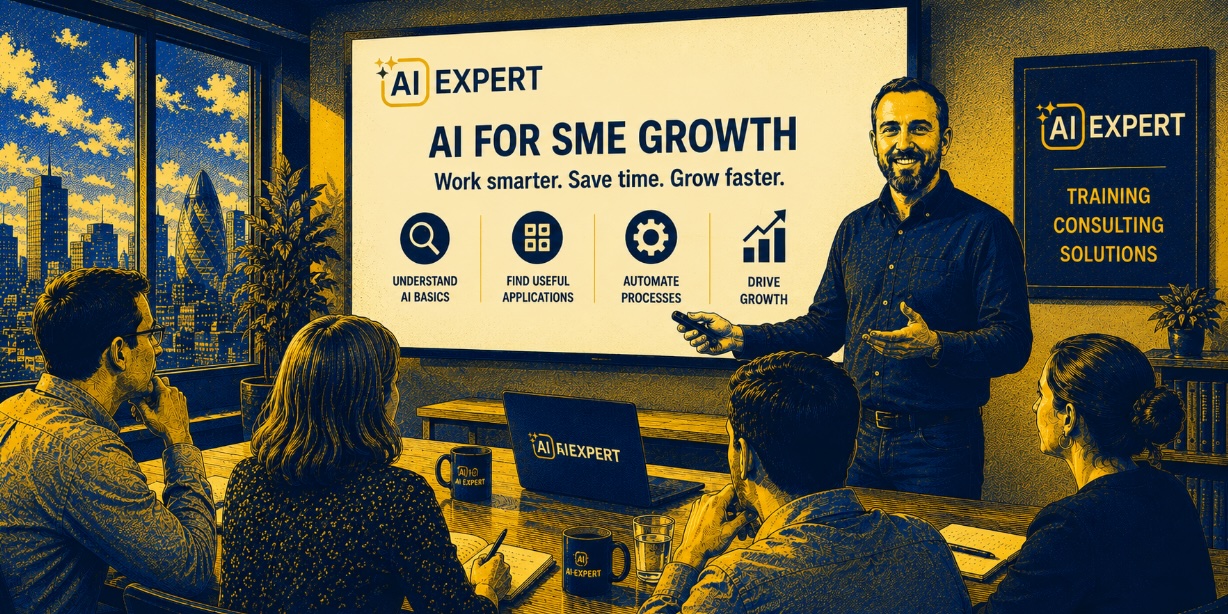
What is AI training is the question business leaders ask once they have moved past the initial confusion about where their business stands with AI and are starting to think seriously about deployment. The answer matters enormously because IDC research shows that 43% of AI training budgets in 2026 are being wasted on programmes that fail to translate into commercial outcomes. The gap between effective AI training and ineffective AI training is the difference between a workforce that delivers measurable productivity gains and one that produces expensive inconsistent results from the same tools.
AI training in its proper sense is the structured process of equipping your team members with the knowledge, skills and judgement they need to use AI tools effectively, safely and consistently within the context of your specific business. It is not a one-hour webinar on prompt engineering. It is not a generic course on how to use ChatGPT. It is a comprehensive capability-building programme tailored to the roles, responsibilities and workflows that exist inside your organisation and it sits at a specific point on the journey every business takes from AI confusion to AI confidence.
What is AI Training in a Business Context
Generic AI training teaches your team how to use AI tools. Effective AI training teaches your team how to use AI tools to achieve your specific commercial objectives. The distinction is enormous and it is the reason most off-the-shelf AI training programmes fail to move the needle on business performance.
Proper AI training covers five distinct capability areas, each of which is essential for translating individual tool adoption into organisational productivity.
Tool literacy is the foundational layer: understanding what AI tools can and cannot do, how they differ from one another, when to use which tool for which task and how to evaluate output quality. A team that cannot reliably distinguish between a task suited to Claude versus a task suited to a specialised image generator versus a task that should not involve AI at all will waste significant time and produce inconsistent results.
Prompt and context strategy is the next layer: understanding how to communicate effectively with AI tools to extract the output you actually need. As we covered in our AI Context Engineering blog, the skill that mattered in 2024 (clever prompt writing) has been largely superseded by the practice of providing rich context including project files, style guides, examples and constraints. Teams trained on prompt engineering alone are using techniques that are already obsolete.
Workflow integration is where individual productivity becomes organisational productivity. This involves understanding how to weave AI capability into existing processes, where to automate fully, where to keep humans in the loop and how to design handoffs between AI-assisted steps and human-judgement steps. Without this layer AI training produces faster individuals working in unchanged processes, which delivers minimal organisational impact.
AI Governance and Compliance is the layer most generic training programmes ignore entirely. UK businesses operating under GDPR, sector-specific regulations and increasing AI-specific compliance requirements need teams that understand what data can and cannot be entered into public AI tools, when sensitive information needs to be redacted or processed through governed systems and how to maintain audit trails. Our coverage of AI compliance explores the regulatory landscape in more detail.
Role-specific application is the layer that ensures training translates into measurable performance. A marketing coordinator needs different AI skills from a finance manager who needs different AI skills from a senior leader making strategic decisions. Generic training treats everyone identically, which is why it produces inconsistent results. Effective training is differentiated by role, function and seniority.
Where AI Training Sits in Your AI Confidence Journey
Every business we work with travels through five stages on the way from AI uncertainty to AI capability. We call it the AI Confidence Journey and understanding where AI training sits within it is essential for getting the timing, the focus and the measurement right.
Confused is the starting point. Most businesses arrive here overwhelmed by AI hype, unsure where they stand and not knowing where to begin. The right first step is our free AI Readiness Assessment, which establishes a clear view of your current AI maturity, operational readiness and highest-value opportunities. Training delivered at this stage is premature because there is no clarity yet on which tools, workflows or capabilities matter most for your business.
Curious is the stage businesses reach after assessment when they have seen what AI could mean for their operations and want to explore the possibilities seriously. The right move at this stage is an AI Workshop, which maps your business function by function and identifies where AI delivers genuine commercial impact. Training delivered at this stage still risks being unfocused because the strategic direction has not been locked in yet.
Committed is the stage where leadership has aligned, the direction is clear and the business is ready to build a proper plan. An AI Roadmap turns the workshop outputs into a sequenced costed implementation plan with clear milestones and KPIs. Training begins to take shape at this stage because the roadmap defines exactly which roles need which capabilities at which point.
Capable is where AI training delivers its highest commercial return. This is the stage where tools are live, workflows are being redesigned and teams are actively using AI in their day-to-day operations. Our AI Training is delivered in conjunction with AI Implementation so teams are trained on the actual tools and workflows being deployed rather than on hypothetical scenarios. This connection between training and live deployment is what separates training that compounds from training that evaporates.
Confident is the destination stage where AI is genuinely part of how the business operates and the focus shifts to refinement, measurement and scaling what works. At this stage AI training continues but evolves, supporting AI Optimisation and Support through ongoing capability development as new tools, techniques and use cases emerge. Confidence is not a one-time achievement but a maintained state and ongoing training is what maintains it.
The reason this sequencing matters is that AI training delivered out of order produces the wasted spend the IDC data captures. Training a confused organisation just adds more confusion. Training a curious organisation without a roadmap produces enthusiasm with no destination. Training a capable organisation without ongoing optimisation support lets the initial capability decay. Sequenced properly training is the engine that drives the journey forward. Sequenced wrongly it is one of the biggest sources of wasted budget SMEs currently face.
What is AI Training Designed to Achieve
The purpose of structured AI training is not to make every team member technically proficient in every AI tool. The purpose is to embed AI capability into your organisation in a way that delivers measurable commercial value while managing the risks that ungoverned AI adoption creates.
Effective AI training delivers four specific outcomes.
First it eliminates the ‘shadow AI’ problem we covered in our Why AI Pilots Fail blog, where individual team members adopt AI tools privately, build personal workflows around them and never share what they have learned. McKinsey’s April 2026 research found that fewer than 10% of organisations have managed to scale AI agents into production despite 79% experimenting with them. Proper training is what bridges that gap, turning individual experimentation into shared organisational capability.
Second it dramatically improves output quality and consistency. A trained team produces predictable high-quality AI-assisted output. An untrained team produces wildly variable results that often require more correction time than the AI was supposed to save. The compounding effect across hundreds of weekly AI interactions is significant.
Third it manages risk. Untrained teams entering client data into public AI tools, generating regulated content without oversight or relying on hallucinated AI outputs in client-facing communications create genuine commercial and reputational exposure. Trained teams understand the boundaries and operate within them.
Fourth it builds capability that compounds. As we explored in our AI Context Engineering blog, AI value compounds when teams build maintained knowledge layers, refined workflows and shared learnings around their AI tools. Training is the foundation that makes that compounding possible.
What is AI Training Delivered by AI Expert
Our AI Training programmes are designed specifically for SMEs, drawing on the same structured methodology that runs through our entire service pathway. Training programmes are built around the EDIP framework: Explain (covering the concepts and context), Demonstrate (showing real-world application), Imitate (guided practice with real scenarios from your business) and Practice (independent application with feedback).
Training engagements are designed to deliver against the specific objectives identified in your AI Readiness Assessment and AI Workshop, which means every session connects directly to commercial outcomes your business has already prioritised. Generic training programmes cannot do this because they are designed to be sold to anyone. Targeted training works because it is built around your specific operations.
Training is typically delivered in conjunction with AI Implementation so teams are trained on the actual tools and workflows being deployed rather than on hypothetical scenarios. This connection between training and implementation is what ensures the IDC ‘43% wasted training budgets’ statistic does not apply to AI Expert engagements. Training that connects to deployment, with measurement against pre-established KPIs, produces commercial outcomes. Training delivered in isolation does not.
What is AI Training: The Real Difference for SMEs
What is AI training properly understood is the structured capability-building programme that takes your team from theoretical understanding to practical competence and ultimately from Capable to Confident on the AI Confidence Journey. It covers tool literacy, prompt and context strategy, workflow integration, governance and compliance, and role-specific application, delivered with measurement and connection to your actual business operations.
Generic AI training is one of the biggest sources of wasted spend in UK SMEs right now with 43% of training budgets failing to translate into commercial outcomes according to IDC. Effective AI training is one of the highest-return investments you can make because the capability it builds compounds across every AI tool, every workflow and every team member it touches.
The real difference comes down to whether the training is structured, targeted, measured and sequenced properly within your AI Confidence Journey, or generic, off-the-shelf and disconnected from where your business actually stands.
Complete our free AI Readiness Assessment to understand where your team’s current AI capability sits on the journey, where the highest-value training opportunities are and how to build a training programme that delivers measurable commercial value rather than another wasted line item on next year’s budget.
%20(1).jpg)
%20(1).png)
