
AI Transformation: Why SMEs Won’t Get There by Buying Software
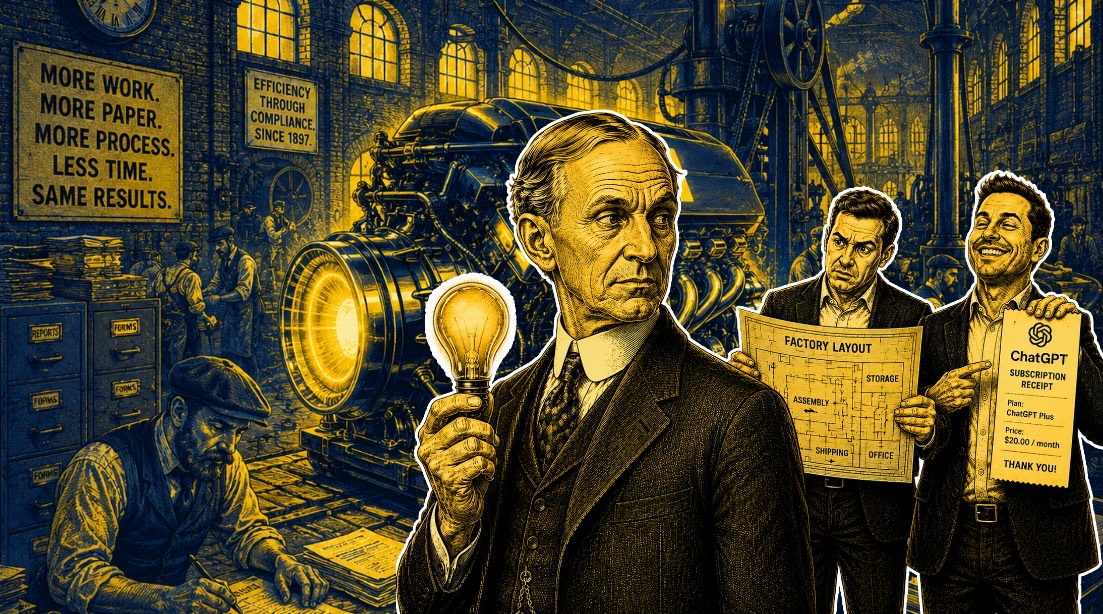
AI transformation is what every SME leader claims to be pursuing in 2026 but most of what is happening under that label is software procurement dressed up as strategic change.
Buying agentic software seats, adding Copilot licences and signing up for no-code workflow builders rarely moves the needle on revenue, cost or margin, because transformation is not a piece of software you can purchase. It is a structural change in how your business operates and it starts with the people and the processes that run it rather than the tools layered on top of them.
The industrial revolution proved this point at significant cost. For roughly 30 years after electricity became commercially available, factories saw almost no productivity gains from the new technology. The reason was uncomfortable. Most factories simply replaced their central steam engine with a central electric motor and changed nothing else about the building, the layout or the way work flowed.
The productivity unlock only arrived when factories were rebuilt from the ground up around what electricity made possible, with small motors on every machine, machines arranged in the order work actually flowed and what eventually became the modern assembly line. Henry Ford figured this out in the early 1900s and the same operational redesign principle now applies to AI.
AI Transformation Starts With Process, Not Procurement
The temptation for SMEs is to start an AI transformation by evaluating tools. Which AI assistant should we adopt, which workflow automation platform fits our stack, which agentic vendor has the slickest demo. This is the wrong question and businesses that lead with it end up with expensive subscriptions that produce marginal returns.
The right starting point is understanding how work actually gets done across your business, end to end, in granular detail. Not the version that appears in the org chart or the process documentation. The real version, including the workarounds, the manual exceptions, the email chains, the spreadsheets people maintain in private and the tribal knowledge held in the heads of long-serving team members who know how things really work. As we explored in our Shadow AI blog, the gap between documented process and actual practice is usually significant and almost always invisible to leadership.
This is why a proper AI transformation begins with structured discovery rather than tool selection. Our AI Workshop uses LUMA and Rose/Thorn/Bud methodology to map your operations function by function, surface the real processes underneath the documented ones and identify where AI can deliver genuine commercial value rather than where it sounds impressive in a demo.
If the AI does not understand the underlying process, it will not create meaningful value. If the people who own that process are not brought along, adoption will be weak even when the technology works perfectly. Both of these failure modes are common and both are direct consequences of starting an AI transformation with procurement rather than with process.
AI Transformation Requires Picking the Right Workflows First
Once your operations are mapped end to end, the next decision is choosing which workflows are actually worth redesigning around AI. Not every process should be automated and not every process is a sensible candidate for agentic AI. Getting this choice right is one of the highest-leverage decisions in the entire transformation.
The best candidates usually share four characteristics that distinguish them from workflows that look promising but produce disappointing results.
They happen often enough to matter
A workflow that runs hundreds or thousands of times each month delivers transformation value because every improvement compounds across the volume. A workflow that runs ten times a month rarely justifies the investment, regardless of how much pain a single instance causes.
They involve repeatable decisions
The work does not need to be identical every time, but it should follow patterns that an AI agent can learn from. Agents are most useful when they can apply business rules, draw on past decisions and route exceptions sensibly. Workflows where every instance is genuinely unique tend to be poor fits.
They depend on context spread across multiple systems
This is where AI delivers some of its biggest gains, because the human time currently spent searching across email, Slack, CRM records, spreadsheets and ERP systems is exactly the time that AI can collapse dramatically. If your team is constantly switching between tools to gather the context they need, that workflow is a strong candidate for redesign.
They have measurable pain
Before any redesign happens, you should be able to quantify the current cost of the workflow in terms of cycle time, error rate, manual hours, delayed revenue or duplicate work. Without that baseline, you cannot prove the transformation worked, and as we covered in our Why AI Pilots Fail coverage, IDC research found that 50.8% of businesses cannot measure AI ROI precisely because they skipped this step.
The goal of mapping each candidate workflow is to separate the work into three categories. What can be handled by deterministic automation (rules-based scripts, no AI needed), what should be handled by AI agents (judgement work with patterns the AI can learn) and what needs to stay with humans (high-risk, high-judgement decisions where consistency and accountability matter most).
AI Transformation Delivers Both Cost and Revenue, Done Properly
The mistake most leadership teams make when scoping an AI transformation is framing it as a cost-cutting initiative. This is a substantial underclaim. Done correctly, a transformation does more than reduce headcount or hours, because the agents you deploy produce more than just efficiency.
Effective agents give people better context, faster. Better context helps people make better decisions, faster. Consistently better decisions unlock revenue growth alongside the efficiency gains, which means a proper transformation should yield both topline growth and bottom-line improvement.
A recent transformation at a multi-billion-dollar revenue enterprise software company illustrated this clearly. The sales process had too much work trapped in busy administration, with large deals touching six teams across eleven handoff points. After mapping the process end-to-end, automating the deterministic work, deploying agents on the judgement work and keeping high-stakes decisions with humans, the transformation delivered $25 million of value in the first year through a combination of margin expansion and revenue growth.
The numbers will be smaller at SME scale but the principle holds. The businesses we work with that approach AI transformation as both a cost and revenue exercise end up with materially different outcomes than the ones that frame it as efficiency alone. For SMEs at the Capable stage of the AI Confidence Journey, this is the kind of measurable commercial impact that pays for the broader programme.
AI Transformation Without Disrupting the Business
The single biggest risk in any AI transformation is disrupting the operations you are trying to improve. The businesses that get this right share two non-negotiable practices.
Build on the systems you already have, do not rip and replace
Most SMEs have spent years getting their teams onto Salesforce, NetSuite, Xero, HubSpot or whatever else runs their operations. Forcing those teams to migrate to entirely new platforms in order to adopt AI slows everything down, creates retraining overhead and introduces risk that has nothing to do with the AI itself. The smarter approach is to build the transformation on top of what you already use, through APIs or computer-use agents, so workflows continue running on the systems your team understands while the AI capability layers in around them.
Keep your data layers separate so the system can scale
The data that powers an AI transformation typically falls into four distinct categories. The system of record (your CRM, ERP, accounting platform), the business rules (the policies and approval logic), the raw intake data (the emails, documents and inputs flowing in) and the feedback or memory the agents accumulate as they learn. Keeping these four layers separate matters more than most leadership teams realise, because it means an operations person can update a business rule without calling an engineer, and the whole system remains maintainable as your business changes. Mixing these layers produces brittle systems that break every time anything changes.
These principles connect directly to the AI Confidence Journey progression. AI Implementation at the Capable stage is where the build-on-existing-systems principle plays out in practice, and ongoing AI Optimisation and Support at the Confident stage depends on having kept those data layers separate from the start.
AI Transformation Through Staged Deployment
The way agents reach production matters as much as which workflows they handle. Deploy them too aggressively and you destabilise operations. Deploy them too cautiously and the transformation never delivers the gains the business case promised. The pattern that works for SMEs follows three stages.
Sandbox
Agents run in isolated environments with simulated data, where the team can test behaviour, review outputs and refine the rules without any risk to live operations.
Shadow mode
Agents run alongside the human team on real work, but their outputs are reviewed by people before any action is taken. Every output, every human correction and every piece of surrounding context gets logged. This is where the agent learns from the team’s expertise, and where accuracy typically improves by 10% or more in the first few weeks.
Supervised production
Agents start taking action on lower-risk work autonomously, with humans handling exceptions, edge cases and anything that hits a confidence threshold. As the team builds trust and the agents continue to improve, the scope of autonomous work expands.
The human-in-the-loop feedback is not optional, it is what makes the system improve over time and what gives the human team the confidence to hand over more work. As we covered in our AI Training blog, training the team to operate alongside AI is just as important as training the AI itself.
Where AI Transformation Usually Starts
The first workflows we scope when working with new clients usually cluster in four functional areas, because these are where the four-trait test most consistently identifies high-value redesign candidates.
Accounts payable
Invoice automation, GL coding, purchase order matching, exception routing and approval workflows. These workflows tick every box, with high volume, repeatable decisions, context spread across multiple systems and measurable pain in cycle time and error rates.
Procurement
Vendor onboarding, supplier scorecards, contract compliance monitoring and renewal management. Less obvious than AP but often higher-value because procurement workflows often involve hidden inefficiency that compounds across vendor relationships.
Sales
Deal desk routing, CRM enrichment, forecast intelligence, commission calculation and pipeline hygiene. The Varick case study showed the upside here is significant when the workflows are redesigned properly.
Operations
Exception detection and routing, allocation optimisation, returns processing and quality control. These workflows often look operational but produce financial impact when they go wrong, which makes the business case for redesign easier to build.
Starting with these four areas does not mean you stay there. As confidence grows and the team becomes comfortable handing busy work to AI, the transformation expands across the business workflow by workflow. The pattern works because each successful deployment builds momentum and proof for the next one.
AI Transformation: The Practical Path Forward for SMEs
AI transformation is not something you buy, it is something you build through structured operational redesign. Buying agentic software seats, Copilot licences and no-code platforms produces marginal returns. Mapping your real workflows end to end, choosing the right candidates for redesign, deploying agents in staged production and keeping your data layers cleanly separate produces compounding commercial returns over time.
The businesses extracting genuine value from AI in 2026 are the ones treating it as the industrial revolution made visible, with the same operational redesign playbook Henry Ford figured out 120 years ago. The businesses still trying to buy their way to transformation are repeating the mistake of the factories that spent thirty years swapping steam engines for electric motors and wondering why nothing improved.
SMEs sit in a strong position to make this shift because they are small enough to redesign their operations without enterprise-scale change programmes, but large enough to benefit from the productivity, margin and revenue gains that proper transformation delivers. The structured path runs through AI Readiness Assessment, AI Workshop, AI Roadmap, AI Implementation, AI Training and AI Optimisation, with each stage building on the last and each producing measurable outcomes that compound rather than evaporate.
Complete our free AI Readiness Assessment to understand where your business currently sits and how to build a transformation pathway that delivers commercial value rather than just adding another software subscription to your stack.

.png)
.jpg)