
AI Development Solutions: Pilot to Production
Published July 2026. Updated September 2026.
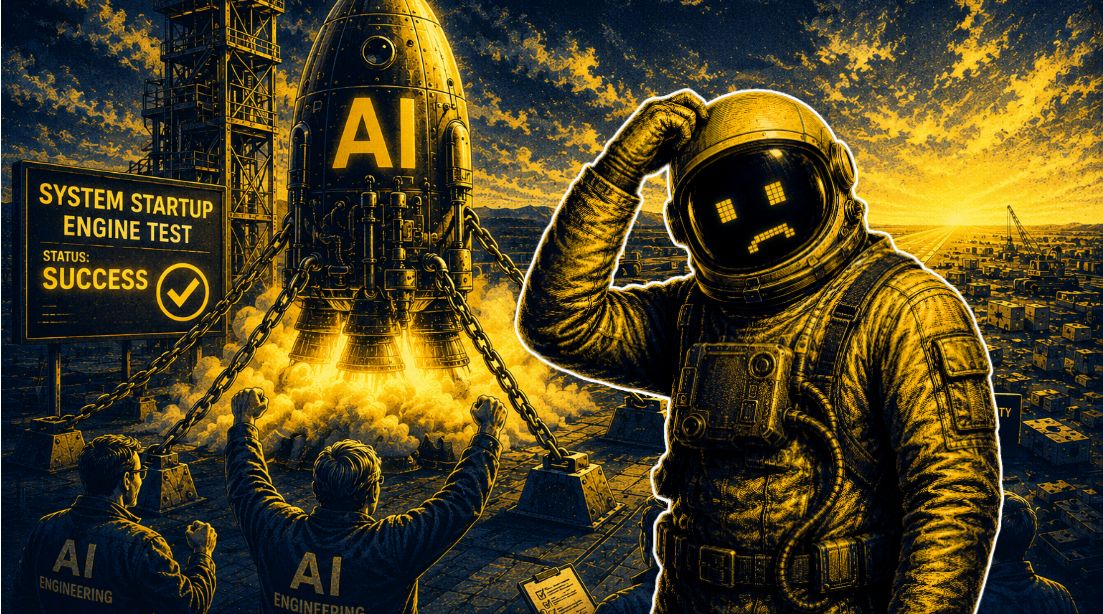
AI development solutions are where most SMEs start well and then stall. The pilot works, the demo impresses and then six months later the project is quietly shelved. This is not a technology problem. It is a scaling problem, and it is far more common than the industry admits.
According to McKinsey's 2025 State of AI report, the majority of organisations that experiment with AI fail to move beyond isolated pilots. For SMEs, the cost of that failure is not just wasted budget. It is lost competitive ground, low team confidence and a growing scepticism about whether AI can deliver anything real.
UPDATE, September 2026: The challenge of scaling AI remains significant. Gartner research published in September 2026 found that only 22% of surveyed organisations had successfully scaled AI across multiple business units or adopted an AI-first approach. McKinsey's 2026 State of AI research similarly shows a gap between adoption and scaling, particularly for smaller organisations. The evidence reinforces the importance of moving beyond experimentation with clear business outcomes, measurement and a structured approach to implementation.
The good news is that the gap between a promising pilot and a production-ready system is bridgeable. It just requires a different kind of thinking at every stage.
Why AI Development Solutions Fail to Scale
The failure point is rarely the technology itself. Most pilots collapse because they were designed to prove a concept rather than to survive contact with the real business.
A pilot runs on clean data, controlled conditions and a small group of motivated users. Production is messier. It involves legacy systems, inconsistent data, staff who were not involved in the pilot and operational pressures that do not pause for an AI rollout. Without a plan that accounts for all of that, even a technically excellent pilot will fail in the field.
The other common cause of stalled AI projects is the absence of a clear business case. If your pilot cannot demonstrate a measurable outcome, time saved, revenue generated, cost reduced, there is no foundation to justify the investment required to scale it.
The Pilot Trap: When Small Wins Create False Confidence
A successful pilot is not evidence that your solution will scale. It is evidence that your solution worked under controlled conditions. This distinction matters enormously for SMEs with limited resources.
Before any pilot reaches production, the business needs to answer three questions honestly: who owns this in the long term, how will it be maintained and what does failure look like at scale? Answering these questions before scaling, rather than after, is what separates teams that succeed from those that do not.
Building a Scalable AI Development Solution
Scaling an AI development solution is a structured process, not a single decision. The businesses that do it well follow a clear sequence rather than jumping from demo to deployment.
The first step is a genuine assessment of AI readiness. This means evaluating your data quality, your existing systems, your team's capability and your organisational appetite for change. Our AI readiness assessment takes two minutes and gives SMEs a clear starting point before any build begins.
The second step is a structured workshop process to define the problem precisely. Vague briefs produce vague solutions. A well-run AI workshop forces the business to articulate exactly what success looks like in measurable terms, which in turn shapes every technical decision that follows.
Designing for Production From Day One
The most expensive mistake in AI development is building a pilot without production in mind. Data pipelines that work manually at small scale will not survive automation at volume. Models trained on a curated dataset will behave differently when exposed to the full range of real-world inputs.
Designing for production from the outset means building with integration, security and governance in mind from the first sprint rather than treating these as issues to solve later. It also means involving the people who will use the system daily, not just the project sponsor, from the earliest stages.
The Role of an AI Roadmap in Scaling Successfully
An AI roadmap is not a Wishlist. It is a phased, costed plan that shows exactly how a pilot becomes a production system, what it will cost at each stage, what the dependencies are and what the business should expect to gain at every milestone.
Without this, SMEs tend to scale reactively, adding resource when something breaks rather than planning for capacity in advance. A well-structured roadmap prevents that. It gives leadership the confidence to commit to the next phase because the risks and costs are already visible.
This is where an experienced external partner adds disproportionate value. Our AI consulting services are built around this kind of structured, commercially grounded planning rather than technical experimentation for its own sake.
From Roadmap to Live: What AI Implementation Actually Looks Like
Moving from roadmap to live deployment is where many SMEs encounter their steepest learning curve. Integration with existing systems takes longer than expected. Staff adoption requires active change management, not just training. And the model itself will need refinement once it is exposed to real data at scale.
Effective AI implementation is iterative. It builds in review points, measures the outcomes defined in the business case and adjusts based on what the data shows rather than what the original plan assumed. Our AI optimisation support exists specifically to help businesses manage this phase without losing momentum.
Measuring ROI on AI Development Solutions
ROI on AI is measurable, but only if you defined the right metrics before the build began. The businesses that struggle to demonstrate value from AI are almost always the ones that set vague goals at the outset.
Concrete metrics matter: hours saved per week, error rates reduced, customer response times improved, revenue influenced by automation. A 2025 study from Gartner found that organisations with clearly defined AI success metrics were significantly more likely to scale their solutions beyond initial deployment.
Defining those metrics is not a technical task. It is a commercial one. It requires the business to understand its own operations clearly enough to say what good looks like in numbers
Frequently Asked Questions
What is the difference between an AI pilot and an AI development solution?
A pilot tests whether an AI approach can work under controlled conditions. An AI development solution is a fully built, integrated and production-ready system designed to operate reliably at scale within real business processes.
How long does it take to scale an AI solution from pilot to production?
This varies significantly depending on complexity, data quality and integration requirements. However, a well-scoped project following a clear roadmap typically moves from approved pilot to initial production deployment within three to six months.
Do SMEs need technical staff to scale AI development solutions?
Not necessarily. Many SMEs scale AI solutions successfully with external specialist support rather than in-house technical teams. What matters more is having clear business ownership and defined success metrics internally, with the technical expertise provided externally.
What is the biggest risk when moving from pilot to production?
The most common risk is underestimating the gap between controlled pilot conditions and real operational environments. Data quality issues, integration complexity and low staff adoption are the three factors that most frequently cause projects to stall at this stage. AI development solutions only deliver lasting value when the business treats scaling as a deliberate process rather than a natural progression from a successful pilot. The companies pulling ahead right now are not those with the most sophisticated technology. They are the ones who combine a clear business case, a structured roadmap and practical implementation support to turn small wins into operational capability.
If your SME is ready to move beyond the pilot stage, our AI consulting services are designed to take you from where you are now to where your business needs to be. Start with our free AI readiness assessment and get a clear picture of your next step.