Shadow AI: The Hidden Risk Sitting Inside Every SME Right Now
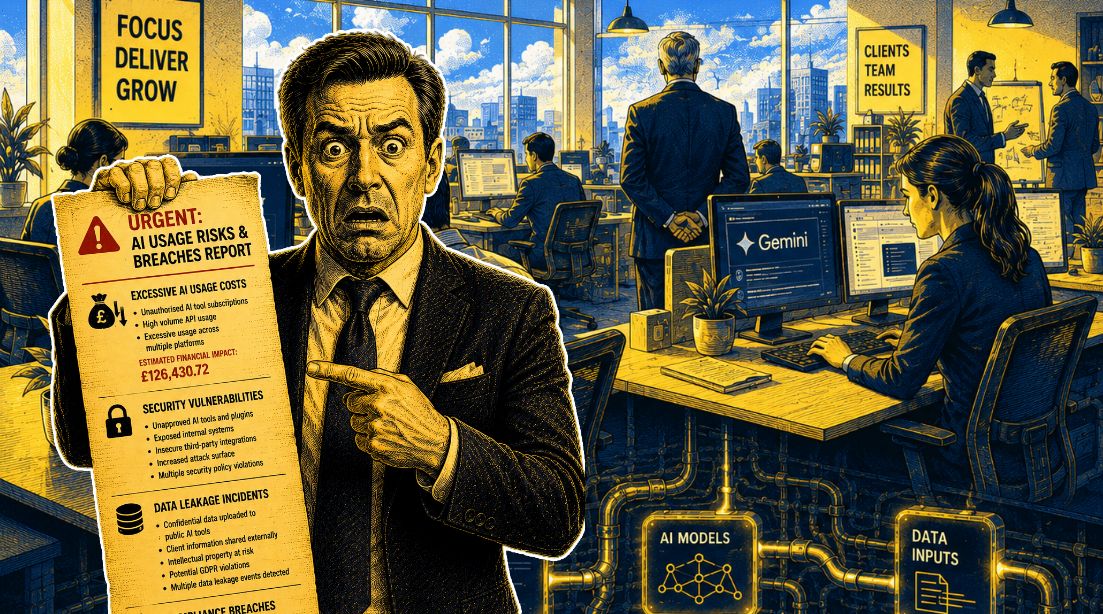
Shadow AI is the term for the AI tools, workflows and capabilities your team members are using privately without your knowledge or governance. Inside a typical 75-person UK SME the pattern looks like this. One analyst is running Claude for market research. A few associates are using Gemini to draft pitch sections. A partner has built a private custom GPT for proposal writing and has not told anyone. None of it appears in your IT inventory. None of it has been assessed for data security or compliance. None of it is being measured against commercial outcomes. All of it is happening every single day.
McKinsey’s April 2026 research found that 79% of organisations are now experimenting with AI yet fewer than 10% have scaled it into production. The gap between those two numbers is largely the shadow AI problem in action. Individual experimentation is everywhere. Coordinated organisational capability is rare. The result is a business with significant hidden AI activity that produces individual productivity gains for the people doing it while creating commercial risks and missed opportunities for the business as a whole.
What Shadow AI Actually Is
Shadow AI sits within the broader category of shadow IT, the long-standing problem where employees adopt technology tools without involving the IT function or senior leadership. The difference is that shadow AI is happening at a speed and scale that previous shadow IT problems never approached. ChatGPT, Claude, Gemini, custom GPTs, AI-powered browser extensions, AI features baked into existing software, free trial versions of enterprise AI platforms. The barrier to entry is zero. The signup is instant, the capability is genuinely useful and the visibility to leadership is essentially none.
In practice shadow AI takes four common forms inside SMEs.
Personal subscriptions used for work. A team member signs up to a paid ChatGPT or Claude account using a personal email address, then uses it daily for work tasks. The business benefits from the productivity gain. The business also has no visibility, no governance and no continuity if the person leaves.
Free tools used for sensitive work. Free AI tools become the default for tasks the team member knows they could not officially get approved. Client briefs entered into public AI chatbots. Financial data summarised through free transcription services. Sensitive documents processed through AI tools whose data handling practices have never been reviewed.
Custom GPTs and personal automations. More technically capable team members build their own AI workflows using custom GPTs, automation platforms or coding assistants. These workflows often deliver substantial productivity gains for the individual. They are also entirely undocumented, unrepeatable for anyone else and disappear completely when the person leaves the business.
Quiet AI use embedded in normal work. AI features now live inside almost every productivity tool. Email assistants, meeting transcription, document summarisation, code completion. Team members use these features without any conscious decision to ‘adopt AI’. The cumulative effect is that significant portions of your business output now involve AI processing that has never been formally acknowledged.
Why Shadow AI Is Rampant in UK SMEs Right Now
Three factors combine to make shadow AI almost inevitable inside any business that has not yet built a structured approach to AI adoption.
The first is the productivity gap. AI genuinely helps people get their work done faster. Team members who have figured this out are not going to wait for the business to formally approve AI use before they capture that benefit. The longer the business takes to provide sanctioned AI tools and training, the more individual workarounds proliferate.
The second is the absence of structured alternatives. Most SMEs have not yet deployed approved AI tools, governance frameworks or clear policies. Team members are not deliberately violating rules. They are operating in a vacuum where no rules exist and making the rational choice to use the tools that help them do their job.
The third is cultural. In businesses that have not yet established a positive frame around AI adoption, team members often hide their AI use because they fear being judged for using it. Some worry about appearing lazy. Others worry about admitting they did not produce the work entirely on their own. Some worry about being asked to take on more work if their AI productivity becomes visible. The result is a culture of quiet AI use that is invisible to leadership precisely because it is being deliberately hidden.
The Real Cost of Shadow AI to UK Businesses
Shadow AI creates four categories of commercial risk that compound over time and most SMEs are not currently quantifying any of them.
Data security and confidentiality exposure. Client data, financial information, employee records, intellectual property and competitive intelligence are routinely entered into public AI tools without governance. Even when individual team members are careful, the cumulative organisational exposure is significant. Free AI tools generally use prompts to improve their models, which means information entered today may surface in someone else’s response tomorrow.
Regulatory and compliance risk. UK businesses operate under GDPR, sector-specific regulations and increasingly AI-specific compliance requirements. Shadow AI use creates compliance gaps that are invisible until they are not. A regulator asking how the business uses AI cannot get an honest answer because the business itself does not know what is being used or where. Our AI compliance coverage explores the regulatory landscape in more detail.
Inconsistent output quality. When team members use different AI tools, different prompts, different approaches and different quality controls, the output the business produces varies wildly. Some interactions deliver excellent results. Others produce mediocre or hallucinated content that gets used in client-facing communications. The business has no way to ensure consistency because it does not even know what tools are being used.
Capability that does not compound. This is the cost that hurts most over time. When AI use is hidden inside individual workflows, the business never builds shared capability. Lessons learned by one team member are not transferred to others. Effective prompts and approaches developed privately disappear when the person leaves. The business spends years experimenting without ever building the organisational capability that experimentation should produce. As we covered in our why AI pilots fail blog, this is the structural reason fewer than 10% of organisations have managed to scale AI into production despite 79% experimenting with it.
Shadow AI Within Your AI Confidence Journey
Shadow AI is the predictable symptom of a business sitting at the Confused stage of the AI Confidence Journey. The pattern is consistent across the UK SMEs we work with. Businesses that have not yet established a clear strategic position on AI develop shadow AI activity within months. The longer they stay at the Confused stage the more entrenched the shadow activity becomes.
Moving through the journey is the structural solution to the shadow AI problem.
Confused businesses have rampant shadow AI activity but no visibility into it. The first step is our free AI Readiness Assessment, which establishes the operational picture of where your business actually stands. The assessment often surfaces shadow AI activity that leadership did not know existed.
Curious is the stage where shadow AI starts to come into the light. An AI Workshop creates a structured environment where team members can share what they have been doing privately. The framing matters here. The workshop should treat existing shadow AI as evidence of innovation worth building on rather than as misconduct worth punishing. Done well this is the moment where hidden activity becomes shared capability.
Committed is the stage where shadow AI becomes governed AI. An AI Roadmap establishes which tools, workflows and use cases the business will adopt officially, with proper compliance frameworks and clear policies. Team members who were operating in the shadows now have sanctioned alternatives that often work better than what they had built privately.
Capable is where the business operates with full AI visibility. AI Implementation deploys the sanctioned tools and AI Training ensures every team member has the capability to use them effectively. Shadow AI activity at this stage drops sharply because the official alternatives are usually better than the unofficial ones.
Confident is the destination stage where AI is a normal, governed, measured part of how the business operates. AI Optimisation and Support maintains visibility as new tools emerge and use cases expand. Shadow AI re-emerges in any business that lets its governance lapse, which is why ongoing optimisation matters.
How to Surface Shadow AI Without Killing Morale
The instinct of many SME leaders on hearing about shadow AI is to lock everything down. Issue policy banning unauthorised AI use. Block AI tools at the network level. Demand that team members report any AI use immediately. This approach fails for three reasons.
It punishes the people who have been most productive. Shadow AI users are usually the most innovative members of your team. Coming down hard on them sends exactly the wrong cultural signal at a moment when you need their engagement most.
It drives shadow AI deeper rather than surfacing it. People do not stop using tools that help them do their work. They just hide it better.
It loses you the institutional knowledge those individuals have built. The prompts, workflows and approaches developed privately often represent months of trial and error. Punishing the people who built them means losing all of that learning.
The productive approach is the opposite. Treat shadow AI as evidence that your team is ready for proper AI adoption and use it as the starting point rather than the problem. Workshop sessions designed to surface existing AI use without judgement consistently produce the highest-quality input we see in any AI strategy engagement. People who have been using AI privately have already done the hardest part of the discovery work. The job of the business is to harvest that learning, scale it across the organisation and put proper governance around it.
This is exactly what our LUMA and Rose/Thorn/Bud workshop methodology is designed to do. Looking at how AI is actually being used across the business, understanding the value team members are extracting, mapping the workflows that have emerged organically and analysing where these workflows can be formalised, scaled and governed.
Shadow AI: The Path from Hidden Risk to Visible Capability
Shadow AI is not a problem to be eliminated. It is a signal to be acted on. The fact that your team members are using AI without official sanction tells you that AI delivers real value to them and that your business is ready for structured adoption rather than continuing to ignore the question. The longer the shadow activity goes unaddressed the more risk accumulates, the more capability gets lost when people leave and the more your competitors who have moved past this stage pull ahead.
The path forward is the AI Confidence Journey, starting with a proper assessment of where your business stands and progressing through structured workshop, roadmap, implementation, training and optimisation. Each stage of the journey converts more shadow AI activity into governed shared capability that compounds over time rather than disappearing when individuals leave.
The businesses that move quickly through this journey will be the ones extracting the full commercial value from AI by the end of 2026. The businesses that keep ignoring the shadow AI activity inside their walls will keep paying the four-category cost in data exposure, compliance risk, inconsistent quality and lost capability.
Complete our free AI Readiness Assessment to understand where your business currently sits, how much shadow AI activity is likely already happening inside your operations and how to convert that activity into structured commercial capability rather than ongoing hidden risk.
%20(1).png)
%20(1).png)
%20(1).png)