What is Shadow AI? A Topline Guide for SMEs
What is Shadow AI is a question more SME leaders should be asking, because the answer is almost certainly relevant to their business right now whether they realise it or not.
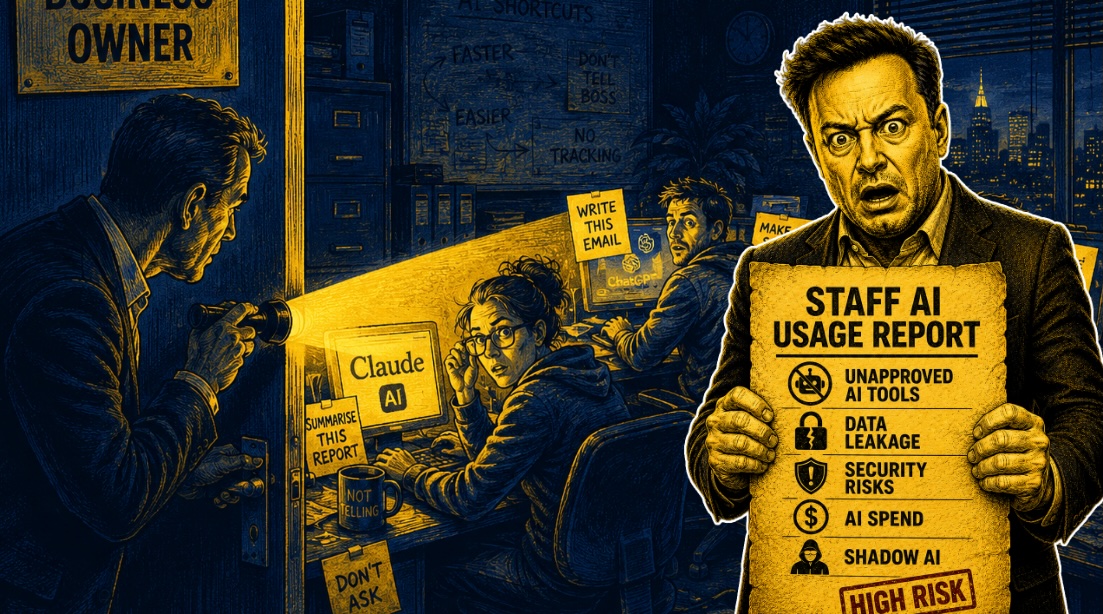
Shadow AI is the use of artificial intelligence tools by your team members without the knowledge, approval or governance of the business. The analyst running Claude on a personal account. The associate drafting client documents through a free AI tool. The manager who built a custom GPT and never told anyone. It is happening inside the majority of SMEs today and most leadership teams have no visibility into how much of it is going on.
This topline guide covers what Shadow AI is, what it is costingbusinesses and the practical solutions that bring it under control, starting with the single most effective first step any business can take.
What is Shadow AI: The Topline for Busy Leaders
For leaders who want the essentials before the detail, here is the topline view.
Shadow AI is unauthorised, ungoverned AI use inside your business. It is widespread, it is growing and it exists because AI tools are free, instant to access and genuinely useful, while most businesses have not yet provided sanctioned alternatives or clear policies. The risks fall into four categories: data security exposure, regulatory and compliance gaps, inconsistent output quality and capability that vanishes when staff leave. The solution is not to ban AI, which simply drives the activity deeper underground. The solution is to bring it into the light through clear governance, sanctioned tools and proper training, starting with an AI Policy that gives your team the clarity they currently lack.
What is Shadow AI in Practice
Shadow AI sits within the broader category of shadow IT, the long-standing problem where employees adopt technology without involving leadership or the IT function. The difference is speed and scale. AI tools require no procurement process, no installation and no budget approval. A team member can be using a powerful AI tool within sixty seconds of deciding they want to, and the business has no way of knowing.
In practice it takes four common forms inside SMEs. Personal AI subscriptions used for work tasks on accounts the business cannot see. Free AI tools used for sensitive work that would never be officially approved. Custom GPTs and personal automations built by more technical team members and known only to them. AI features embedded inside everyday software that team members use without any conscious decision to ‘adopt AI’ at all.
The common thread is invisibility. None of this activity appears in any inventory, none of it is governed and none of it is measured. The business benefits from the productivity gains while carrying all of the risk. We explored the full picture in our Shadow AI blog, including why team members hide their AI use and how to surface it without damaging morale.
What is Shadow AI Costing UK Businesses
The cost of Shadow AI is real, measurable and compounding across four categories.
Data security and confidentiality exposure
Client information, financial data and intellectual property are routinely entered into public AI tools whose data handling practices have never been reviewed. Many free tools use the information entered into them to train their models, which means sensitive business data can resurface elsewhere.
Regulatory and compliance risk
UK businesses operate under GDPR, sector-specific regulations and increasingly AI-specific requirements. A regulator asking how your business uses AI cannot receive an honest answer if the business itself does not know what is being used or where. Our AI compliance coverage explores the regulatory landscape in more detail.
Inconsistent output quality
When team members use different tools, different prompts and different quality controls, the output your business produces varies wildly. Hallucinated or mediocre content can reach clients before anyone spots the problem.
Capability that does not compound
Lessons learned by one team member never transfer to others. Effective prompts and workflows built privately disappear when the person leaves. The business spends years experimenting without ever building shared organisational capability, which is one of the structural reasons McKinsey found that fewer than 10% of organisations have scaled AI into production despite 79% experimenting with it.
What is Shadow AI Solved By: Start With an AI Policy
The instinct to ban unauthorised AI use fails for three reasons. It punishes your most productive people, it drives the activity deeper underground and it loses you the valuable institutional knowledge those individuals have already built. The productive approach is to bring Shadow AI into the light through clear governance, and the single most effective first step is a proper AI Policy.
An AI Policy gives your team the clarity they currently lack. It defines which tools are approved, what data can and cannot be entered into AI systems, where human oversight is required and how AI use should be documented. It replaces the current vacuum, where team members guess at the rules, with explicit guidance that lets them use AI confidently and safely.
Our AI Policy is available in three tiers designed to match the needs and scale of different businesses.
AI Policy Lite (£999) provides the essential governance framework every business should have in place, covering acceptable use, data handling and the core rules that bring immediate Shadow AI activity under control.
AI Policy Essential (£1,499) builds on the Lite tier with more comprehensive coverage, including role-specific guidance, expanded compliance alignment and clearer governance structures for businesses with more complex operations.
AI Policy Complete (£1,999) delivers the full governance package, with comprehensive policy coverage, detailed compliance frameworks and the structures needed by businesses with significant AI activity or heightened regulatory exposure.
A policy on its own is the foundation rather than the whole solution. Bringing Shadow AI fully under control also means providing sanctioned tools through AI Implementation, building team capability through AI Training and establishing the strategic direction through an AI Workshop. The policy is what makes the immediate risk manageable while the broader work brings the business from Confused to Confident on its AI journey.
What is Shadow AI: Bringing It Into the Light
What is Shadow AI? In the end, it's more of a signal rather than a scandal. The fact that your team is using AI without official sanction tells you two things. It tells you that AI delivers genuine value to the people doing the work and it tells you that your business is ready for structured adoption rather than continuing to leave the question unaddressed. The longer the activity stays in the shadows, the more risk accumulates and the more capability is lost when people leave.
The path forward begins with visibility and governance. A clear AI Policy brings the immediate activity under control and gives your team the confidence to use AI safely. From there, the structured journey through assessment, workshop, AI Roadmap, AI Implementation, training and AI Optimisation converts hidden Shadow AI into governed shared capability that compounds over time.
Start with our free AI Readiness Assessment to understand how much Shadow AI activity is likely already happening inside your business and how to bring it into the light with proper governance and a clear AI Policy.
.png)
%20(1).png)
%20(1).png)