
92% of Businesses Report AI Inefficiency: What's Wrong?
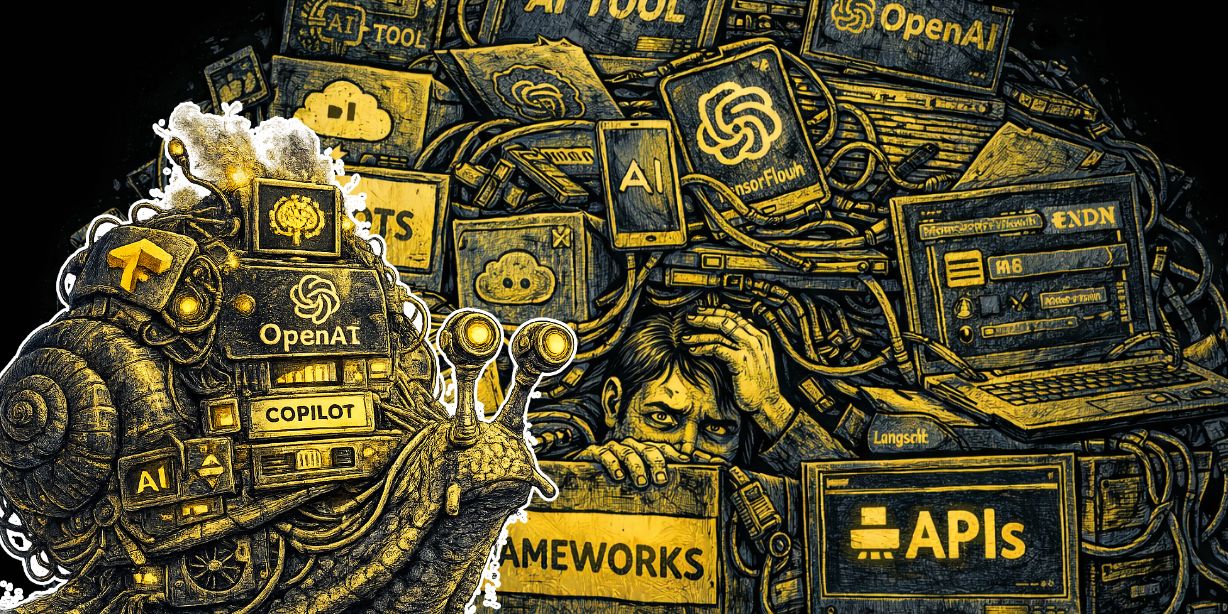
AI inefficiency is now the norm, not the exception, for organisations deploying artificial intelligence.
A January 2026 IDC study surveying 1,317 senior AI decision-makers found that 54.3% of organisations regularly use multiple AI frameworks or hardware platforms across their infrastructure. Of those, 92% report that this fragmentation has a negative effect on efficiency. The result is increased costs, increased complexity and decreased performance across the board.
The tools designed to make businesses smarter are, in most cases, making them slower and more expensive to run.
Why AI Inefficiency Is So Widespread
The problem starts with how most organisations adopt AI. Different teams select different tools based on their own projects, preferences or whatever platform they trialled first. One department uses TensorFlow. Another uses PyTorch. A third is experimenting with a completely different accelerator. Nobody coordinates and over time the business accumulates a patchwork of frameworks, hardware and platforms that were never designed to work together.
The IDC study quantifies the damage. Among organisations experiencing this fragmentation, the top reported impacts were redundant functionality across tools (41.6%), increased compute and resource costs (40%) and increased engineering complexity (40.4%). Beyond those, 37.4% reported increased latency, 34% had difficulty debugging performance issues and 27.7% faced maintenance and versioning challenges.
Every one of these problems costs money but because they sit in the infrastructure layer, and invisible to most business leaders, they rarely get the attention they deserve until the AI budget is already blown.
The Real Cost of AI Inefficiency
The financial impact of fragmentation compounds across every AI workload. Consider the IDC finding that even a 1% efficiency gain reduces total cost of ownership significantly at scale. For an application processing 500 million inferences daily, a 1% improvement in compute efficiency delivers over $1,800 in annual savings on a single service. Multiply that across dozens of AI models and operations and the savings — or conversely, the waste — quickly reaches hundreds of thousands or millions.
Now reverse that logic. If your infrastructure is fragmented, you’re not losing 1% efficiency, you’re likely losing 10%, 20% or more. The IDC data shows that 43% of AI training budgets were spent on tools that didn’t deliver expected productive value. For inference, it was 29%.
The waste isn’t just financial, it’s operational. When engineering teams spend their time managing compatibility issues between frameworks, debugging cross-platform performance problems and maintaining redundant tooling, they’re not building AI solutions that deliver business value. The complexity becomes the job, not the AI.
AI Inefficiency Gets Worse as You Scale
This is the uncomfortable truth that most AI vendors won’t tell you – fragmentation doesn’t resolve itself with growth, it gets worse.
The IDC study found that data management is a major compounding factor. Among the top challenges affecting business outcomes, 47.7% of respondents cited difficulties ensuring data quality, consistency and governance. Data storage costs and efficient management were flagged by 45.6% and the complexity of data cleaning and preparation by 44.1%.
As AI deployments scale, data volumes increase, more models are trained and inference loads grow. Each of these puts additional pressure on an already fragmented infrastructure. The result is a widening efficiency gap which means more spend, more complexity and less return.
This is why 32.6% of respondents identified controlling the rising costs of AI as their top concern over the next two years. The problem isn’t that AI is inherently expensive, it’s that fragmented, unplanned deployments make it unnecessarily expensive.
How to Fix AI Inefficiency
The IDC research points to three clear priorities for organisations tackling this problem.
First, cloud optimisation tools. Some 30.4% of respondents are investing here to better manage and scale their infrastructure costs. The objective is to move from static provisioning to dynamic, consumption-based models that match spend to actual usage.
Second, model optimisation techniques. Some 28.9% are implementing approaches like quantisation and distillation to make their AI models run more efficiently on available hardware, maximising utilisation without increasing spend.
Third, and most relevant for SMEs, partnering with specialist AI service providers. Some 26.3% of organisations are choosing this route to access external expertise and best practices rather than trying to solve the efficiency problem internally.
This third point matters because most SMEs don’t have — and shouldn’t need — internal teams capable of diagnosing infrastructure fragmentation, optimising model deployment, and managing multi-framework environments. That’s specialist work and it’s exactly where an AI Workshop adds value. It identifies where your current setup is creating waste, where tools overlap and where simplification delivers immediate cost savings. An AI Roadmap then builds a clear plan to consolidate, optimise and deploy AI in a way that eliminates the fragmentation problem before it scales.
The Bottom Line
AI inefficiency isn’t a technology problem, it’s a planning problem. The IDC data is unambiguous. Organisations that accumulate AI tools without a coherent strategy end up paying more, achieving less and burning engineering time on complexity management instead of value creation.
The 92% figure should be a wake-up call. If your business is using more than one AI tool or platform without a unified strategy, the odds are overwhelming that you’re already experiencing the negative effects, whether you’ve measured them or not.
Complete our free AI Readiness Assessment to find out where fragmentation is costing your business before it scales.
.jpg)