
Responsible AI in Regulated Industries: What Good Practice Looks Like
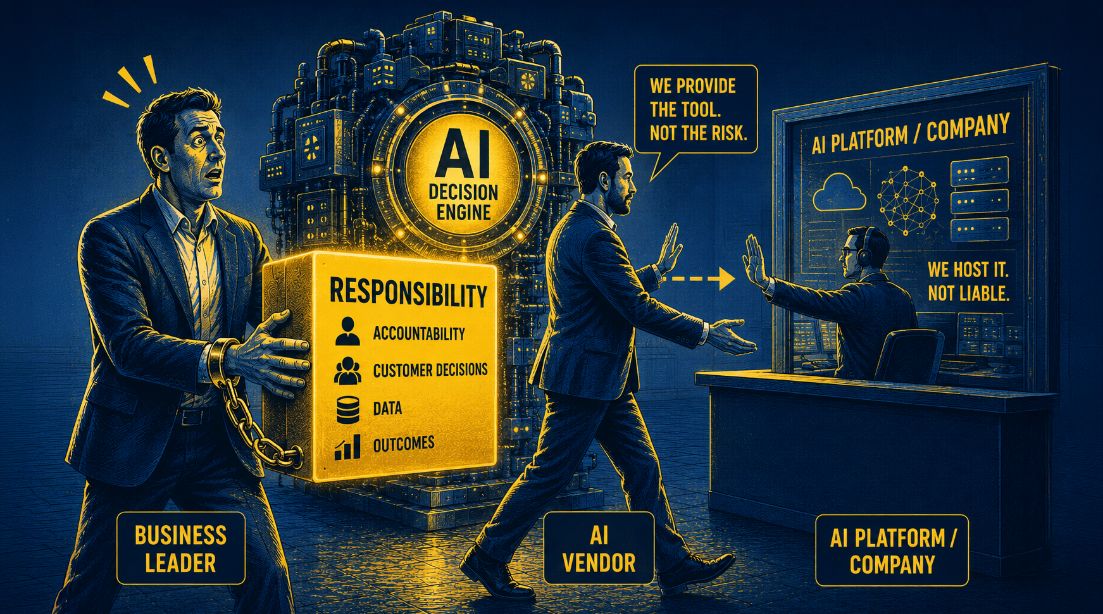
Responsible AI in regulated industries means showing a regulator what your AI systems decided, why they decided it and who checked the output before it reached a customer. For a small or mid-sized firm in finance, healthcare or professional services, that is a documentation problem before it is an ethics problem.
Ethics boards and Chief AI Officers belong to organisations with the budget for them. Accountability does not.
The UK government's AI Opportunities Action Plan set the direction in January 2025 by backing adoption across the economy. Regulators expect the accountability that travels with it.
What responsible AI means when your sector already has a regulator
Most definitions list fairness, transparency, accountability and privacy. Those principles hold. They help less on a Tuesday morning when you are pointing a new tool at your customer inbox.
In practice responsible AI comes down to three questions you can answer on demand.
What data do your tools use and where does it go? Which decisions do they make on your behalf? Can you explain any one of those decisions to a regulator, a client or an employee who asks?
None of that requires new law. Regulators already hold you to account for outcomes.
Putting an AI system in the middle of a process does not move that accountability to your supplier. The AI compliance duties attached to your sector are the duties you already carry, applied to a decision maker you never interviewed.
The accountability gap in regulated sectors
Financial services
The Bank of England and the FCA found that 75% of financial services firms already use AI, while only 34% claim complete understanding of the systems they use (Artificial intelligence in UK financial services, 2024). That gap is the exposure.
A lending, pricing or advice decision belongs to the firm that made it, whether the model came from the IT team or a supplier. The FCA have not written a separate AI rulebook. Our reading of their published approach is that they do not intend to, because the Consumer Duty, senior manager accountability and outsourcing rules already reach AI-driven outcomes.
Healthcare and life sciences
The MHRA classify software with a medical purpose as a medical device, which brings approval duties and post-market surveillance (Software and artificial intelligence as a medical device). Triage tools, diagnostic support and some clinical workflow software sit inside that definition.
Under UK GDPR, data minimisation, access control and audit trails are legal requirements rather than good habits. Any tool touching patient data needs that framework in place before it goes near a clinical pathway.
Legal and professional services
Professional liability follows the practitioner. If an AI tool drafts a weak clause, produces a wrong tax position or misreads a case, the professional who signed it off carries it.
Guidance from the professional bodies remains thin. Until that changes, the commercially sensible position treats AI as a capable junior: strong on research, drafting and summarising, never the last pair of eyes.
'The deadline moved. We have time.'
That objection has a real basis. The EU's Digital Omnibus, which legislators adopted in June 2026, deferred the high-risk obligations of the EU AI Act to 2 December 2027 for standalone systems and to 2 August 2028 for AI inside regulated products (Freshfields).
Three points cut against it. The Act's transparency obligations applied from 2 August 2026 and escaped the deferral. Any EU-facing chatbot or synthetic media you publish sits in scope today.
UK regulators never worked to the EU timetable in the first place, because the FCA, the MHRA and the professional bodies set their own. Legislators also moved the date because the standards and conformity infrastructure were not ready, not because the obligations softened.
If EU exposure is the live question for your business, our EU AI Act readiness workshop deals with it directly.
Responsible AI governance without an ethics team
Three habits cover most of what a regulator will ask an SME.
Documentation. Keep a register of every AI tool in use, the data it touches, who has access and what it decides.
Human oversight. Name the decisions that carry enough consequence to need sign-off before they become an action, then name the person who signs.
Review cycles. Models drift and suppliers change their systems without telling you. A quarterly look at both catches problems while they are still small.
What good looks like
Take a mid-sized accountancy practice automating client reporting. Before anything goes live the partners confirm the tool meets UK GDPR requirements, confirm client data will not train third-party models, name the accountant who reviews every report and write down what happens when the tool gets something wrong.
Four decisions, none of them technical, each one landing before the build rather than after the complaint. Our view, from the work we do across regulated sectors, is that governance settled at this stage costs a fraction of the same work bolted on later. You can see how that plays out in our AI case studies.
Where to start
Start with what you already run rather than what you plan to buy. From there the AI Workshop surfaces the governance questions early using our Rose, Thorn, Bud method. The AI Roadmap then sequences deployment so compliance stays manageable phase by phase.
We advise independently rather than resell software, which is why our AI consulting services treat governance as part of the build instead of a separate product.
Frequently asked questions
What is responsible AI?
Responsible AI is the practice of designing, deploying and managing AI systems so they stay transparent, fair, accountable and lawful. For a regulated business it means holding evidence of what your systems do and who oversees them, ready for the day someone asks.
Do SMEs need to comply with the EU AI Act?
If you serve customers in EU member states or deploy AI systems there, the Act reaches you regardless of size. Transparency obligations applied from 2 August 2026 and high-risk obligations for standalone systems now apply from 2 December 2027. Take independent legal advice on your specific position.
Who is liable when an AI tool gets it wrong?
In regulated sectors, the firm or the professional who acted on the output. Buying the tool from a third party does not transfer the duty, which is why contracts, documented oversight and human review at the decision points matter more than vendor assurances.
How do we build a responsible AI framework without a compliance team?
Map where the business uses AI, rate each use by consequence, put named human oversight on the high-consequence ones and review quarterly. Most SMEs reach a defensible position in weeks rather than months.
Responsible AI in regulated industries rewards the businesses that write things down early. Regulators will ask what the system decided and who checked it. Firms with an answer ready spend a morning on that question rather than a quarter.
Find out where you stand with our free AI readiness assessment. Two to three minutes, no obligation and a readiness score at the end.
%20(1).png)
%20(1).png)
%20(1).png)