
Anthropic’s Agentic AI Tool: What the ant CLI Means for SMEs
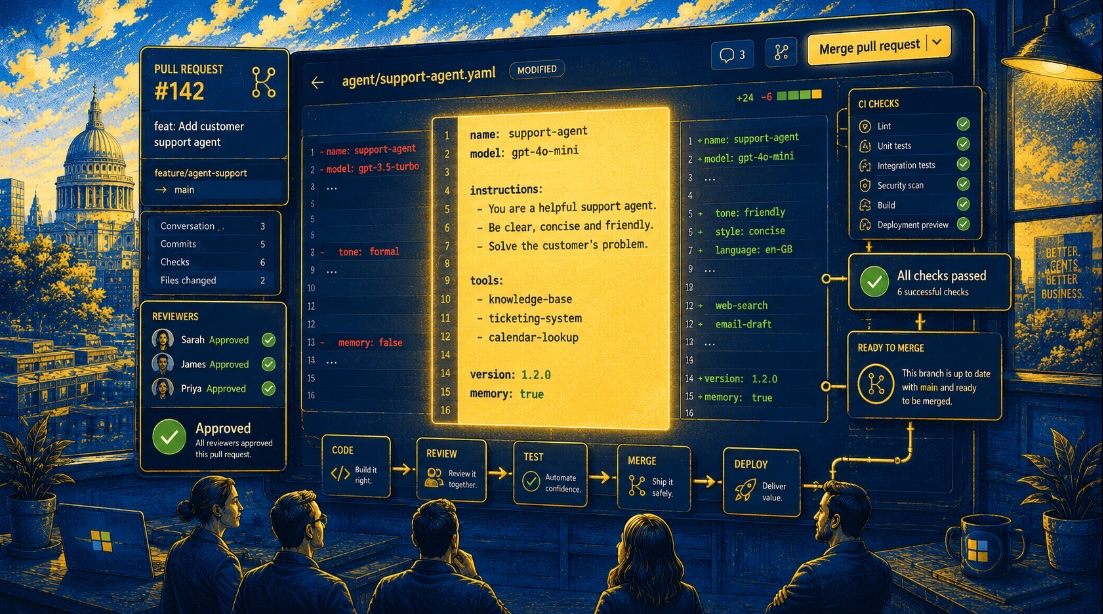
Anthropic’s Agentic AI Tool, the ant CLI, was released as the official command-line client for the Claude Developer Platform, and the wider implications are bigger than the technical specifications suggest.
The tool lets developers run every Claude API endpoint from their terminal, define agents in YAML files, check those files into Git and deploy AI agents the same way they ship code. The headline most coverage missed is what that combination actually means. AI agents have stopped being prompts you babysit. They have started being infrastructure you deploy. For UK SME leaders this matters even if your team will never touch the ant CLI itself, because the shift it represents tells you where AI is heading next.
What Anthropic’s Agentic AI Tool Actually Does
The ant CLI is a command-line interface that exposes every Anthropic API endpoint as a subcommand. You install it via Homebrew or Go, authenticate through your browser and start running commands like ant messages create, ant models list, ant beta:agents retrieve and ant beta:sessions:events list. The technical capability is straightforward. The strategic implication is not.
The genuinely interesting feature is the YAML workflow. Anthropic’s Agentic AI Tool lets you define an entire AI agent as a YAML configuration file, check that file into your Git repository alongside your application code and use CI to keep the deployed agent in sync with the version-controlled definition. As Anthropic puts it in their own documentation, the CLI is for the control plane while the SDK is for the data plane. Translation: agents and environments are now static resources you configure and version, while sessions and events stay dynamic and run through your application.
The second meaningful capability is the integration with Claude Code, which knows how to drive the ant CLI natively through a built-in skill. Developers no longer write glue code to call the API. They tell Claude Code what they want and Claude Code shells out to ant. The friction between defining an agent and deploying it has collapsed.
Anthropic’s positioning is deliberate. They are not selling Anthropic’s Agentic AI Tool as a developer convenience. They are positioning it as the operational substrate that turns AI agents into deployable, version-controlled, governable infrastructure. The implications travel well beyond developers.
Why Anthropic’s Agentic AI Tool Signals a Maturity Shift
For most of the last three years, AI agents have been treated by businesses as something between a clever chatbot and a productivity experiment. You wrote prompts, you tweaked them, you ran them, you watched what happened and you iterated. The work was real but the artefacts were ephemeral. There was nothing to commit to a repository, nothing to review in a pull request, nothing to deploy through a pipeline.
Anthropic’s Agentic AI Tool changes that posture. AI agents become files you can read, review, version, audit, deploy, roll back and re-deploy. They get a Git history. They sit alongside your application code in your repository. They go through code review. They pass through CI before they reach production. The maturity gap between AI agents and the rest of your software stack closes.
The strategic implication for UK SMEs is significant even if your team will never run an ant command. The shift Anthropic’s Agentic AI Tool represents is the same shift every previous wave of enterprise technology made on its way from experimental to operational. Web applications went through this transition in the late 2000s. Infrastructure went through it with the cloud era. Machine learning went through it with MLOps. AI agents are now making the same move, and businesses that understand the implications early build a structural advantage over the ones still treating AI as a prompt experiment.
What Anthropic’s Agentic AI Tool Means for Governance
The most commercially important implication is governance. UK SMEs running shadow AI activity across their teams have a problem that no policy document can solve, because the activity itself is invisible. Anthropic’s Agentic AI Tool offers the first credible path to making AI agent deployment auditable in the same way code deployment is auditable.
Every agent becomes a file with a Git history. Every change to an agent goes through review. Every deployment leaves a trail. Every rollback can be evidenced. The audit problem that has been making compliance officers nervous about AI suddenly looks more tractable, because the underlying capability is moving from ‘employee using a chatbot’ to ‘business deploying a versioned artefact’.
This matters more as the regulatory environment tightens. As we explored in our EU AI Act blog, the substantive provisions of the EU AI Act come into force on 2 August 2026, with extraterritorial scope that catches any UK business with EU customers. Penalties run up to 7% of global annual turnover for serious violations. The businesses with structured, auditable, version-controlled AI agent deployments will find compliance dramatically easier than the businesses with unstructured shadow AI activity across their teams.
Anthropic’s Agentic AI Tool and the Vendor Concentration Question
The release also sharpens a question we covered in our AI as a Utility blog. Anthropic’s Agentic AI Tool is built specifically for the Claude Platform. The YAML configurations are Anthropic-specific. The agent definitions live in Anthropic’s managed agent infrastructure. The deeper your business builds on top of Anthropic’s Agentic AI Tool, the more locked in to Anthropic your AI capability becomes.
This is not a criticism of Anthropic specifically. Every vendor in the AI market is racing to build the operational substrate that captures the next decade of enterprise AI deployment. The ant CLI is genuinely good software and a meaningful capability uplift for businesses building on Claude. It is also exactly the kind of capability that creates structural switching costs over time.
SMEs investing in AI infrastructure should think about this the way they think about any other foundational supplier choice. As we covered in our Claude vs ChatGPT for business coverage, the most resilient SME AI strategies in 2026 increasingly run multiple vendors with clear workflow rules about which handles which task. The same logic applies to agent infrastructure. Building deeply on a single vendor’s agent platform is a strategic choice, not a default to fall into.
Where Anthropic’s Agentic AI Tool Sits in Your AI Strategy
The release fits naturally into the broader AI Confidence Journey we use as the structural spine for SME AI adoption. We cover the full framework in our AI Confidence Journey blog, but the relevance for Anthropic’s Agentic AI Tool is specific to the later stages.
At the Confused and Curious stages, Anthropic’s Agentic AI Tool is genuinely not your concern. The right work is establishing where your business stands and what AI capability would deliver commercial value. The free AI Readiness Assessment is the right first step.
At the Committed stage, your AI Roadmap should now factor in the operational maturity of the vendor platforms you are choosing between. The ant CLI changes how ‘serious’ Anthropic looks for businesses that need governed, deployable AI agents.
At the Capable stage, businesses building agentic workflows are now able to do so on properly version-controlled infrastructure. AI Implementation for SMEs running agentic systems looks materially different in mid-2026 than it did twelve months ago, with the operational substrate having matured significantly.
At the Confident stage, AI Optimisation and Support becomes easier when the agents being optimised are versioned artefacts rather than ephemeral prompts. Diagnostic, refinement and scaling all work better when the underlying assets are auditable.
The journey itself does not change. The artefacts you work with at the Capable and Confident stages now look significantly more like production software, which is exactly the maturity shift Anthropic’s Agentic AI Tool signals for the wider market.
Anthropic’s Agentic AI Tool: What UK SME Leaders Should Take From It
Anthropic’s Agentic AI Tool is technical news that has strategic implications for every SME thinking seriously about AI. The capability itself matters less than what it tells you about where the market is heading. AI agents have moved from prompts you babysit to infrastructure you deploy. The shift from experimental to operational is happening faster than most coverage suggests, with the operational substrate maturing through 2026 in ways that were not available twelve months ago.
The businesses that handle this transition well will treat AI agents the way they already treat their other business-critical software, with version control, code review, deployment pipelines, audit trails and governance built in from the start. The businesses that continue to treat AI as a series of individual employee experiments will look increasingly exposed as regulatory pressure rises, vendor concentration sharpens and the gap between experimental AI use and operational AI deployment widens.
For SMEs, the practical question is not whether to install the ant CLI. The practical question is whether your AI strategy reflects the operational maturity the market is now demanding. If it does not, you are running last year’s playbook in a market that has moved on.
Complete our free AI Readiness Assessment to understand where your business currently sits on the AI Confidence Journey, what your AI agent strategy should look like in a market where agents are becoming deployable infrastructure and how to position your business for the operational maturity the market is now demanding.