AI Growth vs AI Saving: Which One Comes First
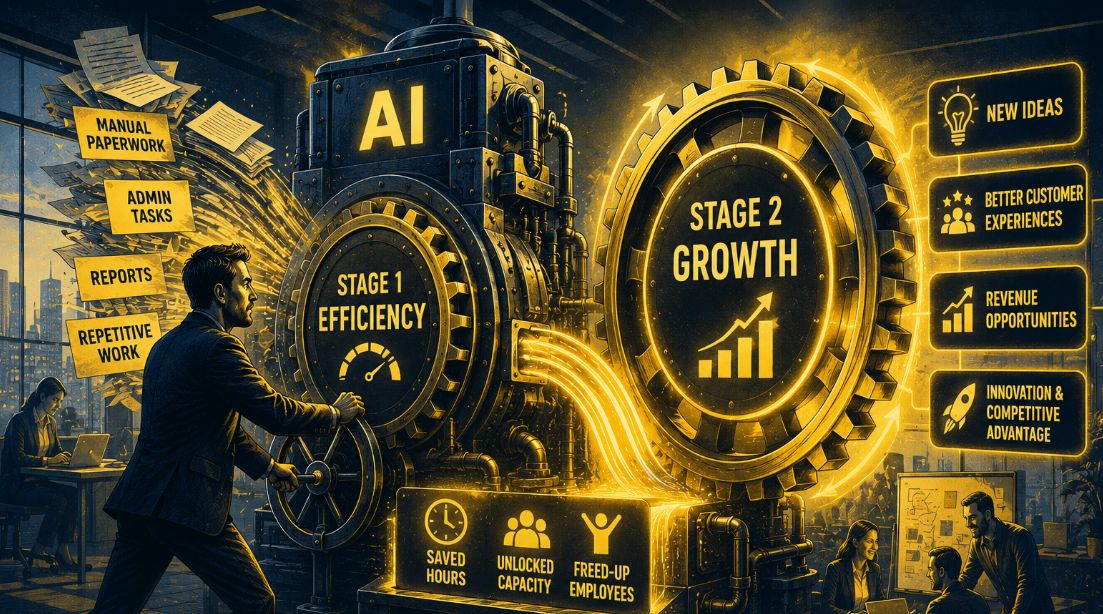
AI saving comes first. AI growth is where the value sits. The distance between the two is where most SMEs get stuck.
That is the short answer to the AI growth vs AI saving question. The longer answer covers why the sequence matters and why so few businesses ever finish it.
What AI saving and AI growth mean in practice
AI saving means using AI to take cost and time out of what you already do. Automated reporting, AI-assisted customer service, faster invoice processing, less manual admin. The wins are measurable and they show up on the P&L within weeks.
AI growth means using AI to earn revenue you could not earn before. New products, new markets, personalisation at a scale your headcount could never support. These take longer, cost more and need a commercial case behind them.
Both are legitimate. Only one of them is common.

The evidence: almost everybody stops at saving
ONS figures published in July 2026 show AI use among UK businesses with 10 or more employees rising from around 12% in late 2023 to around 35% by June 2026 (Artificial intelligence in UK businesses). Adoption is no longer the interesting number.
Depth is. The average adopting business runs 1.6 AI technologies, up from 1.4 in late 2023. Only 10% describe their use as extensive.
Improving business operations is the most reported purpose, cited by close to 60% of businesses, while developing new products or exploring new markets sits well behind.
McKinsey's global survey tells the same story from the other end. Eighty per cent of respondents set efficiency as an objective for AI, yet the companies capturing the most value set growth or innovation as objectives as well (The state of AI in 2025).
Only 39% report any EBIT impact at all. Most of those put it below 5%.
The saving that never gets redeployed
One ONS finding deserves a longer look. Of the UK businesses using AI to improve operations, 63% report no change in workforce headcount and 6% report a decrease.
The saving is real. It arrives as recovered hours rather than as removed cost, which is exactly why so much of it evaporates.
Recovered hours only become value when somebody decides where they go. Without that decision the hours quietly refill with more of the same work.
How to use AI saving to fund AI growth
Step one: name the destination before you automate
An AI workflow that hands your operations team eight hours a week has achieved nothing on its own. Those eight hours become value only when they go to customer development, product work or market expansion.
Decide that destination before the automation goes live, not after. Our AI Workshop uses the Rose, Thorn, Bud method to find where a business loses time today, then maps those findings to the growth opportunities worth funding tomorrow.
Step two: build a roadmap that carries both
A phased AI Roadmap should set out the cost cuts and the capability investments in one sequence, with timelines, costs and projected return against each. It should also show which savings pay for which investments.
Without that, most SMEs default to whichever tool is cheapest or loudest this quarter. That approach produces a collection of tools rather than a position.
'We will get to growth later'
That is the honest objection. It deserves an honest answer.
Later rarely arrives. The ONS depth figures have barely moved in three years, which suggests that businesses starting with efficiency tend to stay with efficiency. McKinsey found the same pattern globally, with roughly a third of organisations scaling AI at all and the smallest companies furthest behind: 29% of those under $100 million in revenue have reached the scaling phase, against nearly half of those above $5 billion.
Our view is that the sequence only works when both stages sit in the same plan with dates against them. A saving-first strategy with no written growth stage is a cost-cutting exercise wearing a strategy label.
What good looks like for an SME
A business doing this well will have automated two or three high-frequency, low-value processes. It will have pointed the recovered capacity at one revenue-facing initiative and measured what came back.
It will also know where its AI compliance exposure sits before a customer or a regulator asks. Above all it will hold a plan with two stages in it rather than a shelf of tools bought one at a time.
There is one advantage smaller businesses hold here. The same ONS data shows that developing new products and exploring new markets are more commonly reported by smaller businesses than larger ones, which suggests the growth stage is easier to reach at your size than at enterprise scale.
Where to start
Start with an honest baseline: your current tools, your team's AI literacy, your data quality and your appetite for change. Our free AI readiness assessment gives you that in two to three minutes and it feeds straight into the workshop and roadmap that follow.
That order is how our AI consulting services run, with saving first and growth planned alongside it rather than after it. AI implementation support then turns the plan into systems your team uses daily.
Frequently asked questions
Should an SME focus on AI saving or AI growth first?
Start with AI saving. Cutting operational cost and recovering capacity gives you the time and money to fund growth work. The condition is that you name the growth destination in the same plan, because capacity with nowhere to go simply fills up again.
How quickly can AI deliver cost savings for a small business?
In our experience, targeted automation in admin, reporting or customer communication shows measurable time savings inside the first month. Anything more ambitious depends on the process rather than the tool, which is why the diagnostic comes before the purchase.
Is AI growth realistic for SMEs without large budgets?
Yes, with a structured approach. ONS data suggests smaller businesses report using AI for new products and new markets more often than large ones do. The barrier is usually clarity about which revenue opportunity you are chasing.
What is the biggest mistake SMEs make with AI strategy?
Buying tools without a plan. Fragmented adoption delivers patchy savings, no growth stage and no way to prove return, which makes the next investment harder to justify internally.
The AI growth vs AI saving question answers itself once both stages live in one plan. Saving buys you the time. Growth is what you choose to spend it on.
See where your business stands with our free AI readiness assessment. Two to three minutes, no obligation and a readiness score at the end.
%20(1).png)
%20(1).png)
%20(1).png)