Anthropic Models the AI Impact on the Economy by 2030
.png)
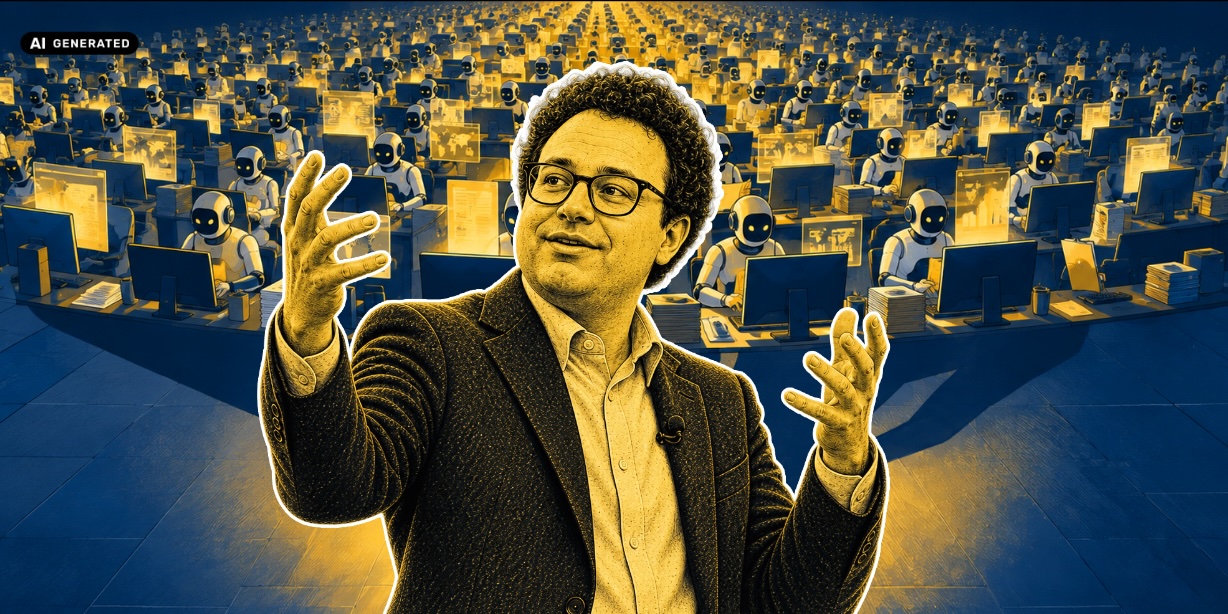
The AI impact on the economy has a new forecast and it comes from the company building the technology. Anthropic has published a model of what AI could do to the US economy by 2030, with three scenarios running from mild to startling. The startling one deserves the attention of anyone running a business built on knowledge work.
The Anthropic Economics team, working with economists Anton Korinek and Chad Jones, treats the economy as a bundle of tasks. AI leaves some tasks alone, helps with others, automates some outright and creates a few new ones. Add up every instance of every task across the country and you have the economy. Change what AI can do and how quickly firms adopt it and the numbers move. Anthropic has built an interactive explorer so readers can plug in their own assumptions and see where they land.
Three scenarios for the AI impact on the economy
In the modest scenario AI has roughly the impact of the internet. GDP ends up 1.6% higher in 2030 than it would otherwise be and the effect is hard to spot in the macro data.
In the substantial scenario AI can do half of all knowledge work by 2030, most of it without a human in the loop, yet most knowledge work is still done by people because adoption lags capability. The economy grows at twice its normal rate, GDP is 8.3% higher, knowledge worker wages are flat and everyone else sees gains.
In the extreme scenario AI is better than people at the vast majority of knowledge work, does nearly all of it alone and creates essentially no new knowledge tasks for humans. Anthropic says this would probably require AI systems that improve themselves. GDP is 32.4% higher, growth reaches 15% a year and the economy doubles in size every four and a half years. Knowledge worker wages fall by more than 10%. Unemployment rises beyond the levels of a typical recession. Capital takes 54.8% of every dollar produced, up from 40% today. Total labour income in 2030 is barely changed, in an economy a third larger.
That last line is the one to sit with. The pie grows enormously and workers as a whole take home roughly what they took home before. Anthropic puts it plainly: in that world the challenge is no longer growth, it is making sure the gains are shared.
Which AI impact on the economy should you plan around?
Anthropic surveyed 10,980 Americans in August and the typical respondent’s expectations map to the substantial scenario: GDP about 10% higher by 2030 and unemployment around 5%. Roughly one in ten hold views in line with the extreme case. Several of the economists who reviewed the model told Anthropic the extreme scenario reads better as a thought experiment than a forecast.
The substantial scenario is uncomfortable enough on its own. AI capable of half of knowledge work. Adoption, not capability, as the constraint. Knowledge worker pay flat while trades, care and hands-on roles gain. That is a plausible description of 2030 and it has consequences for hiring, training and pricing in every professional services firm in the country.
The caveats on Anthropic’s model
This is a US model with no UK equivalent. It is version 1.0. It leaves out policy responses, business cycles, the data centre buildout, financial market shocks and robots. It does not follow individual workers, so it paints a coarse picture of what displacement costs the people it lands on. Some reviewers think the modest scenario understates what is already visible in the data. Anthropic lists all of this itself, which is to its credit.
There is also the obvious point that the firm selling the technology has published the forecast. That does not make the model wrong. It does mean reading it as one informed view rather than the last word, in the same way we read the Microsoft and OpenAI split as a commercial signal rather than a neutral event.
What the AI impact on the economy means for an SME
Three things stand out for a business owner in the UK.
The adoption gap is where the margin sits
In the substantial scenario most knowledge work still happens without AI even though AI could handle half of it. The firms that close that gap early take the productivity gain and the margin that comes with it. That is the case for an AI Roadmap before your competitors have one. A roadmap turns ‘we should be doing something with AI’ into a sequenced plan with owners, budget and dates.
Demand moves towards work AI cannot do
The model says that when designs, permits and paperwork move faster, more building gets built and more care gets delivered. If your business is in construction, care, trades or manufacturing, AI speeds up the admin around you and the work follows. The question is whether you are set up to catch it. Our AI Workshop exists for exactly that question: two days with your leadership team to find where AI takes the friction out of your operation.
The wage story is a hiring story
If knowledge worker pay flattens, the roles you recruit for change. Fewer people producing first drafts, more people checking, directing and owning outcomes. That is a training problem before it is a hiring problem, which is why we start most engagements with AI Training rather than tooling. A team that can direct AI well is worth more than a team that can use it.
Anthropic ends with the line that the future is not predetermined. For a business of 20 or 200 people that is true in a very practical sense. The scenario you end up in depends far more on what you put into AI Implementation in the next 18 months than on what Silicon Valley ships in the next four years.
.jpg)