AI Risk vs AI Opportunity: What SMEs Get Wrong
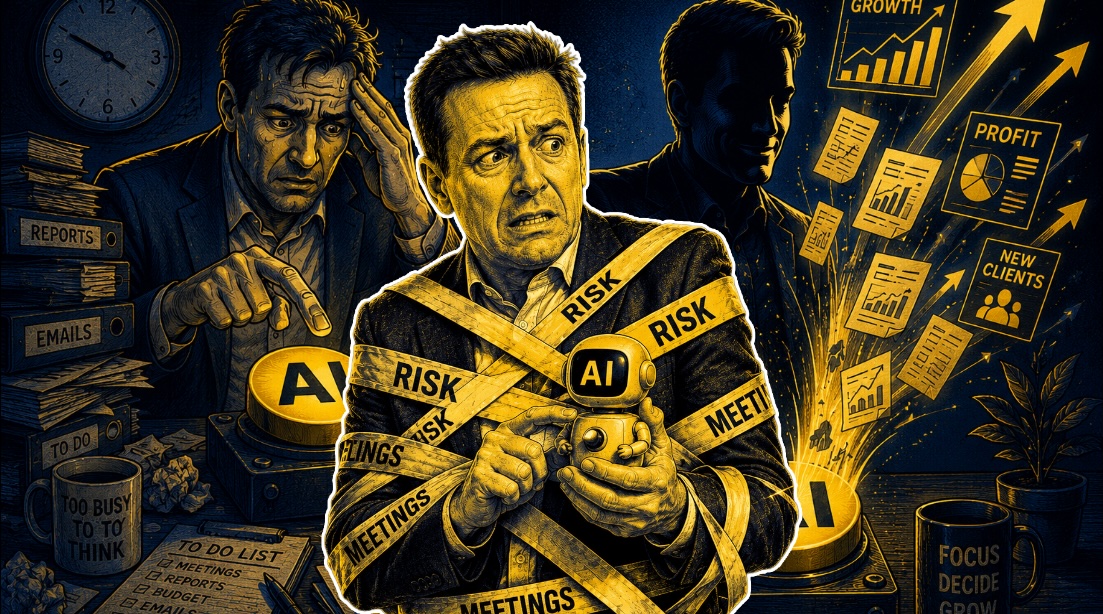
AI risk vs AI opportunity is the wrong debate for most businesses to be having. Not because risks do not exist, but because the businesses spending the most time discussing them are often the ones falling furthest behind. The real question is not whether AI is dangerous. It is whether your competitors are using it while you are still deliberating.
Why the Risk Conversation Has Gone Too Far
There is a version of caution that protects a business. Then there is a version that paralyses it. In conversations about AI across UK SMEs, the balance has tipped too far towards the latter.
Every week, leadership teams sit in rooms debating bias, hallucinations and data privacy while their faster-moving competitors automate their quoting process, their customer follow-up and their reporting. The risks are real. They are also, in the vast majority of practical business applications, manageable.
The point is not to dismiss concern. It is to put it in proportion.
What Businesses Actually Lose by Waiting
The opportunity cost of inaction is rarely calculated with the same rigour applied to the risks of adoption. According to McKinsey's 2025 State of AI report, organisations that have integrated AI into core workflows are already reporting meaningful productivity gains and cost reductions. The gap between early adopters and late movers is widening, not narrowing.
For an SME running on tight margins, that gap is not abstract. It translates into slower turnaround times, higher labour costs per unit of output and sales teams spending time on tasks that a well-configured AI tool could handle in seconds.
If your business has not yet taken a structured look at where AI fits, our AI readiness assessment is a practical first step that takes around two minutes and costs nothing.
AI Risk vs AI Opportunity: Getting the Balance Right
The most commercially useful way to think about AI risk vs AI opportunity is through a simple lens: what is the cost of each? Most risk assessments focus on the downside of doing something. Few factor in the downside of doing nothing.
A business that waits two years before adopting AI has not avoided risk. It has chosen a different risk. It has accepted the risk of falling behind operationally, of losing talent who want to work with modern tools and of competing on cost with businesses that have already automated the work it still does manually.
The EU AI Act: What SMEs Actually Need to Know
The EU AI Act, which began phasing in from 2024 and continues through 2026, has added a layer of regulatory vocabulary to conversations about AI. It is worth understanding, but it is also worth keeping in proportion for most SMEs.
The Act classifies AI systems by risk level. The vast majority of tools that a typical SME would use, such as AI writing assistants, scheduling tools, customer service chatbots and data summarisation platforms, fall into the minimal risk category. They are not subject to the Act's more demanding compliance requirements.
Where the Act becomes directly relevant to SMEs is in high-risk applications, particularly those involving automated decision-making about people, such as recruitment screening or credit scoring. If your planned AI use sits in that space, compliance matters and you need proper guidance. For the rest, the Act is less a barrier and more a framework that, if followed sensibly, supports responsible adoption rather than blocking it.
Our AI compliance service helps SMEs understand exactly where they stand, so regulation becomes a clear boundary rather than a reason to do nothing.
The Greater Risk: Failing to Adopt AI Strategically
Here is a point that rarely appears in the risk assessments: the greatest AI-related risk facing most UK SMEs right now is not adopting AI badly. It is not adopting it at all, or adopting it without a coherent strategy.
Buying a handful of AI subscriptions without a clear plan is genuinely wasteful. Tools get used inconsistently, data does not connect, staff revert to old habits and the investment produces little. However, this is not an argument against AI. It is an argument for doing it properly.
A structured AI roadmap removes this problem. It identifies the highest-value opportunities specific to your operations, sequences implementation in a way that builds on itself and sets measurable outcomes from the start. Strategy is what separates businesses that get a return from AI from those that add it to the list of things that did not work out.
How a Diagnostic Approach Changes the Equation
Before committing budget to any AI implementation, a diagnostic conversation can fundamentally shift how you see the opportunity. Our AI workshop is a fixed-fee session designed to do exactly that. It maps where AI can make the biggest commercial impact in your specific business, not in a generic case study, but in your operations, with your workflows and your team.
Jon Rew, Managing Director of Scimitar Sports, put it plainly after going through this process: 'We learned a lot from the AI Readiness Assessment, which is surprising as it didn't take long to complete. The report highlighted things that were likely costing us money and they were, which we addressed in the AI Workshop. We're now implementing the AI Roadmap with a phased plan and AI Expert are supporting us every step of the way.'
That progression from assessment to workshop to roadmap to implementation is what makes AI adoption sustainable rather than speculative.
What a Balanced AI Strategy Actually Looks Like
A business that has got this right does not ignore risk. It accounts for it honestly and then moves forward. Practically, that means choosing tools appropriate to the risk level of the task, ensuring staff understand how to use them correctly through proper AI training and building in review points to check that outcomes match expectations.
It also means not trying to do everything at once. The SMEs seeing the strongest results from AI are typically starting with one or two high-friction, time-consuming processes and automating those well before expanding. The wins compound. Confidence builds. The organisation learns to integrate AI as a capability rather than treating it as an event.
As a result, the conversation shifts. It stops being about whether to adopt AI and starts being about which opportunity to pursue next.
For a broader look at how SMEs are applying this thinking, our piece on AI automation and UK SMEs scaling without adding headcount is worth reading alongside this one.
Frequently Asked Questions
What are the biggest AI risks for small businesses?
The most commonly cited risks include data privacy concerns, over-reliance on inaccurate outputs and the cost of tools that do not deliver a return. However, many of these are manageable with proper guidance and the right implementation approach.
Does the EU AI Act affect UK SMEs?
The EU AI Act primarily affects businesses deploying AI in high-risk contexts such as automated HR or credit decisions. Most SMEs using standard productivity and automation tools fall into the minimal risk category and face very limited compliance obligations under the Act.
How do I know if AI is worth it for my business?
Start with a structured assessment of where time and cost are being lost in your operations. If repeatable, manual tasks are consuming significant staff hours, AI is almost certainly worth exploring. A free AI readiness assessment is the fastest way to find out.
Is it better to wait until AI matures before adopting it?
Waiting carries its own risk. AI tools available today are already delivering measurable results for SMEs. The businesses building capability now will have a structural advantage over those who defer the decision. The conversation about AI risk vs AI opportunity will not resolve itself. However, for SMEs operating in competitive markets, sitting on the sideline while the tools mature is a choice with consequences. If you are ready to move from deliberation to action, our AI consulting services are built to make that transition practical, commercial and measurable.
.png)
.png)
.png)