AI Content Marketing: What SMEs Need to Know
AI content marketing is reshaping how small and medium-sized businesses compete for attention, customers and revenue. The question is no longer whether AI belongs in your content strategy. It is whether you are using it well enough to matter.
For most SMEs, content marketing has always been a resource problem. You know you need consistent, high-quality output across your website, email, social and search. You rarely have the team or the budget to deliver it at scale. AI changes that equation, but only if you approach it with a clear strategy rather than a handful of disconnected tools.
How AI Content Marketing Is Changing the Competitive Landscape for SMEs
The shift happening right now is structural, not cosmetic. According to HubSpot's State of Marketing Report 2025, over 80% of marketers using AI say it improves their content quality and saves significant time. For larger businesses, that efficiency gain is useful. For an SME with a lean team, it is transformational.
The competitive gap between a well-resourced enterprise marketing department and a five-person SME used to be enormous. AI is closing it. A business that builds the right content infrastructure today can produce, distribute and optimise content at a pace that simply was not possible three years ago.
However, the businesses pulling ahead are not those who adopted AI the fastest. They are those who aligned it to a coherent commercial strategy from the start. Speed without direction produces noise, not results.
What AI Content Marketing Actually Means in Practice
AI content marketing is the use of artificial intelligence tools to assist with the creation, personalisation, distribution and performance analysis of content. That covers a wide range of activity, from using a large language model to draft a blog post, to using predictive analytics to identify which topics will drive the most traffic, to automating email sequences based on user behaviour.
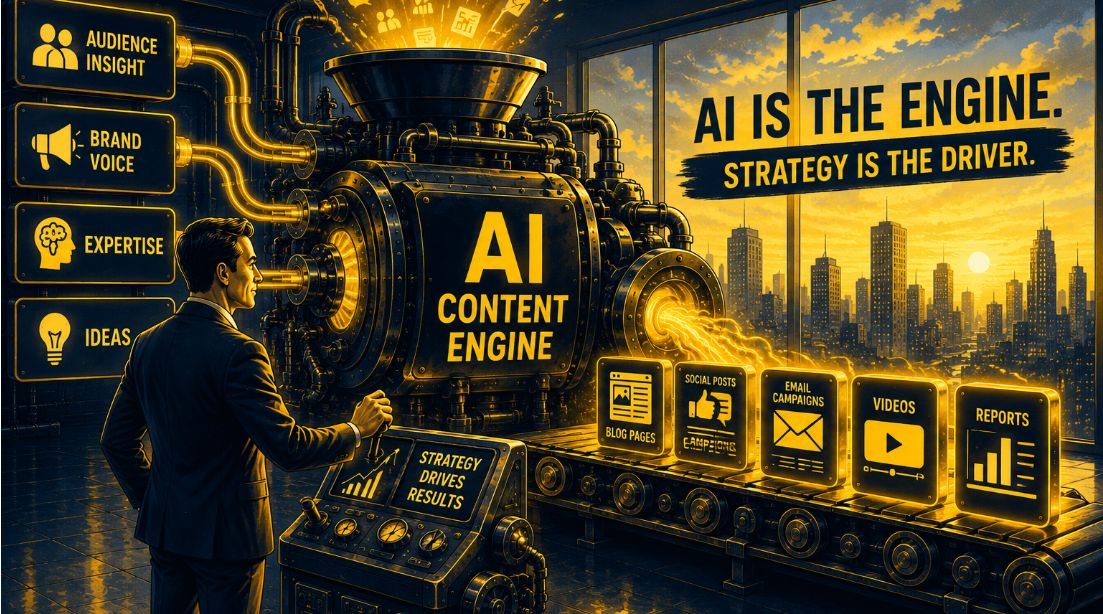
The key word is 'assist'. AI does not replace the strategic thinking that makes content connect with a specific audience. It accelerates execution once that thinking is in place. SMEs that conflate the two often produce a high volume of generic content that ranks for nothing and resonates with no one.
Does AI Content Marketing Actually Improve SEO?
This is one of the most common questions SME owners ask, and the honest answer is nuanced. AI-assisted content can significantly improve SEO performance when it is structured around genuine search intent, built on accurate information and edited to reflect authentic expertise. Google's own guidance, including its helpful content guidance, is explicit: it rewards content that demonstrates experience, expertise, authority and trustworthiness regardless of how that content was produced.
The risk is on the other side. Businesses that use AI to churn out thin, repetitive content at scale are building on unstable ground. Search algorithms are increasingly sophisticated at identifying low-value output and the penalties for it are real.
The SMEs winning at AI content marketing are treating AI as a production accelerator, not a strategy replacement. They identify what their audience actually needs to read, they brief the AI properly and they edit the output with a human eye for quality and originality.
The Role of a Content Strategy Before You Touch Any Tool
This is where most SMEs go wrong. They start with a tool and work backwards to a purpose. The businesses seeing genuine commercial returns start with a content strategy that defines their audience, maps content to the buyer journey and sets clear metrics for success. Only then do they bring AI into the production process.
That strategic foundation is exactly what a structured AI workshop can help you build. Before you commit budget to any AI content tool, it is worth understanding where your real opportunities are and what a realistic return looks like.
How to Use AI for Content Marketing Without Losing Your Brand Voice
Brand voice is the most common casualty of rushed AI content adoption. When you feed a generic prompt into a general-purpose tool, you get generic output. That output might be grammatically correct and reasonably informative, but it will not sound like you. For SMEs that have built customer trust on a distinctive personality, that erosion matters.
The solution is not to avoid AI. It is to invest time upfront in defining your voice clearly enough that the AI can reflect it. That means building detailed prompt frameworks, creating style guides the model can reference and editing outputs critically rather than publishing them wholesale.
It also means being selective about which content types you use AI for. Long-form thought leadership that showcases deep expertise still benefits from a human-led approach. Routine content such as product descriptions, email subject lines and social copy is where AI delivers the greatest time savings with the least brand risk.
Measuring the ROI of AI Content Marketing
One of the clearest signals that an SME has a mature AI content strategy is that they measure it. Not just traffic and rankings, but pipeline influence, conversion rate by content type and cost per qualified lead.
AI tools can also support the measurement process itself, automating the aggregation of performance data and surfacing patterns that would take a human analyst hours to find. If you are not yet measuring your content at this level of precision, our AI readiness assessment is a good place to start.
Building an AI Content Marketing Strategy That Scales
Scaling AI content marketing responsibly requires a phased approach. In the first phase, you audit your existing content, identify the gaps and establish your baseline metrics. In the second phase, you introduce AI into your production workflow selectively, starting with the highest-volume, lowest-risk content types. In the third phase, you integrate AI into your distribution and optimisation processes, creating a feedback loop where performance data informs future content decisions.
This phased approach maps closely to the methodology AI Expert uses across all of its engagements. The AI roadmap we build with clients does not just cover content. It covers the full picture of where AI can deliver measurable value across the business. But for many SMEs, content is the most accessible starting point because the output is visible, the results are measurable and the investment required is relatively low.
For businesses that want to go further and build custom content infrastructure, AI software development services can create bespoke tools tailored to your specific content processes and brand requirements.
It is also worth noting that as AI content marketing becomes more sophisticated, so do the compliance and governance requirements around it. Understanding your obligations, particularly around transparency and data use, is increasingly important. Our AI compliance guidance covers what SMEs need to know.
Frequently Asked Questions
Can SMEs realistically compete with large businesses using AI content marketing?
Yes, and this is one of the most significant opportunities AI presents. AI tools dramatically reduce the resource gap between enterprise marketing teams and lean SME teams. The businesses that capitalise on this invest in strategy before tools and measure their outputs rigorously.
Is AI-generated content penalised by Google?
Google does not penalise content for being AI-generated. It penalises content that is unhelpful, thin or manipulative, regardless of how it was produced. AI-assisted content that is accurate, original and genuinely useful for the reader performs well in search.
How much does AI content marketing cost for a small business?
Costs vary widely depending on the tools you use and whether you work with external consultants. Many SMEs start with accessible subscription tools costing under £100 per month. The more significant investment is in strategy and setup, which is where working with AI consulting services pays for itself quickly by avoiding costly false starts.
Where should an SME start with AI content marketing?
Start with a clear understanding of your current content performance and your audience's search behaviour. Then identify one or two content types where AI can save the most time with the least risk to quality. Build from there rather than attempting a wholesale transformation at once.
Ready to Build a Smarter Content Strategy?
AI content marketing offers SMEs a genuine competitive advantage, but only when it is built on clear strategy, honest measurement and the right technical foundations. If you are unsure where to start or whether your current approach is working as hard as it could, we can help you find out quickly.
Take our free AI readiness assessment to get an immediate picture of where you stand. Or contact us to speak directly with one of our consultants about what a structured approach to AI content marketing could mean for your business.
.png)