Artificial Intelligence Strategy for UK SMEs

Artificial intelligence strategy is no longer something businesses plan for in five years' time. It is happening now, and the gap between companies that have a plan and those that are still watching is widening fast. For UK SMEs, the question is not whether to engage with AI but how to do it in a way that creates real commercial value rather than wasted spend.

What Does Artificial Intelligence Strategy Actually Mean?
Most businesses hear 'AI strategy' and picture something technical, expensive and built for enterprise. The reality is different. A practical artificial intelligence strategy is simply a clear plan that identifies where AI can reduce costs, save time or improve outcomes and sets out how your business will get there.
It is not about chasing every new tool that launches. It is about understanding your operations, identifying the processes that drain time and money and applying AI where it makes a measurable difference. For most SMEs, that starts with a small number of high-impact changes, not a wholesale transformation.
Why Generic AI Strategies Fail
The reason so many businesses struggle is that they adopt AI reactively. A team member experiments with a chatbot. Someone buys a subscription to a generative AI tool. Nothing connects. There is no coherent plan, no way to measure success and no one accountable for the outcome.
According to McKinsey's 2025 State of AI report, only a minority of organisations report capturing significant value from AI at scale. The businesses that do succeed share one common characteristic: they treat AI as a strategic priority with clear ownership, not an experiment left to individuals.
What Does Artificial Intelligence Strategy Mean for My Industry?
This is the question most business owners actually want answered, yet most generic content avoids it. The honest answer is that it depends on your operations, not your sector label.
A manufacturer with repetitive quality-control checks faces a different opportunity to a professional services firm billing time on administrative tasks. A logistics company losing margin to poor route planning has different priorities to an e-commerce business drowning in customer queries. The principle is the same: find where time and money are leaking, and apply AI there first.
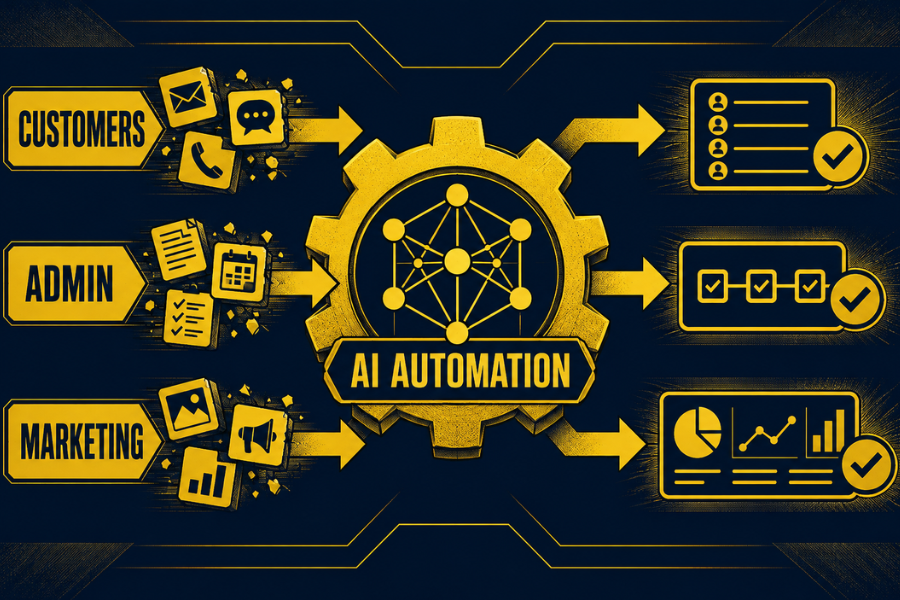
That said, certain patterns repeat across industries. Document-heavy workflows, manual data entry, customer communication, reporting and compliance tasks are consistently the areas where AI delivers the fastest return. If your team does any of these things repeatedly, your AI consulting services conversation should start there.
How to Prioritise AI Opportunities in Your Business
The biggest mistake businesses make when building an artificial intelligence strategy is trying to do everything at once. Prioritisation matters more than ambition at the start.
A structured approach works far better. Start by mapping the ten processes in your business that consume the most time per week. Then ask, for each one: is this repeatable, rule-based and time-consuming? If yes, it is likely a strong candidate for automation or AI assistance. The AI Readiness Assessment from AI Expert takes exactly this approach, helping businesses identify their highest-value opportunities before committing budget to anything.
What Does a Good AI Roadmap Look Like?
A solid artificial intelligence strategy produces a roadmap that is specific, phased and tied to business outcomes. Vague plans that reference 'leveraging AI to drive growth' are not strategies. They are aspiration documents.
A useful roadmap identifies specific tools or capabilities to implement, sets a realistic timeline, names who is responsible and defines what success looks like in measurable terms. It also accounts for your team's readiness. The best technology fails if the people using it do not understand it or trust it. That is why AI training for your team is often as important as the tools themselves.
Jon Rew, Managing Director of Scimitar Sports, describes this kind of structured approach well: 'We're now implementing the AI Roadmap with a phased plan and AI Expert are supporting us every step of the way.' That phased approach matters. It keeps the investment manageable and makes it easier to demonstrate value internally before scaling further.
Building Internal Confidence Alongside Your Strategy
One of the most underestimated barriers to AI adoption is not technical. It is human. Teams that feel AI threatens their roles disengage. Teams that understand how AI removes the tedious parts of their work and lets them focus on higher-value activity become advocates.
A good strategy addresses this directly. It communicates clearly, involves the team early and sets realistic expectations. The AI workshop model works well here because it brings key stakeholders into the process from the start, rather than presenting a finished plan for sign-off.
When Should a Business Start Building Its AI Strategy?
The honest answer is that the best time was twelve months ago. The practical answer is now. Research published by the Office for National Statistics in 2025 shows AI adoption among UK businesses is accelerating. The businesses that build a clear plan now will compound that advantage over the next two to three years. Those that wait will face a steeper climb.
The risk of waiting is not catastrophic failure. It is slow erosion. Competitors operating with AI-assisted workflows can handle more volume, respond faster and run leaner. That is a structural advantage that compounds quietly over time.
If your business is not yet sure where to start, the AI Readiness Assessment is a free, two-minute diagnostic that gives you a practical starting point with no obligation. You can also explore recent AI news and guidance to stay informed as the landscape develops.
Frequently Asked Questions
Do I need a large budget to build an AI strategy?
No. Many of the most impactful AI changes cost very little to implement. A good strategy identifies where investment will produce a measurable return before you spend anything significant.
What is the difference between an AI strategy and just using AI tools?
Using tools without a plan is experimentation. A strategy ties those tools to specific business outcomes, sets clear priorities and defines how success is measured. Without a strategy, most businesses underuse the tools they already have.
How long does it take to build an artificial intelligence strategy?
A focused diagnostic workshop can produce a clear picture of your opportunities within a day. Building a full roadmap typically takes a few weeks, depending on the complexity of your operations.
What if AI is not right for my business yet?
That is a legitimate outcome of a proper assessment. Independent consultants who are not selling you software will tell you honestly if the timing is not right. The goal is commercial value, not technology for its own sake. – An artificial intelligence strategy is the difference between businesses that use AI to build a real competitive advantage and those that spend money on tools that never connect to outcomes. The process does not need to be complicated, expensive or time-consuming to begin. It needs to be structured, commercially grounded and specific to how your business actually operates. If you are ready to find out where AI can make the biggest difference in your business, start with our AI Workshop and get a clear plan built around your operations.
.png)